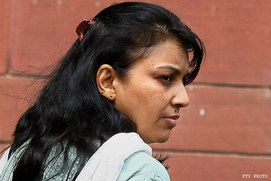
Aarushi murder case: CBI's U-turn on Nupur Talwar

April 18, 2012

arushi


New Delhi, April 18: The Central Bureau of Investigation seems to have taken a U-turn on Nupur Talwar in the Aarushi Talwar murder case. At a hearing at the Ghaziabad court on Wednesday, the CBI claimed it raided several locations to arrest Nupur Talwar but were unable to find her last week.

This is completely opposite to what the agency told the Supreme Court just days back, where it claimed that it was the agency's call to not arrest her as the plea against the warrant was pending. The CBI had then said that it knew about Nupur's whereabouts but did not want to arrest her as her plea was pending.

Nupur Talwar yet again skipped the court hearing on Wednesday. The court extended the non-bailable warrant against Nupur Talwar till April 30. The CBI had sought an extension of the warrant date and said that Nupur Talwar won't be arrested until the Chief Justice takes up the matter.

She had got a temporary breather from the Supreme Court last week. Her plea against a non-bailable warrant is still pending in the Supreme Court.

Earlier, the Ghaziabad court had issued a non-bailable warrant against Nupur Talwar after she failed to appear before a special CBI court despite a deadline given to her.

The Aarushi murder case hearing resumed in a special CBI court in Ghaziabad on Wednesday. Aarushi's father Rajesh Talwar was present in court with his brother Dinesh Talwar.

Rajesh Talwar and his wife Nupur have been accused by the CBI of being involved in the murder of their teenaged daughter Aarushi in May 2008.

Aarushi, 14, was found dead inside her Noida residence in May, 2008 with her throat slit and the body of the Talwars' domestic servant Hemraj was recovered from the terrace hours later.

An outcry against the shoddy investigation by Uttar Pradesh police had led to the then Mayawati government in Uttar Pradesh handing over the case to the CBI.

Comments

Add new comment

  • Coastaldigest.com reserves the right to delete or block any comments.
  • Coastaldigset.com is not responsible for its readers’ comments.
  • Comments that are abusive, incendiary or irrelevant are strictly prohibited.
  • Please use a genuine email ID and provide your name to avoid reject.
Agencies
June 6,2020

United Nations, Jun 6: The coronavirus disease has not "exploded" in India, but the risk of that happening remains as the country moves towards unlocking its nationwide lockdown that was imposed in March to contain the Covid-19, according to a top WHO expert.

WHO Health Emergencies Programme Executive Director Michael Ryan on Friday said the doubling time of the coronavirus cases in India is about three weeks at this stage.

“So the direction of travel of the epidemic is not exponential but it is still growing,” he said, adding that the impact of the pandemic is different in different parts of India and varies between urban and rural settings.

“In South Asia, not just in India but in Bangladesh and...in Pakistan, other countries in South Asia, with large dense populations, the disease has not exploded. But there is always the risk of that happening,” Ryan said in Geneva.

He stressed that as the disease generates and creates a foothold in communities, it can accelerate at any time as has been seen in a number of settings.

Ryan noted that measures taken in India such as the nationwide lockdown have had an impact in slowing transmission but the risk of an increase in cases looms as the country opens up.

“The measures taken in India certainly had an impact in dampening transmission and as India, as in other large countries, open up and as people begin to move again, there's always a risk of the disease bouncing back up,” he said.

He added that there are specific issues in India regarding the large amount of migration, the dense populations in the urban environment and the fact that many workers have no choice but to go to work every day.

India went past Italy to become the sixth worst-hit nation by the COVID-19 pandemic.

India saw a record single-day jump of 9,887 coronavirus cases and 294 deaths on Saturday, pushing the nationwide infection tally to 2,36,657 and the death toll to 6,642, according to the health ministry.

The lockdown in India, was first clamped on March 25 and spanned for 21 days, while the second phase of the curbs began on April 15 and stretched for 19 days till May 3. The third phase of the lockdown was in effect for 14 days and ended on May 17. The fourth phase ended on May 31.

The country had registered 512 coronavirus infection cases till March 24.

The nation-wide lockdown in containment zones will continue till June 30 in India but extensive relaxations in a phased manner from June 8 are listed in the Union home ministry's fresh guidelines on tackling the Covid-19 pandemic issued last week.

WHO Chief Scientist Soumya Swaminathan said the over 200,000 current coronavirus cases in India, a country of over 1.3 billion people, "look big but for a country of this size, it's still modest.”

She stressed that it is important for India to keep track of the growth rate, the doubling time of the virus and to make sure that that number doesn't get worse.

She said that India is a “heterogeneous and huge country” with very densely populated cities and much lower density in some rural areas and varying health systems in different states and these offer challenges to the control of Covid-19.

Swaminathan added that as the lockdown and restrictions are lifted, it must be ensured that all precautions are taken by people.

“We've been making this point repeatedly that really if you want behaviour change at a large level, people need to understand the rationale for asking them to do certain things (such as) wearing masks,” she said.

In many urban areas in India, it's impossible to maintain physical distancing, she said adding that it then becomes very important for people to wear appropriate face coverings when they are out, in office settings, in public transport and educational institutions.

“As some states are thinking about opening, every institution, organisation, industry and sector needs to think about what are the measures that need to be put in place before you can allow a functioning and it may never be back to normal.”

She said that in many professions working from home can be encouraged but in several jobs, people have to go to work and in such cases measures must be put in place that allow people to protect themselves and others.

“I think communication and behaviour change is a very large part of this whole exercise,” she added.


Comments

Add new comment

  • Coastaldigest.com reserves the right to delete or block any comments.
  • Coastaldigset.com is not responsible for its readers’ comments.
  • Comments that are abusive, incendiary or irrelevant are strictly prohibited.
  • Please use a genuine email ID and provide your name to avoid reject.
News Network
May 11,2020

May 11: Congress leader Rahul Gandhi on Monday said many states were amending labour laws, but the fight against the novel coronavirus pandemic cannot be an excuse to exploit workers, suppress their voice and crush their human rights.

Gandhi said there cannot be any compromise on the basic principles by allowing unsafe workplaces.

"Many states are amending labour laws. We are together fighting against corona, but this cannot be an excuse to crush human rights, allow unsafe workplaces, exploit workers and suppress their voice," he said.

"There cannot be any compromise on these basic principles," he added.

Congress leader Jairam Ramesh also said it would be dangerous and disastrous to loosen labour, land and environment laws in the name of economic revival and stimulus.

"In the name of economic revival and stimulus, it will be dangerous and disastrous to loosen labour, land and environmental laws and regulations as the Modi govt is planning.

"The first steps have already been taken. This is a quack remedy like demonetisation," Ramesh tweeted.

Comments

Add new comment

  • Coastaldigest.com reserves the right to delete or block any comments.
  • Coastaldigset.com is not responsible for its readers’ comments.
  • Comments that are abusive, incendiary or irrelevant are strictly prohibited.
  • Please use a genuine email ID and provide your name to avoid reject.
Agencies
July 30,2020

New Delhi, Jul 30: India's gold demand in 2020 is expected to fall to the lowest level in 26 years with domestic bullion prices hitting a record high and as falling disposable incomes could curtail retail purchases, the World Gold Council (WGC) said on Thursday.

Lower demand by the world's second-biggest bullion consumer could limit a rally in global prices, which hit a record high earlier this month, although it could also reduce India's trade deficit and support the ailing rupee.

"Fast rising gold prices could act as headwinds," said Somasundaram PR, the managing director of WGC's Indian operations.

Local gold futures have jumped 35% so far this year after rising a quarter in 2019.

India's gold consumption in the first half of 2020 plunged 56% on-year to 165.6 tonnes. Meanwhile, the coronavirus-triggered lockdown also slashed demand by 70% in the June quarter to 63.7 tonnes, the lowest in more than a decade, the WGC said in a report published on Thursday.

Millions of Indians have lost their jobs or taken a pay cut after the country imposed a lockdown on its 1.3 billion people to curb the spread of the virus that has infected more than 1.5 million Indians.

Consumption is generally high during the June quarter due to weddings and key festivals such as Akshaya Tritiya, but lockdown restrictions kept shoppers indoors this year.

The weak demand in the first half could drag down India's gold consumption in 2020 to the lowest since 1994, when demand stood at 415 tonnes, Somasundaram said, adding that it is still difficult to provide an estimate for full-year demand as the coronavirus crisis is still unfolding.

"Indian demand has previously jumped as much as 300 tonnes in a quarter. Latent demand could come out in the second half," Somasundaram said.

Comments

Add new comment

  • Coastaldigest.com reserves the right to delete or block any comments.
  • Coastaldigset.com is not responsible for its readers’ comments.
  • Comments that are abusive, incendiary or irrelevant are strictly prohibited.
  • Please use a genuine email ID and provide your name to avoid reject.