



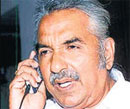
Kerala lashes out at Rawal remarks on firing from ship

April 21, 2012

kerala-chandy

Kochi, April 21: Kerala Chief Minister Oommen Chandy Saturday lashed out at Additional Solicitor General Harin Rawal for his mark that the state government had no jurisdiction to detain the Italian ship as firing from it took place outside India's territorial waters.

Speaking to reporters on the sidelines of a party function, Chandy said the additional solicitor general's remark before the Supreme Court was contrary to the stand of the state government and that it as "not the position of state or centre".

"We checked up with the central government and it has been found what he said in the court yesterday (Friday) was not the stand of the centre. The centre's stand is the same as to what we have taken," Chandy said.

All hell broke loose Friday when Chandy and the state government came under fire from the opposition after Additional Solicitor General Harin Rawal during a hearing informed the apex court that the state government had no jurisdiction to detain the Italian cargo ship as the firing from its took place outside the Indian territorial waters (20.5 nautical miles off the coast while Indian territory extends to only 12 nautical miles).

Two Italian marines Massimillano Latorre and Salvatore Girone, the Italian naval Marines detailed as security crew on cargo vessel Enrica lexie, were taken into judicial custody Feb 20 for the Feb 15 shooting of two Indian fishermen, Ajesh Binki, 25, and Gelastine, 45, about 14 nautical miles off Alappuzha coast in Kerala.

The Chandy government has decided to request the central government to ensure exclusion of Rawal in the next hearing of the case on April 30.

Central Minister M. Veerappa Moily, speaking to reporters in Thrissur, denied the opposition allegation that the change in the centre's stand was effected due to external influences.

"What was told in the court yesterday (Friday) was his personal opinion and not the position of the centre. Corrective measures would be taken," said Veerappa Moily.

CPI-M state secretary Pinarayi Vijayan Friday alleged that the development proved the "relationship between the Congress party and Italy".

"There was a lot of delay as police got access to the ship after a few days of the shooting and by then vital evidences might have been erased. With Friday's stand of the centre, it is now clear that even the state government played hide and seek in this case," Vijayan said.

Apart from the already appointed state government counsel, a senior lawyer would appear for the April 30 hearing.

Comments

Add new comment

  • Coastaldigest.com reserves the right to delete or block any comments.
  • Coastaldigset.com is not responsible for its readers’ comments.
  • Comments that are abusive, incendiary or irrelevant are strictly prohibited.
  • Please use a genuine email ID and provide your name to avoid reject.
News Network
May 4,2020

New Delhi, May 4: The country's manufacturing sector activity witnessed unprecedented contraction in April amid national lockdown restrictions, following which new business orders collapsed at a record pace and firms sharply reduced their staff numbers, a monthly survey said on Monday.

The headline seasonally adjusted IHS Markit India Manufacturing Purchasing Managers' Index (PMI) fell to 27.4 in April, from 51.8 in March, reflecting the sharpest deterioration in business conditions across the sector since data collection began over 15 years ago.
The index slipped into contraction mode, after remaining in the growth territory for 32 consecutive months.

In PMI parlance, a print above 50 means expansion, while a score below that denotes contraction.

Amid widespread business closures, demand conditions were severely hampered in April. New orders fell for the first time in two-and-a-half years and at the sharpest rate in the survey's history, far outpacing that seen during the global financial crisis, the survey said.

"After making it through March relatively unscathed, the Indian manufacturing sector felt the full force of the coronavirus pandemic in April," said Eliot Kerr, Economist at IHS Markit.
Panellists attributed lower production to temporary factory closures that were triggered by restrictive measures to limit the spread of COVID-19.

Export orders also witnessed a sharp decline. Following the first reduction since October 2017 during March, foreign sales fell at a quicker rate in April. "In fact, the rate of decline accelerated to the fastest since the series began over 15 years ago," the survey said.

On the employment front, deteriorating demand conditions saw manufacturers drastically cut back staff numbers in April. The reduction in employment was the quickest in the survey's history.

"In the latest survey period, record contractions in output, new orders and employment pointed to a severe deterioration in demand conditions.
“Meanwhile, there was evidence of unprecedented supply-side disruption, with input delivery times lengthening to the greatest extent since data collection began in March 2005," Kerr said.

On the prices front, both input costs and output prices were lowered markedly as suppliers and manufacturers themselves offered discounts in an attempt to secure orders.

Going ahead, sentiment regarding the 12-month outlook for production ticked up from March's recent low on hopes that demand will rebound once the COVID-19 threat has diminished and lockdown restrictions eased.

"There was a hint of positivity when looking at firms' 12-month outlooks, with sentiment towards future activity rebounding from March's record low. That said, the degree of optimism remained well below the historical average," Kerr said.

In India, the death toll due to COVID-19 rose to 1,373 and the number of cases climbed to 42,533 as on Monday, according to the health ministry.

Meanwhile, the coronavirus-induced lockdown has been extended beyond May 4, for another two weeks in the country.

Comments

Add new comment

  • Coastaldigest.com reserves the right to delete or block any comments.
  • Coastaldigset.com is not responsible for its readers’ comments.
  • Comments that are abusive, incendiary or irrelevant are strictly prohibited.
  • Please use a genuine email ID and provide your name to avoid reject.
News Network
March 20,2020

New Delhi, Mar 20: The four men convicted of the gang rape and murder of a Delhi woman on December 16, 2012 were hanged in the darkness of pre-dawn on Friday, ending a horrific chapter in India's long history of sexual assault that had seared the nation's soul. Mukesh Singh (32), Pawan Gupta (25), Vinay Sharma (26) and Akshay Kumar Singh (31) were executed at 5.30 am for the savage assault in an empty moving bus on the 23-year-old physiotherapy intern who came to be known the world over as Nirbhaya, the fearless one.

This is the first time that four men have been hanged together in Tihar Jail, South Asia's largest prison complex that houses more than 16,000 inmates. The executions were carried out after the men exhausted every possible legal avenue to escape the gallows. Their desperate attempts only postponed the inevitable by less than two months after the first date of execution was set for January 22.

They were hanged at 5.30 am, Director General of Prison Sandeep Goel said.

After raping and brutalising the woman, the men, one of whom was a juvenile at the time, dumped her on the road and left for dead on the cold winter night. Her friend who was with her was also severely beaten and thrown out along with her. She was so severely violated that her insides were spilling out when she was taken to hospital. She died in a Singapore hospital after battling for her life for a fortnight.

Six people, including the four convicts and the juvenile, were named as accused.

While Ram Singh allegedly committed suicide in the Tihar Jail days after the trial began in the case, the juvenile was released in 2015 after spending three years in a correctional home.

The road to the gallows was a long and circuitous one, going through the lower courts, the High Court, the Supreme Court and the president's office before going back to the Supreme Court that heard and rejected various curative petitions.

The death warrants were deferred by a court thrice on the grounds that the convicts had not exhausted all their legal remedies and that the mercy petition of one or the other was before the president.

On March 5, a trial court issued fresh death warrants for March 20 at 5.30 am as the final date for the execution.

Comments

Add new comment

  • Coastaldigest.com reserves the right to delete or block any comments.
  • Coastaldigset.com is not responsible for its readers’ comments.
  • Comments that are abusive, incendiary or irrelevant are strictly prohibited.
  • Please use a genuine email ID and provide your name to avoid reject.
News Network
April 23,2020

Washington, Apr 23: Air pollution over northern India has plummeted to a 20-year-low for this time of the year, according to satellite data published by US space agency National Aeronautics and Space Administration (NASA).
The US space agency's satellite sensors observed aerosol levels at a 20-year low post the countrywide lockdown, implemented to slow the spread of the novel coronavirus.

"We knew we would see changes in atmospheric composition in many places during the lockdown," said Pawan Gupta, a Universities Space Research Association (USRA) scientist at NASA''s Marshall Space Flight Center. "But I have never seen aerosol values so low in the Indo-Gangetic Plain at this time of year," added Mr Gupta.

Acting Assistant Secretary of State for South and Central Asia Alice G Wells tweeted, "These images from NASA were taken each spring starting in 2016 and show a 20-year low in airborne particle levels over India. When India and the world are ready to work and travel again, let's not forget that collaborative action can result in cleaner air."

The data published with maps show aerosol optical depth (AOD) in 2020 compared to the average for 2016-2019. Aerosol optical depth is a measure of how light is absorbed or reflected by airborne particles as it travels through the atmosphere.

If aerosols are concentrated near the surface, an optical depth of 1 or above indicates very hazy conditions. An optical depth, or thickness, of less than 0.1 over the entire atmospheric vertical column is considered "clean." The data were retrieved by the Moderate Resolution Imaging Spectroradiometer (MODIS) on NASA's Terra satellite.

In the first few days of the lockdown, it was difficult to observe a change in the pollution signature. "We saw an aerosol decrease in the first week of the shutdown, but that was due to a combination of rain and the lockdown," said Mr Gupta.

Around March 27, heavy rain poured over vast areas of northern India and helped clear the air of aerosols. Aerosol concentrations usually increase again after such heavy precipitation.

"After the rainfall, I was really impressed that aerosol levels did not go up and return to normal. We saw a gradual decrease and things have been staying at the level we might expect without anthropogenic emissions," Mr Gupta said.

On March 25, the Indian government placed its 1.3 billion citizens under a strict lockdown to reduce the spread of COVID-19. The countrywide mandate decreased activity at factories and severely reduced car, bus, truck and airplane traffic. Every year, aerosols from anthropogenic (human-made) sources contribute to unhealthy levels of air pollution in many Indian cities.

Aerosols are tiny solid and liquid particles suspended in the air that reduce visibility and can damage the human lungs and heart.

In southern India though, the story is a little hazier. Satellite data show aerosol levels have not yet decreased to the same extent. In fact, levels seem to be slightly higher than in the past four years. The reasons are unclear but could be related to recent weather patterns, agricultural fires, winds or other factors.

"This a model scientific experiment," Robert Levy, program leader for NASA's MODIS aerosol products, said about the lockdown and its effects on pollution.

"We have a unique opportunity to learn how the atmosphere reacts to sharp and sudden reductions in emissions from certain sectors. This can help us separate how natural and human sources of aerosols affect the atmosphere," Mr Levy added.

Comments

Add new comment

  • Coastaldigest.com reserves the right to delete or block any comments.
  • Coastaldigset.com is not responsible for its readers’ comments.
  • Comments that are abusive, incendiary or irrelevant are strictly prohibited.
  • Please use a genuine email ID and provide your name to avoid reject.