



TNT trigger in bombing of Israeli diplomat's car

April 23, 2012

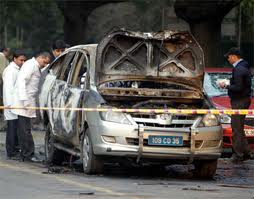
New Delhi, April 23: More than two months after the attack on an Israeli diplomat in the capital, the Central Forensic Science Laboratory has identified trinitrotoluene (TNT) as the explosive material used in the strike.

The 31-page forensic report was handed over to Delhi Police at a time when a team is getting ready to leave for Tehran to probe the role of three Iranians - Houshang Afshar Irani, Mohammad Reza Abolghasemi and Seyed Ali Mahdian Sadr - allegedly involved in the February 13 bombing of diplomat Tal Yehoshua Koren's car. The letters rogatory, being sent to Iran, Thailand and Malaysia, are already under process.

Sources say TNT has not been used widely by terrorists in India earlier. "It is a material which is usually used by military and armed forces. There are few blasts in India where traces of TNT have been found. Terror groups in India mostly use RDX, PETN, ammonium nitrate or potassium chlorate," said a senior officer.

CFSL deputed its senior scientists for identifying the explosive material used in the terror incident, the first time when a foreign diplomat was targeted in India. "It is established from samples picked from the scene of crime that TNT was used as the explosive material," the report said. It also talks about pieces having magnetic nature that could have been used by main bomber Irani for sticking the bomb on the car.

Yehoshua was seriously injured in the attack and was treated at a Delhi hospital for a few days before being flown back to Israel. The Indian driver of the car and two others were also injured.

The investigators, who are in touch with intelligence agencies of other countries, feel that the attack was carried out by Tevhid-Selam-Quds, an organization that is being handled out of Iran. "Its operatives are trained and equipped with weapons, ammunition and explosives, especially in handling of TNT and C4," said a source. The group has a history of carrying out terrorist attacks on Israel in other countries like those in Turkey, including the murder of Israeli security officer Ehud Sadan.

Delhi Police has already arrested Indian journalist Syed Mohammed Ahmed Kazmi, who was working part-time for an Iranian news agency and Persian newspapers, for allegedly being a part of the car blast conspiracy in Delhi. He was sent to judicial custody for 14 more days on Saturday.

The National Bomb Data Centre, which comes under the elite NSG, was kept away from collection of samples at the blast site by Delhi Police despite being the central nodal agency for monitoring, recording and analysing all bombing incidents in the country.

car_bomb

Comments

Add new comment

  • Coastaldigest.com reserves the right to delete or block any comments.
  • Coastaldigset.com is not responsible for its readers’ comments.
  • Comments that are abusive, incendiary or irrelevant are strictly prohibited.
  • Please use a genuine email ID and provide your name to avoid reject.
News Network
May 21,2020

Bengaluru, May 21: The COVID-19-induced lockdown saw a spurt in crybercrimes in India with Kerala recording the highest number during the period, according to an analysis of IT security solutions provider K7 Computing.

The report analyses various cyberattacks within India during the pandemic and reveals that threat actors targeted the States with COVID-19-themed attacks aimed at exploiting user trust.

The sudden surge in the frequency of attacks witnessed from February 2020 to mid-April 2020 indicates that scamsters across the world were exploiting the widespread panic around coronavirus at both the individual and corporate level, the company said in a statement.

These attacks aimed to compromise computers and mobile devices to gain access to users confidential data, banking details and cryptocurrency accounts.

The key threats seen during this period ranged from phishing attacks to rogue apps disguised as COVID-19 information apps that targeted users sensitive data.

Phishing attacks were noticed more in Tier-II and Tier-III cities while the metros fared better.

Smaller cities saw over 250 attacks being blocked per 10,000 users.

Users from Ghaziabad and Lucknow seem to have faced almost six and four times the number of attacks, respectively, as Bengaluru users.

In Kerala, regions like Kottayam, Kannur, Kollam, and Kochi saw the highest hits with 462, 374, 236, and 147 attacks respectively, while the state as a whole saw around 2,000 attacks during the period, the highest thus far in the country.

This was followed by Punjab with 207 attacks and Tamil Nadu at 184 attacks, the statement said.

A majority of the recorded attacks were phishing attacks with sophisticated campaigns that could easily snare even the most educated users, it said.

These attacks were aimed at heightening users fears and creating a sense of urgency to take action.

The report noted phishing attacks where scamsters posed as representatives of the United States Department of the Treasury, the World Health Organisation, and the Centres for Disease Control and Prevention.

Users were encouraged to visit links that would automatically download malware on the host computer such as the Agent Tesla keylogger or Lokibot information-stealing malware, infamous banking Trojans such as Trickbot or Zeus Sphinx, and even disastrous ransomware.

Other attacks included infected COVID-19 Android apps like CoronaSafetyMask that scam users with promises of masks for an upfront payment; the spyware app Project Spy; and seemingly genuine apps that are infected with dangerous malware like banking Trojans such as Ginp, Anubis and Cerberus, it was stated.

Comments

Add new comment

  • Coastaldigest.com reserves the right to delete or block any comments.
  • Coastaldigset.com is not responsible for its readers’ comments.
  • Comments that are abusive, incendiary or irrelevant are strictly prohibited.
  • Please use a genuine email ID and provide your name to avoid reject.
News Network
January 23,2020

Mumbai, Jan 23: Rashmi Sahijwala never expected to start working at the age of 59, let alone join India’s gig economy—now she is part of an army of housewives turning their homes into “cloud kitchens” to feed time-starved millennials.

Asia’s third-largest economy is battling a slowdown so sharp it is creating a drag on global growth, the International Monetary Fund said Monday, but there are some bright spots.

The gig economy, aided by cheap mobile data and abundant labour, has flourished in India, opening up new markets across the vast nation.

Although Indian women have long battled for access to education and employment opportunities, the biggest hurdle for many is convincing conservative families to let them leave home.

But new apps like Curryful, Homefoodi, and Nanighar are tapping the skills of housewives to slice, dice and prepare meals for hungry urbanites from the comfort of their homes.

The so-called cloud kitchens—restaurants that have no physical presence and a delivery-only model—are rising in popularity as there is a boom in food delivery apps such as Swiggy and Zomato.

“We want to be the Uber of home-cooked food,” said Ben Mathew, who launched Curryful in 2018, convinced that housewives were a huge untapped resource.

His company—which employs five people for the app’s daily operations—works with 52 women and three men, and the 31-year-old web entrepreneur hopes to get one million female chefs on-board by 2022.

“We usually train them in processes of sanitisation, cooking, prep time and packaging... and then launch them on the platform,” Mathew told news agency.

One of the first housewives to join Curryful in November 2018 shortly after its launch, Sahijwala was initially apprehensive, despite having four decades of experience in the kitchen.

But backed by her children, including her son who gave her regular feedback about her proposed dishes, she took the plunge.

Since then, she’s undergone a crash course in how to run a business, from creating weekly menus to buying supplies from wholesale markets to cut costs.

The learning curve was steep and Sahijwala switched from cooking everything from scratch to preparing curries and batters for breads in advance to save time and limit leftovers.

She even bought a massive freezer to store fruits and vegetables despite her husband’s reservations about the cost.

“I told him that I am a professional now,” she told news agency.

‘Internet restaurants’

Kallol Banerjee, co-founder of Rebel Foods which runs 301 cloud kitchens backing up 2,200 “internet restaurants”, was among the first entrepreneurs to embrace the concept in 2012.

“We could do more brands from one kitchen and cater to different customer requirements at multiple price points,” Banerjee told AFP.

The chefs buy the ingredients, supply the cookware and pay the utility bills.

The apps—which make their money through charging commission, such as more than 18 percent per order for Curryful—offer training and supply the chefs with containers and bags to pack the food in.

Curryful chef Chand Vyas, 55, spent years trying to set up a lunch delivery business but finally gave up after failing to compete with dabbawalas, Mumbai’s famously efficient food porters.

Today Vyas works seven hours a day, five days a week in her kitchen, serving up a bevy of Indian vegetarian staples, from street food favourites to lentils and rice according to the app’s weekly set menus.

“I don’t understand marketing or how to run a business but I know how to cook. So, the current partnership helps me focus on just that while Curryful takes care of the rest,” Vyas told AFP.

She pockets up to $150 (Rs 10,000 approx) a month after accounting for the commissions and costs, but hopes to earn more as the orders increase.

In contrast, a chef at a bricks-and-mortar restaurant takes home a monthly wage of between $300 (Rs 20,000 approx) and $1,000 (Rs 70,000) approx for working six days a week.

With India’s cloud kitchen sector expected to reach $1.05 billion by 2023, according to data platform Inc42, other companies are also keen to get a slice of the action.

Swiggy, for example, has invested 2.5 billion rupees ($35.3 million) in opening 1,000 cloud kitchens across the nation.

Back in her Mumbai kitchen, Sahijwala is elated to have embarked on a career at an age when her contemporaries are eyeing retirement.

Over the past year, she has seen her profit grow to $200 (Rs 15,000 approx) a month, but more importantly, she said, “My passion has finally found an outlet.

“I am just glad life has given me this chance.”

Comments

Add new comment

  • Coastaldigest.com reserves the right to delete or block any comments.
  • Coastaldigset.com is not responsible for its readers’ comments.
  • Comments that are abusive, incendiary or irrelevant are strictly prohibited.
  • Please use a genuine email ID and provide your name to avoid reject.
News Network
January 28,2020

Panaji, Jan 28: Bureaucrat-turned-activist Kannan Gopinathan on Tuesday said even some "RSS people" are convinced the Citizenship Amendment Act is a bad law but are keeping quiet as the NDA government at the Centre is their own baby.

Speaking in Panaji, he further said the Narendra Modi government was behaving like a "drunken teenager" which needs to be questioned or else it will end up destroying homes.

"I was detained twice in UP, kept the whole day, because they (government) do not want the questioning (of CAA). I have met so many RSS people, they also understand this...if you have this conversation, they also understand the government has done something (wrong) and they have been asked to support it," he claimed.

He said the line of thought among these RSS people (he met) was "just support it (CAA)" as they don't want an altercation because the "government is their baby".

"He (government) is not a normal baby, he is a drunken teenager. He should be asked questions because when he starts destroying, he does not destroy somebody else's home but your own home," Gopinathan said.

He also hit out at those who have been claiming that the people protesting against the CAA are unaware about the law and have not even read it.

Gopinathan claimed if one had asked supportive MPs about the CAA on the day it was passed in Parliament, several of them would not have been able to speak on it as "they would not have known what was passed, because they were not given time (to go through the bill)".

He said, earlier, such legislation was passed after several rounds of consultation but "now, by night, it becomes an Act", adding (now) "everything is a surgical strike".

Gopinathan, in a possible reference to the National Register of Citizens exercise carried out in Assam, also claimed "thousands of people are in detention centres".

"It is your fundamental right to peacefully assemble without arms, Article 19 (1) (D) (of the Constitution)," he said at a function organised by a group opposed to CAA.

Gopinathan said people "always felt they were in a democracy" because they never tried to fly, when in reality "you are in a cage".

"The moment you want to fly you realise you are in a cage," he said, adding that "we have to question, we have to ask ourselves where are we going".

"When you don't allow a person to speak against an incorrect legislation, then what is democracy? What is freedom of expression?" Gopinathan questioned.

Gopinathan, a 2012 batch AGMUT cadre Indian Administrative Service officer, was the secretary, Power Department of the Union Territories of Daman and Diu, and Dadra and Nagar Haveli when he resigned on August 21 last year.

At the time, he had claimed the people of Jammu and Kashmir were being denied freedom of expression following abrogation of Article 370 by the Centre.

Comments

Add new comment

  • Coastaldigest.com reserves the right to delete or block any comments.
  • Coastaldigset.com is not responsible for its readers’ comments.
  • Comments that are abusive, incendiary or irrelevant are strictly prohibited.
  • Please use a genuine email ID and provide your name to avoid reject.