



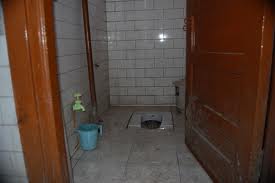
Now, UP gets its Rs 2,900 crore Toilet Scam

April 26, 2012

indian_toilet

Lucknow, April 26: This one really stinks. UP, home to scams of all kinds, ranging from NRHM to land, now has a filthy new entrant: the Toilet Scam.

The state was to build toilets in rural households under the Centre-sponsored Total Sanitation Campaign. The state panchayati raj department told the ministry of rural development that it got 1.71 crore toilets constructed under the scheme in the past one decade. But the household census data says that only 55 lakh rural households have toilets. Which means, 1.16 crore toilets in rural UP are "missing".

The Total Sanitation Campaign was launched in 1999 to end open defecation in India by 2017. The scheme got functional in UP in 2002. Under the programme, various sections of the society were given a subsidy to get permanent toilets built in their houses. In 2002, the amount was about Rs 600; now, this has gone up to around Rs 4,500. Assuming the average expenditure on construction of new toilets was Rs 2,500, the Toilet Scam would work out to Rs 2,900 crore.

The extent of over-reporting has been close to three times , say experts. According to TSC reports, there are only 17.50% households without toilets in rural UP. whereas the census reports that more than 78% of the households do not have latrines within their premises. According to TSC online data, there are two districts in UP, Lakhimpur Kheri and Farrukhabad, where 100% households have toilets whereas census 2011 reports show 81.7% and 76.10% households are without toilets in the respective districts.

The extent of over-reporting has been extremely high in Lucknow as well. The official data for households without toilets says that one in 10 (10.16%) houses don't have toilets. In other words government data says that 89.84% of the households in Lucknow have a toilet. But the census figures say that only 65.6% households have toilets on their premises.

Because of this scam, the very aim of TSC stands defeated in the state with actually now more people defecating in the open. During the decade 2001-2011, of all the people defecating in open in the country, UP alone accounts for 39.05%. In absolute terms, 35.31 lakh households are defecating in the open in the state. And 93% of them are in rural areas. Sources claimed that lack of a monitoring mechanism led to the problem. The union government is now mulling over whether to get the flagship programme examined by CAG auditors.

"A peep into the house of a villager in UP shows how women live without toilets. They go in groups to fields every morning. Some women feel that loose motions are a curse as they have to run to the fields during the day," said Madhu Garg, secretary, All India Democratic Women's Association. She added that the problem for women in urban slums was worse. "In pakka talaab area of Chinhat for instance, women are exposed to eve-teasing when they go out for nature's call," she said.

Comments

Add new comment

  • Coastaldigest.com reserves the right to delete or block any comments.
  • Coastaldigset.com is not responsible for its readers’ comments.
  • Comments that are abusive, incendiary or irrelevant are strictly prohibited.
  • Please use a genuine email ID and provide your name to avoid reject.
News Network
January 24,2020

New Delhi, Jan 24: Although India's Ujjwala programme encouraged adoption of liquefied petroleum gas (LPG) for cooking among the poor, households availing the scheme have not shifted away from using highly polluting fuels like firewood, a study reveals.

The researchers, including those from the University of British Columbia (UBC) in Canada, found that additional incentives to encourage regular use of cooking gas are necessary for a complete transition to clean cooking fuel among poor rural households.

They noted that about 2.9 billion people across Asia, Africa, and Latin America burn solid fuels like firewood to meet their cooking energy needs.

This has significant negative implications for public health, the environment, and societal development, according to the researchers.

Through the Pradhan Mantri Ujjwala Yojana (PMUY), India has provided capital cost subsidies to poor women to adopt a clean-burning cooking fuel or LPG.

The researchers explained that within the first 40 months of the scheme, more than 80 million households obtained LPG stoves.

However, the full benefits of LPG adoption depend on near complete replacement of polluting fuels with LPG, according to a research-based policy brief published in the journal Nature Energy.

The scientists said this cannot be assumed solely on the basis of LPG presence in the household.

"Our research shows that Ujjwala was able to attract new consumers rapidly, but those consumers did not start using LPG on a regular basis," Abhishek Kar, a postdoc at Columbia University in the US, told PTI.

The study analysed LPG sales data for over 25,000 consumers, including PMUY beneficiaries, as well as general rural LPG consumers in Koppal district of Karnataka.

The scientists employed data covering all LPG purchases of PMUY beneficiaries through their first year in the programme.

They also assessed the general rural population's purchases during their first five years as consumers to assess the effect of experience on use.

The findings estimate that an average rural family needs to purchase five 14.2 kilogramme-cylinders annually to meet half of their cooking needs.

However, the study said just seven per cent of PMUY beneficiaries in Koppal purchased five or more cylinders annually, suggesting that the beneficiaries seldom use LPG.

The general (nonPMUY) consumers in this region use on average two times more LPG cylinders than PMUY beneficiaries, the researchers noted.

Yet, only 45 per cent of nonPMUY consumers use five or more cylinders per year -- even after several years of experience with LPG, they said.

The team assessed price and seasonal factors affecting LPG use among the general population over a three-year period.

It found that LPG consumers are sensitive to price and seasonality -- LPG cylinder refill rates are lower in the summer when agricultural activity is limited, and cash is scarce.

"There was no scheme incentives to promote use, except general LPG subsidies which is available to all, including the urban middle class," said Kar, who was a Ph.D. scholar at UBC when the research was published.

"If there is no additional income, what cost would a poor family on an already tight budget cut to pay for an extra expense on a regular basis.

"Ujjwala has started the scheme of 5 kg-cylinder in response, but the impact of that on LPG sales is still publicly unknown," he said.

These findings, the researchers noted, suggest the need for additional measures to promote regular LPG use for all rural populations.

Although the finding come from a single district in Southern India, it may also apply to other areas with similar socio-economic conditions, they said.

A more expansive evaluation of PMUY would help design targeted incentives to transform infrequent users to regular users, according to the researchers.

Comments

Add new comment

  • Coastaldigest.com reserves the right to delete or block any comments.
  • Coastaldigset.com is not responsible for its readers’ comments.
  • Comments that are abusive, incendiary or irrelevant are strictly prohibited.
  • Please use a genuine email ID and provide your name to avoid reject.
Agencies
January 26,2020

Jaipur, Jan 26: Rajasthan on Saturday on Saturday became the third state in the country to pass a resolution urging the Centre to repeal the Citizenship Amendment Act (CAA).

he resolution was passed in the state Assembly amid opposition by the BJP which accused the ruling Congress of pursuing appeasement politics.

It is the second Congress-ruled state to pass such a resolution after Punjab. The Kerala Assembly too had passed such a resolution against the CAA moved jointly by the ruling Left Front alliance and the opposition Congress-led UDF.

The Rajasthan Assembly resolution, passed by voice vote, also asked the Centre to withdraw the new fields of information that have been sought for updation of the National Population Register (NPR) 2020.

"It is evident that the CAA violates the provisions of the Constitution. Therefore, the House resolves to urge upon the government of India to repeal the CAA to avoid any discrimination on the basis of religion in granting citizenship and to ensure equality before law for all religious groups of India," the state's parliamentary affairs minister Shanti Dhariwal said, moving the resolution.

Leader of the opposition Gulab Chand Kataria of the BJP questioned the state's right to challenge the Act.

"Granting citizenship is a matter for the Centre. In such a situation do we have the right to challenge the CAA? The Congress should stop doing appeasement and vote bank politics," he said.

Comments

abdullah
 - 
Sunday, 26 Jan 2020

Salute to Rajasthan Govt for rejecting communal and black CAA bill.   This bill is agaisnt the teach of our Constitution and bjp has never done anything as per our constitutin.   Its trying its best to scrap the constitution and restore it with RSS agenda.    We should oppose any move by bjp against the value of constitution.   As bjp has no respect to our constitution, it has no right to be in power.    Many of bjp leaders are giving statemetns against the value of constitution and such leaders should be treated as anti indians and action be taken on them.   

Add new comment

  • Coastaldigest.com reserves the right to delete or block any comments.
  • Coastaldigset.com is not responsible for its readers’ comments.
  • Comments that are abusive, incendiary or irrelevant are strictly prohibited.
  • Please use a genuine email ID and provide your name to avoid reject.
News Network
June 5,2020

New Delhi, Jun 5: On World Environment Day, Prime Minister Narendra Modi on Friday urged citizens to ensure that the flora and fauna thrive and take a pledge to preserve our planet's rich biodiversity.

"On #WorldEnvironmentDay, we reiterate our pledge to preserve our planet's rich biodiversity. Let us collectively do whatever possible to ensure the flora and fauna with whom we share the Earth thrive. May we leave an even better planet for the coming generations," the Prime Minister tweeted.

He also shared a clip from his last 'Mann Ki Baat' programme where he mentioned about conservation of rainwater and protecting the rich diversity of nature.

"On June 5, the entire world will celebrate 'World Environment Day'. The theme for this year's 'World Environment Day' is bio-diversity. This theme is especially pertinent in the current circumstances. During lockdown in the last few weeks the pace of life may have slowed down a bit but it has also given us an opportunity to introspect upon the rich diversity of nature or biodiversity around us," the Prime Minister had said.

"Much of the avian fauna had sort of disappeared due to sound and air pollution, and now after years people can once again listen to their melodic chirping in their homes," he said.

The Prime Minister also said that water conservation, in particular the conservation of rainwater, is essential and exhorted everyone to strive for saving rainwater in the upcoming monsoons.

Comments

Add new comment

  • Coastaldigest.com reserves the right to delete or block any comments.
  • Coastaldigset.com is not responsible for its readers’ comments.
  • Comments that are abusive, incendiary or irrelevant are strictly prohibited.
  • Please use a genuine email ID and provide your name to avoid reject.