



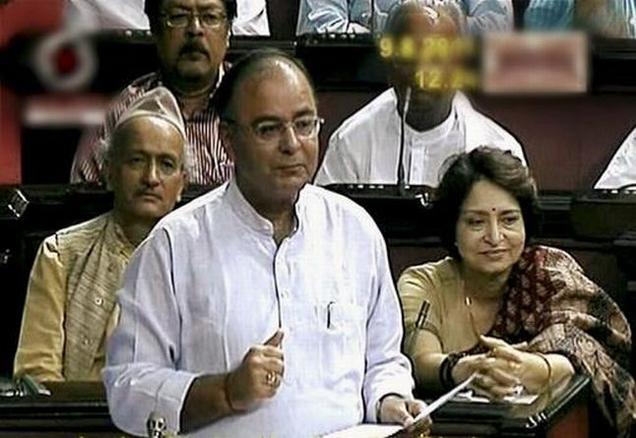
Jaitley: Bofors, a serious reflection of probe agencies

April 27, 2012

Jaitley_748844f

New Delhi, April 27: Leader of Opposition in the Rajya Sabha Arun Jaitley on Thursday said that the fact that culprits could not be brought to book in the Bofors gun deal was a serious reflection on the health of the investigating agencies.

“Somebody swung the deal, somebody got kickbacks. Money was traced, accounts were traced, you don't need further evidence and the man was allowed to leave the country. How was the man [Italian businessman Ottavio Quattrocchi] so powerful that the Indian State looks helpless?” he said.

‘Pakistan better'

In his Zero Hour intervention following two adjournments during the Question Hour, Mr. Jaitley questioned the helplessness of the investigating agencies and said: “See what is happening in our neighbouring country [Pakistan] in pursuit of truth and how helpless we look.”

He emphasised that middlemen must be eliminated and probity ensured in public life.

Communist Party of India (Marxist) leader Sitaram Yechury said the Bofors issue that had “plagued” the country for 25 years was a “serious matter.” “If there is anything new, it must be investigated and government must make it public,” he said.

As several leader members sought permission to intervene, presiding officer P.J. Kurien disallowed them saying it was not a debate.

Samajwadi Party leader Mohan Singh said this was an important matter and the economic offender must be extradited and punished.

As Mani Shankar Aiyar rose to speak on behalf of the Treasury Benches, Opposition members questioned why he was being allowed when only leaders of parties in the House had been permitted to raise the matter. Naresh Agrawal (SP) said this amounted to partiality and demanded that everybody be given the opportunity to speak.

Noting that Mr. Jaitley had bemoaned the fact that unsuccessful efforts were being made to unearth the truth, Mr. Aiyar said: “We could not unearth the truth because of distortions and historic inaccuracies.”

Mr. Aiyar pointed out that no progress was made in the case from December 1989 to November 1990 (during V.P. Singh government as well as the National Democratic Alliance rule later). Mr. Jaitley intervened to counter this.

Though Mr. Jaitley had not named anyone, Mr. Aiyar said he had made serious allegations that needed to be replied to. On being asked by Bharatiya Janata Party members to name the individual, Mr. Aiyar said he had no problem in saying that Bofors incident took place during the period when Rajiv Gandhi was the Prime Minister.

This was followed by heated exchanges between the treasury and Opposition members, including the All India Anna Dravida Munnetra Kazhagam.

Nothing could be heard in the din and after several minutes of persuading Mr Aiyar to stay brief in his observations, Mr. Kurien adjourned the House.

Comments

Add new comment

  • Coastaldigest.com reserves the right to delete or block any comments.
  • Coastaldigset.com is not responsible for its readers’ comments.
  • Comments that are abusive, incendiary or irrelevant are strictly prohibited.
  • Please use a genuine email ID and provide your name to avoid reject.
News Network
July 25,2020

Bhopal, Jul 25: Madhya Pradesh chief minister Shivraj Singh Chouhan said on Saturday he has tested positive for the coronavirus disease (Covid-19).

Chouhan made the announcement in a series of tweets.

“My dear countrymen, I had symptoms of COVID-19 and after the test, my report has come back positive. I appeal to all my colleagues that whoever came in contact with me, must get their corona test done. And my close contacts should quarantine themselves,” Chouhan said in a tweet in Hindi.

“If COVID19 is treated on time, a person is completely cured. I have been reviewing the status of corona infection every evening since March 25. I will try to review corona situation through video conferencing as much as possible now,” he added.

The chief minister said the review meeting will now be held by home minister Narottam Mishra, urban development and administration minister Bhuppendra Singh, health education minister Vishvas Sarang and health minister Dr Prabhuram Choudhary in his absence.

“I will also continue to do everything possible to help control COVID19 in the state during treatment,” he said.

One of Chouhan’s ministerial colleagues tested positive for Covid-19 late on July 22.

The chief minister along with the minister, the Bharatiya Janata Party’s state unit president VD Sharma and state unit general secretary (organisation) Suhas Bhagat had visited Lucknow in a government plane on July 21 to attend the funeral of MP governor Lalji Tandon who died away in the Uttar Pradesh capital, his hometown. during hospitalisation.

The minister is admitted to a private medical college’s teaching hospital in Bhopal.

Comments

Kannadiga
 - 
Saturday, 25 Jul 2020

Why so priority for him. There are so many  better person here in our State and District Talk and Right about them.

Add new comment

  • Coastaldigest.com reserves the right to delete or block any comments.
  • Coastaldigset.com is not responsible for its readers’ comments.
  • Comments that are abusive, incendiary or irrelevant are strictly prohibited.
  • Please use a genuine email ID and provide your name to avoid reject.
Agencies
May 27,2020

Global health experts on Wednesday said novel coronavirus is here to stay for more than a year and called for aggressive testing to prevent its spread.

In an interaction with Congress leader Rahul Gandhi, health experts Professor Ashish Jha and Professor Johan Giesecke talked about the COVID-19 pandemic as part of the series being aired on Congress social media channels.

While Jha exuded confidence that a vaccine will be available in a year's time, Prof Giesecke said India should practice a lockdown that is as 'soft' as possible, as a severe lockdown will ruin its economy very quickly.

"When the economy is opened up after lockdown, you have to create confidence among people," Harvard health expert Ashish Jha told Gandhi.

Jha is a professor of Global Health at TH Chan School of Public Health and Director, Harvard Global Health institute.

He said coronavirus is a '12-18 months' problem and the world is not going to be free of this till 2021.

The expert also called for the need for aggressive testing strategy for high-risk areas.

Gandhi, while interacting with the experts, said life is going to change post COVID-19.

"If 9/11 was a new chapter, this will be a new book," he remarked.

Professor Johan Giesecke, former chief scientist, European Centre for Disease Prevention and Control said India should have a 'soft lockdown'.

"The situation that India is in, I think, you should have a soft lockdown, as soft as possible," he said.

"I think for India, you will ruin your economy very quickly if you have a severe lockdown. It is better, skip the lockdown, take care of the old and the frail...," he noted.

Comments

Add new comment

  • Coastaldigest.com reserves the right to delete or block any comments.
  • Coastaldigset.com is not responsible for its readers’ comments.
  • Comments that are abusive, incendiary or irrelevant are strictly prohibited.
  • Please use a genuine email ID and provide your name to avoid reject.
Agencies
January 9,2020

The World Bank says that a lack of credit and drop in private consumption have led to a gloomy growth outlook for India with a steep cut in growth rate for the current fiscal year and only a modest gain projected for the next year.

India's growth rate is forecast to be only 5 per cent for the current fiscal year, weighed down by a growth of only 4.5 per cent in the July-September quarter, according to the 2020 Global Economic Prospects report released on Wednesday.

"In India, [economic] activity was constrained by insufficient credit availability, as well as by subdued private consumption," the Bank said.

The growth rate is forecast by the Bank to pick up to 5.8 per cent in the next fiscal year and to 6.1 per cent in 2021-22.

India's growth rate was 6.8 per cent in 2018-19.

The 5 per cent growth rate projection for the current financial year is a sharp cut of 2.5 per cent from the 7.5 per cent forecast made by the Bank in January last year, toppling it from the rank of the world's fastest growing economy.

India's performance follows a global trend of lowered growth weighed down by developed economies.

The report estimated world economic growth rate to be only 2.4 per cent last year and forecast it to edge up 0.1 per cent to 2.5 per cent in the current year.

Even with the lower growth rate of 5 per cent in the current fiscal year and 5.8 per cent forecast for the next, India holds the second rank among large economies, behind only China with an estimated growth rate of 6.1 per cent for 2019 and 5.9 per cent this year.

The report blamed "weak confidence, liquidity issues in the financial sector" and "weakness in credit from non-bank financial companies" for India's slowdown.

The Bank predicated India's recovery to 5.8 per cent in the coming financial year for India but "on the monetary policy stance remaining accommodative" and the assumption that "the stimulative fiscal and structural measures already taken will begin to pay off."

It also warned that sharper-than-expected slowdown in major external markets such as United States and Europe, would affect South Asia through trade, financial, and confidence channels, especially for countries with strong trade links to these economies."

The Bank said that the growth of advanced economies was 1.6 per cent last year and "is anticipated to slip to 1.4 per cent in 2020 in part due to continued softness in manufacturing."

In contrast the growth of emerging market and developing countries is expected to accelerate from 3.5 per cent last year to 4.1 per cent this year, the report said.

In South Asia, Bangladesh is estimated to have the highest growth rate of 7.2 per cent in the current fiscal year, although down from 8.1 per cent last fiscal year.

But its higher regional growth rates are coming off a lower base with a per capital gross domestic product of $1,698 compared to $2,010 for India.

Bangladesh is expected to grow by 7.3 per cent in the next financial year.

Pakistan's growth rate is estimated at only 2.4 per cent in the current fiscal year and is projected to rise to 3 per cent in the next, according to the Bank.

The Bank blamed monetary tightening in Pakistan for a sharp deceleration in fixed investment and a considerable softening in private consumption for the fall in growth rate from 3.3 per cent in the 2018-19 fiscal year.

Sri Lanka's growth rate was estimated to be 2.7 per cent last year and forecast to grow to 3.3 per cent this year.

Nepal grew by an estimated 6.4 per cent in the current fiscal year and will rise to 6.5 per cent in the next.

Comments

Add new comment

  • Coastaldigest.com reserves the right to delete or block any comments.
  • Coastaldigset.com is not responsible for its readers’ comments.
  • Comments that are abusive, incendiary or irrelevant are strictly prohibited.
  • Please use a genuine email ID and provide your name to avoid reject.