



JD(U) snubs BJP for unilaterally announcing its stand on Prez election

May 1, 2012

jdu


New Delhi, May 1: Indicating fissures in the NDA over the issue of Presidential election, the JD-U today snubbed the BJP for unilaterally announcing its stand on the issue.

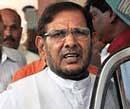
"Whatever Sushma Swaraj has said is the opinion of the BJP. This is not our party's view. The issue was not discussed in any NDA meeting. BJP has not discussed the issue with us," JD-U President Sharad Yadav told reporters here.

He also said that the country is in a bad shape and "everybody needs to be on the side of caution on this issue".

He was reacting to Swaraj's statement yesterday that BJP will not support the candidature of Finance Minister Pranab Mukherjee, Vice President Hamid Ansari or any candidate put up by the Congress for the Presidential election.

Asked whether JD-U agrees with the stand of Swaraj, Yadav merely said, "Ours is a different party and their's is another. Neither have we discussed this issue with the BJP nor have they done it with us so far."

Yadav, who is also the NDA convener, also referred to the statement of SAD leader Sukhbir Singh Badal to hammer home his point that the issue has not been decided by NDA as yet.

Badal said that there has been "no formal meeting" of the alliance so far and hence he cannot comment that who will be NDA's Presidential candidate.

"This will be the decision of the collective leadership. I am just a member of the alliance", was his refrain when asked whether they support the candidature of former President Abdul Kalam.

Swaraj had said that the party was open to the idea of backing former President A P J Abdul Kalam if parties like Samajwadi Party mooted his name.

Yadav said the NDA has not yet discussed any name for the Presidential candidate.

The JD(U) has not discussed any probable candidates for the Presidential elections yet, Yadav said, adding that the party will form an opinion after having internal discussions.

"Whenever such a discussion takes place, the JD(U) will express its views. But, she (Swaraj) has given the opinion of her party. She has not said this after any consultation with us. I do not know whether she consulted any other NDA ally on the issue", he said.

Sources in JD-U said that the unilateral announcement by Swaraj has foreclosed options of building a consensus on the issue.

Asked whether the NDA should have settled with a Vice President like Punjab Chief Minister Prakash Singh Badal for the alliance and backed UPA's candidate for the President's job, a party leader speaking on the condition of anonymity said, "all such options have been closed by the statement".

The leader also made it clear that there was no discussion in the NDA even on supporting or putting up the name of former President Abdul Kalam as the alliance candidate this time, thereby indicating that the BJP may be proposing his name but Kalam is still not the NDA candidate.

The leader pointed out that even in 2007, when the BJP was proposing Kalam's renomination, NDA ally Shiv Sena had not supported his candidature. Sena had then backed Pratibha Patil's candidature in the name of Marathi pride.

Comments

Add new comment

  • Coastaldigest.com reserves the right to delete or block any comments.
  • Coastaldigset.com is not responsible for its readers’ comments.
  • Comments that are abusive, incendiary or irrelevant are strictly prohibited.
  • Please use a genuine email ID and provide your name to avoid reject.
News Network
January 30,2020

Wayanad, Jan 30: Congress leader Rahul Gandhi on Thursday compared Mahatma Gandhi assassin Nathuram Godse with Prime Minister Narendra Modi, saying both believed in the same ideology.

Gandhi, at an anti-CAA rally here, launched a scathing attack on Modi and said he was making Indians to prove that they are Indians.

Addressing participants at "Save the Constitution" march at Kalpetta in Wayanad, his Lok Sabha constituency on Martyr's Day, Gandhi said there was no difference between Godse and Modi.

"Today, an ignorant man is trying to challenge Gandhi's ideology. He is creating an atmosphere of hatred. The ideology is same. Nathuram Godse and Narendra Modi, they believe in the same ideology. There is no difference except that Modi does not have the guts to say he believes in the ideology of Godse," the Wayanad MP said.

Attacking the Prime Minister on the new Citizenship Law, Gandhi questioned Modi and asked who was he to ask Indians to prove that they were Indians.

"Indians are being made to prove that they are Indians. Who is Narendra Modi to decide who is an Indian. Who gave Modi the licence to ask for my Indianness? I know I am an Indian and I don't have to prove it to anyone. Likewise, 1.4 billion Indians do not have to prove that they are Indians," he said.

The Congress leader led the march here as part of efforts to intensify the party's protests against CAA in the state.

Comments

Add new comment

  • Coastaldigest.com reserves the right to delete or block any comments.
  • Coastaldigset.com is not responsible for its readers’ comments.
  • Comments that are abusive, incendiary or irrelevant are strictly prohibited.
  • Please use a genuine email ID and provide your name to avoid reject.
Agencies
June 6,2020

United Nations, Jun 6: The coronavirus disease has not "exploded" in India, but the risk of that happening remains as the country moves towards unlocking its nationwide lockdown that was imposed in March to contain the Covid-19, according to a top WHO expert.

WHO Health Emergencies Programme Executive Director Michael Ryan on Friday said the doubling time of the coronavirus cases in India is about three weeks at this stage.

“So the direction of travel of the epidemic is not exponential but it is still growing,” he said, adding that the impact of the pandemic is different in different parts of India and varies between urban and rural settings.

“In South Asia, not just in India but in Bangladesh and...in Pakistan, other countries in South Asia, with large dense populations, the disease has not exploded. But there is always the risk of that happening,” Ryan said in Geneva.

He stressed that as the disease generates and creates a foothold in communities, it can accelerate at any time as has been seen in a number of settings.

Ryan noted that measures taken in India such as the nationwide lockdown have had an impact in slowing transmission but the risk of an increase in cases looms as the country opens up.

“The measures taken in India certainly had an impact in dampening transmission and as India, as in other large countries, open up and as people begin to move again, there's always a risk of the disease bouncing back up,” he said.

He added that there are specific issues in India regarding the large amount of migration, the dense populations in the urban environment and the fact that many workers have no choice but to go to work every day.

India went past Italy to become the sixth worst-hit nation by the COVID-19 pandemic.

India saw a record single-day jump of 9,887 coronavirus cases and 294 deaths on Saturday, pushing the nationwide infection tally to 2,36,657 and the death toll to 6,642, according to the health ministry.

The lockdown in India, was first clamped on March 25 and spanned for 21 days, while the second phase of the curbs began on April 15 and stretched for 19 days till May 3. The third phase of the lockdown was in effect for 14 days and ended on May 17. The fourth phase ended on May 31.

The country had registered 512 coronavirus infection cases till March 24.

The nation-wide lockdown in containment zones will continue till June 30 in India but extensive relaxations in a phased manner from June 8 are listed in the Union home ministry's fresh guidelines on tackling the Covid-19 pandemic issued last week.

WHO Chief Scientist Soumya Swaminathan said the over 200,000 current coronavirus cases in India, a country of over 1.3 billion people, "look big but for a country of this size, it's still modest.”

She stressed that it is important for India to keep track of the growth rate, the doubling time of the virus and to make sure that that number doesn't get worse.

She said that India is a “heterogeneous and huge country” with very densely populated cities and much lower density in some rural areas and varying health systems in different states and these offer challenges to the control of Covid-19.

Swaminathan added that as the lockdown and restrictions are lifted, it must be ensured that all precautions are taken by people.

“We've been making this point repeatedly that really if you want behaviour change at a large level, people need to understand the rationale for asking them to do certain things (such as) wearing masks,” she said.

In many urban areas in India, it's impossible to maintain physical distancing, she said adding that it then becomes very important for people to wear appropriate face coverings when they are out, in office settings, in public transport and educational institutions.

“As some states are thinking about opening, every institution, organisation, industry and sector needs to think about what are the measures that need to be put in place before you can allow a functioning and it may never be back to normal.”

She said that in many professions working from home can be encouraged but in several jobs, people have to go to work and in such cases measures must be put in place that allow people to protect themselves and others.

“I think communication and behaviour change is a very large part of this whole exercise,” she added.

Comments

Add new comment

  • Coastaldigest.com reserves the right to delete or block any comments.
  • Coastaldigset.com is not responsible for its readers’ comments.
  • Comments that are abusive, incendiary or irrelevant are strictly prohibited.
  • Please use a genuine email ID and provide your name to avoid reject.
Agencies
April 23,2020

New Delhi, Apr 23: The nationwide lockdown in India which started about a month ago has impacted nearly 40 million internal migrants, the World Bank has said.

The lockdown in India has impacted the livelihoods of a large proportion of the country's nearly 40 million internal migrants. Around 50,000 60,000 moved from urban centers to rural areas of origin in the span of a few days, the bank said in a report released on Wednesday.

According to the report -- 'COVID-19 Crisis Through a Migration Lens' -- the magnitude of internal migration is about two-and-a-half times that of international migration.

Lockdowns, loss of employment, and social distancing prompted a chaotic and painful process of mass return for internal migrants in India and many countries in Latin America, it said.

Thus, the COVID-19 containment measures might have contributed to spreading the epidemic, the report said.

Governments need to address the challenges facing internal migrants by including them in health services and cash transfer and other social programmes, and protecting them from discrimination, it said.

World Bank said that coronavirus crisis has affected both international and internal migration in the South Asia region.

As the early phases of the crisis unfolded, many international migrants, especially from the Gulf countries, returned to countries such as India, Pakistan, and Bangladesh until travel restrictions halted these flows.

Some migrants had to be evacuated by governments, such as those of China and Iran, it said.

Before the coronavirus crisis, migrant outflows from the region were robust, the report said.

The number of recorded, primarily low-skilled emigrants from India and Pakistan rose in 2019 relative to the prior year but is expected to decline in 2020 due to the pandemic and oil price declines impacting the Gulf countries.

In India, the number of low-skilled emigrants seeking mandatory clearance for emigration rose slightly by eight percent to 368,048 in 2019.

In Pakistan, the number of emigrants jumped 63 per cent to 6,25,203 in 2019, largely due to a doubling of emigration to Saudi Arabia, it said.

According to the bank, migration flows are likely to fall, but the stock of international migrants may not decrease immediately, since migrants cannot return to their countries due to travel bans and disruption to transportation services.

In 2019, there were around 272 million international migrants.

The rate of voluntary return migration is likely to fall, except in the case of a few cross-border migration corridors in the South (such as Venezuela-Colombia, Nepal-India, Zimbabwe South Africa, Myanmar-Thailand), it said.

Migrant workers tend to be vulnerable to the loss of employment and wages during an economic crisis in their host country, more so than native-born workers.

Lockdowns in labour camps and dormitories can also increase the risk of contagion among migrant workers.

Many migrants have been stranded due to the suspension of transport services. Some host countries have granted visa extensions and temporary amnesty to migrant workers, and some have suspended the involuntary return of migrants, it said.

Observing that government policy responses to the COVID-19 crisis have largely excluded migrants and their families back home, the World Bank said there is a strong case for including migrants in the near-term health strategies of all countries, given the externalities associated with the health status of an entire population in the face of a highly contagious pandemic.

The Bank said governments would do well to consider short, medium and long-term interventions to support stranded migrants, remittance infrastructure, loss of subsistence income for families back home, and access to health, housing, education, and jobs for migrant workers in host/transit countries and their families back home.

The pandemic has also highlighted the global shortage of health professionals and an urgent need for global cooperation and long-term investments in medical training, it said.

Comments

Add new comment

  • Coastaldigest.com reserves the right to delete or block any comments.
  • Coastaldigset.com is not responsible for its readers’ comments.
  • Comments that are abusive, incendiary or irrelevant are strictly prohibited.
  • Please use a genuine email ID and provide your name to avoid reject.