



Standard and poor? SCs, STs in Kerala, Tamil Nadu better off than others

May 6, 2012
TH14_census_NET_jpg_950870f
New Delhi, May 6: New census data on asset ownership among different social groups has shown that a far higher proportion of scheduled castes and higher still of scheduled tribes do not own basic consumer durables like a phone or bicycle as compared to "others".

Three states however buck this trend; across caste groupings in Punjab, Kerala and Tamil Nadu, the rate of ownership of basic consumer durables is high. In fact, the asset ownership rate for scheduled castes in these three states is better than that of OBCs and upper castes in all other states.

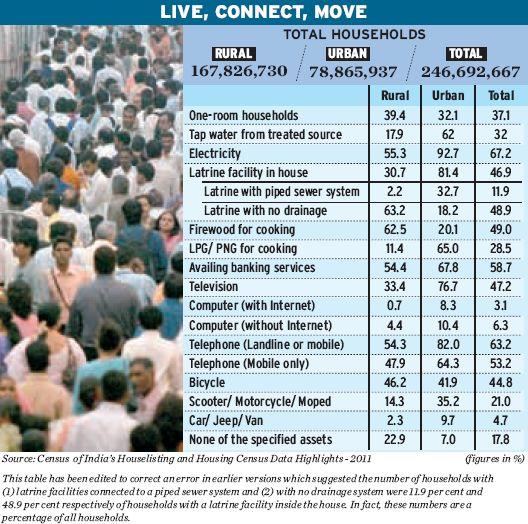
Newly released census 2011 data shows that while 17.8% of households across India do not own a phone, computer, TV, radio, bicycle or any vehicle, this proportion is 22.6% for scheduled castes, 37.3% for scheduled tribes and 14% for "others".

While more than half of "others" own a television, less than a quarter of scheduled tribes own a TV. Less than 2% of SC families own a TV, phone, computer and some mode of transportation, the usual signifiers of a "middle class" Indian family.

This new data fits in with the argument that economist and Indian Council of Social Science Research chairman Sukhadeo Thorat has been making. Thorat is critical of the view that economic liberalization has narrowed the gap between scheduled castes and others.

Yes, poverty is declining, but the rate of decline of poverty is much lower for the Scheduled Castes and Scheduled Tribes than for upper castes. There has undoubtedly been growth, but SCs and STs are not getting to participate equally in it," Thorat says.

There is considerable regional variation in the new census data.

Scheduled tribes are worst off in Madhya Pradesh, followed by in Rajasthan, Tripura and Maharashtra, where over 40% of STs do not own any basic consumer durable. Dalits are worst off in Bihar, Madhya Pradesh, Jharkhand and Orissa, where a third do not own any such asset. Unlike with the SCs, asset ownership for STs is worse than other social groups in all states.

While poverty among STs is fairly widespread across all states with a significant ST population, Kerala, Tamil Nadu and Punjab are the only states where the proportion of SCs who do not own basic assets is around 10% or lower, lowest of all in Tamil Nadu. Asset ownership among SCs in these three states is higher than that among "others" in all other states.

While part of the explanation for Tamil Nadu's status as the best state for dalit asset ownership might be that the previous state government ran a scheme giving free television sets to poor households, this is not the only explanation, as ownership of other consumer durables like phones and computers is also among the highest in TN. In comparison, in Bihar, where the state government ran a scheme to give all school-going girls a free cycle, less than half of all households own a bicycle.

Research by Institute of Applied Manpower Research director-general Santosh Mehrotra has shown that the human development indicators of SCs and OBCs in Kerala and Tamil Nadu are better than those of upper castes in Uttar Pradesh and Bihar. Moreover, all four states have a similar proportion of 'backward castes' in their population: so the key determinant of each of these states' human development situation is not its caste composition, but its politics and governance, Mehrotra says.

"A combination of social mobilization and good governance has lifted all boats in Kerala and Tamil Nadu," Mehrotra said. Social mobilization alone is not enough, Mehrotra adds, or the last twenty years in Uttar Pradesh would have led to tangible outcomes like improvement in health and nutrition, and not just intangibles like dignity and a sense of empowerment, as important as they are.

Comments

Add new comment

  • Coastaldigest.com reserves the right to delete or block any comments.
  • Coastaldigset.com is not responsible for its readers’ comments.
  • Comments that are abusive, incendiary or irrelevant are strictly prohibited.
  • Please use a genuine email ID and provide your name to avoid reject.
Agencies
July 30,2020

New Delhi, Jul 30: Preparing for a long haul in the Eastern Ladakh sector in extreme winters, the Indian Army has an edge over the Chinese as it has deployed 35,000 troops there who have already done tenures in high altitude and cold conditions.

The Indian troops deployed there are mentally prepared for tackling the weather and terrain.
In contrast, the Chinese troops deployed along the Line of Actual Control (LAC) are not used to these conditions as they have been brought from mainland China and are not accustomed to high altitude extreme cold weather conditions.

"We are preparing to provide extreme cold weather portable cabins for around 35,000 troops that have been deployed in the Eastern Ladakh sector," government sources said.

"Our soldiers deployed there have already done a tenure or two in Siachen, Eastern Ladakh or Northeast and they are physically and mentally prepared for a longer deployment there," they said.

The Chinese soldiers deployed on the Indian front include mainly conscripts who join the PLA for a period of 2-3 years and then return to their normal lives, sources said.

Indian and Chinese troops are engaged in a standoff situation all along the LAC in Eastern Ladakh from sub-sector north with both sides having deployed around 40,000 troops against each other over there.

The two sides have disengaged at three friction points including Patrolling Point 14, PP-15 and PP-17 and PP-17A.

At PP-17 and 17A, the Chinese have now maintained a small element of close to 50 troops and the remaining elements have gone back into their permanent locations.

The sources said the Army is also not much bothered about the Chinese build-up along the LAC as it has got more than two additional divisions from outside Ladakh sector.

India Army has more troops than what the Chinese have brought there, they said.

For the winter deployment, the Army already has a sizeable stock of clothes and habitat for troops as the Indian army deploys troops at the world's highest battlefield Siachen glacier and is prepared.

For additional requirements, the force is in the process of placing orders for additional tents and shelters from indigenous as well as foreign vendors.

The time for summer stocking is on and we are going to get the additional cabins and tents by that time, the sources.

Months of June, July, and August are considered to be the best time for stocking winter rations and ammunition. The snowfall is expected to start soon in the Eastern Ladakh area where the temperature is already low.

Prime Minister Narendra Modi's government has given financial powers of Rs 500 crore per procurement to the defence forces to address any type of shortages of weapons, ammunition, and habitat.

Comments

Add new comment

  • Coastaldigest.com reserves the right to delete or block any comments.
  • Coastaldigset.com is not responsible for its readers’ comments.
  • Comments that are abusive, incendiary or irrelevant are strictly prohibited.
  • Please use a genuine email ID and provide your name to avoid reject.
News Network
June 23,2020

Jun 23: The U.S. government on Monday restricted charter flights from India, accusing the nation of "unfair and discriminatory practices" by violating a treaty governing aviation between the two countries.

Air India Ltd. has been making flights to repatriate its citizens during the travel disruptions caused by the Covid-19 outbreak, but also has been selling tickets to the public, the Transportation Department alleged.

At the same time, U.S. airlines have been prohibited from flying to India by aviation regulators there, the DOT said in its order. The situation "creates a competitive disadvantage for U.S. carriers," the agency said in a press release.

Air India is advertising a schedule that is more than half of pre-virus operations, the department said. "The charters go beyond true repatriations, and it appears that Air India may be using repatriation charters as a way of circumventing" that nation's flight restrictions, the U.S. agency said.

The order becomes effective in 30 days, the department said.

Indian airlines must apply to the DOT for authorization before conducting charter flights so that it can scrutinize them more closely, it said. The department will reconsider the restrictions once India lifts restrictions on U.S. carriers.

The action against India follows weeks of DOT restrictions against Chinese airlines after the U.S. agency accused that nation of unfairly banning American carriers in the wake of the virus. On June 15, the U.S. announced it would agree to allow four flights a week from China after it allowed the same number by U.S. carriers.

Attempts to reach Air India and the Indian embassy in Washington after business hours were unsuccessful.

Comments

Add new comment

  • Coastaldigest.com reserves the right to delete or block any comments.
  • Coastaldigset.com is not responsible for its readers’ comments.
  • Comments that are abusive, incendiary or irrelevant are strictly prohibited.
  • Please use a genuine email ID and provide your name to avoid reject.
News Network
March 18,2020

New Delhi, Mar 18: As many as 276 Indians have been infected with coronavirus abroad, including 255 in Iran, 12 in UAE and five in Italy, the government informed the Lok Sabha on Wednesday.

In a written reply to a question in the Lok Sabha, Minister of State for External Affairs V Muraleedharan said the total number of Indians infected by coronavirus is 276 — 255 in Iran, 12 in UAE, five in Italy, and one each in Hong Kong, Kuwait, Rwanda and Sri Lanka.

A fourth batch of 53 Indians returned to India from Iran on Monday, taking the total number of people evacuated from the coronavirus-hit country to 389.

Iran is one of the worst-affected countries by the coronavirus outbreak and the government has been working to bring back Indians stranded there. Over 700 people have died from the disease in Iran and nearly 14,000 cases detected.

Comments

Add new comment

  • Coastaldigest.com reserves the right to delete or block any comments.
  • Coastaldigset.com is not responsible for its readers’ comments.
  • Comments that are abusive, incendiary or irrelevant are strictly prohibited.
  • Please use a genuine email ID and provide your name to avoid reject.