


Standard and poor? SCs, STs in Kerala, Tamil Nadu better off than others

May 6, 2012
TH14_census_NET_jpg_950870f
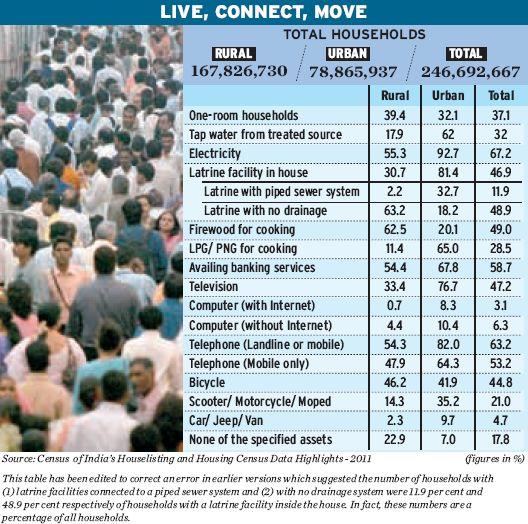
New Delhi, May 6: New census data on asset ownership among different social groups has shown that a far higher proportion of scheduled castes and higher still of scheduled tribes do not own basic consumer durables like a phone or bicycle as compared to "others".

Three states however buck this trend; across caste groupings in Punjab, Kerala and Tamil Nadu, the rate of ownership of basic consumer durables is high. In fact, the asset ownership rate for scheduled castes in these three states is better than that of OBCs and upper castes in all other states.

Newly released census 2011 data shows that while 17.8% of households across India do not own a phone, computer, TV, radio, bicycle or any vehicle, this proportion is 22.6% for scheduled castes, 37.3% for scheduled tribes and 14% for "others".

While more than half of "others" own a television, less than a quarter of scheduled tribes own a TV. Less than 2% of SC families own a TV, phone, computer and some mode of transportation, the usual signifiers of a "middle class" Indian family.

This new data fits in with the argument that economist and Indian Council of Social Science Research chairman Sukhadeo Thorat has been making. Thorat is critical of the view that economic liberalization has narrowed the gap between scheduled castes and others.

Yes, poverty is declining, but the rate of decline of poverty is much lower for the Scheduled Castes and Scheduled Tribes than for upper castes. There has undoubtedly been growth, but SCs and STs are not getting to participate equally in it," Thorat says.

There is considerable regional variation in the new census data.

Scheduled tribes are worst off in Madhya Pradesh, followed by in Rajasthan, Tripura and Maharashtra, where over 40% of STs do not own any basic consumer durable. Dalits are worst off in Bihar, Madhya Pradesh, Jharkhand and Orissa, where a third do not own any such asset. Unlike with the SCs, asset ownership for STs is worse than other social groups in all states.

While poverty among STs is fairly widespread across all states with a significant ST population, Kerala, Tamil Nadu and Punjab are the only states where the proportion of SCs who do not own basic assets is around 10% or lower, lowest of all in Tamil Nadu. Asset ownership among SCs in these three states is higher than that among "others" in all other states.

While part of the explanation for Tamil Nadu's status as the best state for dalit asset ownership might be that the previous state government ran a scheme giving free television sets to poor households, this is not the only explanation, as ownership of other consumer durables like phones and computers is also among the highest in TN. In comparison, in Bihar, where the state government ran a scheme to give all school-going girls a free cycle, less than half of all households own a bicycle.

Research by Institute of Applied Manpower Research director-general Santosh Mehrotra has shown that the human development indicators of SCs and OBCs in Kerala and Tamil Nadu are better than those of upper castes in Uttar Pradesh and Bihar. Moreover, all four states have a similar proportion of 'backward castes' in their population: so the key determinant of each of these states' human development situation is not its caste composition, but its politics and governance, Mehrotra says.

"A combination of social mobilization and good governance has lifted all boats in Kerala and Tamil Nadu," Mehrotra said. Social mobilization alone is not enough, Mehrotra adds, or the last twenty years in Uttar Pradesh would have led to tangible outcomes like improvement in health and nutrition, and not just intangibles like dignity and a sense of empowerment, as important as they are.

Comments

Add new comment

  • Coastaldigest.com reserves the right to delete or block any comments.
  • Coastaldigset.com is not responsible for its readers’ comments.
  • Comments that are abusive, incendiary or irrelevant are strictly prohibited.
  • Please use a genuine email ID and provide your name to avoid reject.
News Network
May 12,2020

Srinagar, May 12: Two paramilitary Central Reserve Police Force (CRPF) officers committed suicide after shooting themselves with their service rifles in Kashmir on Tuesday.

In the first incident, a CRPF sub-inspector on Tuesday committed suicide after shooting himself with his service rifle at Mattan area of south Kashmir’s Anantnag district. The deceased, identified as Fatah Singh of Jaisalmer in Rajasthan, had reportedly left behind a suicide note that read: “I am afraid, I may have Corona.”

Station House Officer (SHO) Akura, Mattan police station Jazib Ahmed said that they have followed the COVID-19 protocol while dealing with the body of the CRPF sub-inspector. “His samples have been taken and post-mortem conducted. Only results would confirm whether he was a COVID-19 positive,” he said.

CRPF spokesman in Srinagar Pankaj Singh said the officer had returned to his unit after performing a day-long duty. “As such, there is no evidence that he had caught COVID-19. Let’s wait for the final report. Details will be shared with the media,” Singh said.

Hours after the first incident, an assistant-sub-inspector of the CRPF posted in Srinagar also committed suicide by shooting himself dead with his service rifle.

Special Director General of CRPF, Zulfikar Hassan said they were trying to find out the reason for the two boys taking this extreme step.

Suicides and fratricide incidents are not uncommon among the CRPF and the Army personnel deployed in Kashmir. In 2006, recognising the rising fratricide and suicide cases among the armed forces, the then Defence Minister had constituted an expert group of psychiatrists under the Defence Institute of Psychological Research in order to suggest remedial measures to prevent suicide and fratricide incidents.

Over the last decade, incidents of fratricide have reportedly reduced in the Army as the force has taken measures to address the issue.

Comments

Add new comment

  • Coastaldigest.com reserves the right to delete or block any comments.
  • Coastaldigset.com is not responsible for its readers’ comments.
  • Comments that are abusive, incendiary or irrelevant are strictly prohibited.
  • Please use a genuine email ID and provide your name to avoid reject.
News Network
February 22,2020

Feb 22: Prime Minister Narendra Modi is unlikely to accompany US President Donald Trump and his family members during their visit to the Taj Mahal in Agra on Monday, official sources said.

The US President will arrive in Ahmedabad at around noon on February 24 for a less that 36-hour visit to India. He will be accompanied by a high-level delegation including First Lady Melania Trump, the President's daughter Ivanka Trump, son-in-law Jared Kushner and a galaxy of top US officials.

After attending an event at Ahmedabad, the Trumps will travel to Agra on Monday afternoon to visit the Taj Mahal before arriving at the national capital for the main leg of the visit.

When asked about reports that Modi may accompany Trump to Agra, official sources said there was no such plan.

They said the visit to the Taj Mahal in Agra by the US President and his family members will afford them the opportunity to view the historical monument suitably. Therefore, no official engagements or presence of senior dignitaries from the Indian side is envisaged there, the sources said.

Comments

Add new comment

  • Coastaldigest.com reserves the right to delete or block any comments.
  • Coastaldigset.com is not responsible for its readers’ comments.
  • Comments that are abusive, incendiary or irrelevant are strictly prohibited.
  • Please use a genuine email ID and provide your name to avoid reject.
News Network
July 2,2020

Lucknow, Jul 2: After a video showing health workers allegedly tossing bodies of coronavirus victims in a large pit in Karnataka, BSP President Mayawati on Wednesday stated that the incident is the "height of cruelty and insult to humanity".
The former UP Chief Minister demanded that the guilty must be punished.

"The tragedy that the bodies of COVID-19 victims being thrown into trenches in Ballari, Karnataka is the height of cruelty and an insult to humanity. Though incidents related to inhuman cruelty with corona patients are rampant but guilty of Ballari must be punished by the state government," Mayawati said in a tweet.

Also, in another tweet, she asked the Central government to extend the Pradhan Mantri Garib Kalyan Anna Yojana till the end of the coronavirus pandemic.

"In order to check ignominy of starvation on account of long unprecedented hardship & unemployment due to coronavirus and the subsequent nationwide lockdown, the PM Garib Kalyan Anna Yojna must continue not till November but till the end of the pandemic, this is the demand of BSP," she tweeted. 

Comments

Add new comment

  • Coastaldigest.com reserves the right to delete or block any comments.
  • Coastaldigset.com is not responsible for its readers’ comments.
  • Comments that are abusive, incendiary or irrelevant are strictly prohibited.
  • Please use a genuine email ID and provide your name to avoid reject.