


Standard and poor? SCs, STs in Kerala, Tamil Nadu better off than others

May 6, 2012
TH14_census_NET_jpg_950870f
New Delhi, May 6: New census data on asset ownership among different social groups has shown that a far higher proportion of scheduled castes and higher still of scheduled tribes do not own basic consumer durables like a phone or bicycle as compared to "others".

Three states however buck this trend; across caste groupings in Punjab, Kerala and Tamil Nadu, the rate of ownership of basic consumer durables is high. In fact, the asset ownership rate for scheduled castes in these three states is better than that of OBCs and upper castes in all other states.

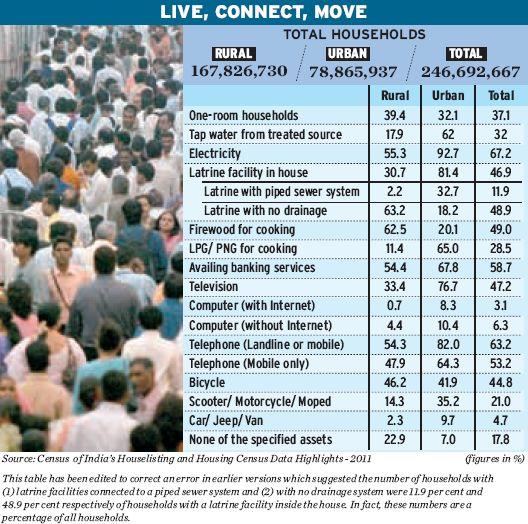
Newly released census 2011 data shows that while 17.8% of households across India do not own a phone, computer, TV, radio, bicycle or any vehicle, this proportion is 22.6% for scheduled castes, 37.3% for scheduled tribes and 14% for "others".

While more than half of "others" own a television, less than a quarter of scheduled tribes own a TV. Less than 2% of SC families own a TV, phone, computer and some mode of transportation, the usual signifiers of a "middle class" Indian family.

This new data fits in with the argument that economist and Indian Council of Social Science Research chairman Sukhadeo Thorat has been making. Thorat is critical of the view that economic liberalization has narrowed the gap between scheduled castes and others.

Yes, poverty is declining, but the rate of decline of poverty is much lower for the Scheduled Castes and Scheduled Tribes than for upper castes. There has undoubtedly been growth, but SCs and STs are not getting to participate equally in it," Thorat says.

There is considerable regional variation in the new census data.

Scheduled tribes are worst off in Madhya Pradesh, followed by in Rajasthan, Tripura and Maharashtra, where over 40% of STs do not own any basic consumer durable. Dalits are worst off in Bihar, Madhya Pradesh, Jharkhand and Orissa, where a third do not own any such asset. Unlike with the SCs, asset ownership for STs is worse than other social groups in all states.

While poverty among STs is fairly widespread across all states with a significant ST population, Kerala, Tamil Nadu and Punjab are the only states where the proportion of SCs who do not own basic assets is around 10% or lower, lowest of all in Tamil Nadu. Asset ownership among SCs in these three states is higher than that among "others" in all other states.

While part of the explanation for Tamil Nadu's status as the best state for dalit asset ownership might be that the previous state government ran a scheme giving free television sets to poor households, this is not the only explanation, as ownership of other consumer durables like phones and computers is also among the highest in TN. In comparison, in Bihar, where the state government ran a scheme to give all school-going girls a free cycle, less than half of all households own a bicycle.

Research by Institute of Applied Manpower Research director-general Santosh Mehrotra has shown that the human development indicators of SCs and OBCs in Kerala and Tamil Nadu are better than those of upper castes in Uttar Pradesh and Bihar. Moreover, all four states have a similar proportion of 'backward castes' in their population: so the key determinant of each of these states' human development situation is not its caste composition, but its politics and governance, Mehrotra says.

"A combination of social mobilization and good governance has lifted all boats in Kerala and Tamil Nadu," Mehrotra said. Social mobilization alone is not enough, Mehrotra adds, or the last twenty years in Uttar Pradesh would have led to tangible outcomes like improvement in health and nutrition, and not just intangibles like dignity and a sense of empowerment, as important as they are.

Comments

Add new comment

  • Coastaldigest.com reserves the right to delete or block any comments.
  • Coastaldigset.com is not responsible for its readers’ comments.
  • Comments that are abusive, incendiary or irrelevant are strictly prohibited.
  • Please use a genuine email ID and provide your name to avoid reject.
Agencies
February 5,2020

New Delhi, Feb 5: Over five crore farmers were yet to get the third instalment of money under the Centre's ambitious PM-Kisan scheme, aimed at providing direct support of Rs 6,000 annually to them, according to the latest Ministry of Agriculture and Farmers' Welfare data.

The total amount of the scheme, which came into effect on December 1, 2018, is to be paid in three equal instalments of Rs 2,000 every four months.

The data showed about 2.51 crore farmers have not got even the second instalment and 5.16 crore of them were yet to get the third instalment.

Over 9 crore farmers have registered themselves under the scheme between December 2018 and November 2019, it said.

Of these, 7.62 crore or 84 per cent of farmers have received the first instalment.

The money through the second instalment was given to nearly 6.5 crore farmers and the amount under the third instalment was given to 3.85 crore beneficiaries, according to the data received in response to an RTI query filed by this PTI journalist.

The agriculture ministry, in its response, gave three sets of data mentioning the benefits given to farmers under the scheme between December 2018 and November 2019.

It said 4.74 crore farmers were registered between December 2018 and March 2019.

Of them, 4.22 crore received the first instalment, 4.02 crore the second and 3.85 crore the third.

There was no mention why nearly 50 lakh, 70 lakh and 90 lakh registered farmers during this period did not get the first, second and third instalment respectively.

There was no registered beneficiary in West Bengal and Sikkim, hence no amount was disbursed during this period, according to the data.

Giving details of the 3.08 crore farmers registered between April and July last year, it said 2.66 crore and 2.47 crore beneficiaries have got their first and second instalments respectively.

The RTI reply did no mention why around 40 lakh and 61 lakh registered farmers during this period did not get their first and second instalment respectively.

"The beneficiaries are eligible for the instalment for the period in which he/she gets registered and subsequent periods, thereafter. Therefore, the third instalment is not due for the beneficiaries registered in the period April 2019-July 2019," the ministry said.

There was no registered beneficiary during this period in West Bengal, Punjab and Chandigarh and therefore nobody was paid first and second instalments.

The ministry said around 1.19 crore beneficiaries were registered between August and November 30, 2019, of these nearly 73.66 lakh farmers have been given the first instalment.

There was no mention of payment of first instalment to over 45 lakh eligible beneficiaries during the period.

"The beneficiaries are eligible for the instalment for the period in which he/she gets registered and subsequent periods, thereafter. Therefore, the second and third instalments are not due for the beneficiaries registered in the period August 2019 to November 2019," it said.

The ministry was asked to provide the total number of farmers, state-wise, and the amount received by them under the Pradhan Mantri Kisan Samman Nidhi or PM-Kisan scheme.

"PM-Kisan Samman Nidhi scheme has been implemented from December 1, 2018. It is stated that PM-Kisan is a continuous and ongoing scheme, in which the financial benefits are transferred to the bank accounts of the identified beneficiaries as and when their correct and verified data is uploaded by the concerned states/union territories on PM-Kisan web portal," the ministry said in the RTI response vide its letter dated December 26, 2019.

The data of beneficiaries so uploaded by them undergoes a multi-level verification, including by banks, and only then the amount is released to the beneficiary, it said, adding that www.pmkisan.gov.in website can be accessed to get more details on the operational guidelines of the scheme.

According to the data updated on the website on February 3, around 8.82 crore farmers have been registered and 8.41 crore have received the first installment, 7.56 crore the second instalment, 6.19 crore the third and 3.03 crore have received the fourth installment.

In Assam, out of 16.97 lakh farmers registered during this period, 14.02 lakh got the first instalment, 13.72 lakh received the second and 9.87 lakh the third.

Of the 42.34 lakh registered beneficiaries in Maharashtra, 36.98 lakh got the first instalment, 31.53 lakh the second and 27.67 lakh got the third instalment.

As many as 23.83 lakh farmers in Kerala received their first instalment, 18.79 lakh got the second and 18.43 lakh the third. A total of 26.13 lakh beneficiaries were registered in the state between December 2018 and March 2019.

There was no beneficiary registered during the period from West Bengal, which has refused to implement the scheme, according to the ministry's response.

In Uttar Pradesh, nearly 9.57 lakh out of 19.64 lakh farmers have got the first instalment. In Gujarat, nearly 1.22 lakh out of 1.98 lakh registered farmers got the first instalment.

Around 9.78 lakh farmers out of the 17.18 lakh registered beneficiaries have received the first instalment in Madhya Pradesh. In Odisha, only 5,507 farmers out of 5.6 lakh registered farmers have got the first instalment, the ministry said.

None of the 7,326 farmers registered in Sikkim was paid the first instalment, according to the ministry's reply. In Delhi, 1,447 farmers out of 1,734 have got the first instalment.

Comments

Add new comment

  • Coastaldigest.com reserves the right to delete or block any comments.
  • Coastaldigset.com is not responsible for its readers’ comments.
  • Comments that are abusive, incendiary or irrelevant are strictly prohibited.
  • Please use a genuine email ID and provide your name to avoid reject.
News Network
April 2,2020

New Delhi, Apr 2: With 437 new cases reported in the last 24 hours, the tally of COVID-19 positive cases in India shot up to 1,834 on Wednesday night.

The number of deaths in the country due to COVID-19 has risen to 41.

The total number of active cases in the country is 1,649. 143 persons have been cured and discharged from the hospitals. One person has migrated, according to the data provided by the Ministry of Health and Family Welfare.

Earlier on Wednesday, Union Home Secretary Ajay Bhalla urged all state governments and Union Territory administrations to ensure the lockdown measures issued by the Ministry of Home Affairs are strictly implemented.

"All the state governments/UT administrations are requested to strictly implement the lockdown measures issued by MHA in the exercise of the powers under Disaster Management Act, 2005 in letter and spirit," Bhalla said.

Prime Minister Modi had earlier announced a 21-day lockdown in the entire country to deal with the spread of coronavirus, saying that "social distancing" is the only option to deal with the disease, which spreads rapidly.

Comments

Add new comment

  • Coastaldigest.com reserves the right to delete or block any comments.
  • Coastaldigset.com is not responsible for its readers’ comments.
  • Comments that are abusive, incendiary or irrelevant are strictly prohibited.
  • Please use a genuine email ID and provide your name to avoid reject.
News Network
June 29,2020

Kolkata, Jun 29: Sweet-loving Bengalis have something to cheer about in COVID-19 time as the West Bengal government decided to come out with a "sandesh" which will contain honey from Sundarbans and increase immunity, an official said on Sunday.

Cotton cheese made from cow milk will be mixed with pure honey from the Sunderbans to prepare the "Arogya Sandesh" which will also have extracts of tulsi leaves, an official of the Animal Resources Development Department said.

No artificial flavours would be added to the sweetmeat which will be available in the department's outlets in the city and neighbouring districts, he said.

The sandesh will boost the immune system as a whole but it is not a COVID-19 antidote, the official said.

Sunderbans Affairs Minister Manturam Pakhira said the honey for making Arogya Sandesh will be collected from beehives in places such as Pirkhali, Jharkhali and other parts of the Sunderbans and it will be stored in a scientific manner.

The sandesh is expected to hit the shelves in another two months and the pricing will be within the reach of the common man, the animal resources development department official said.

Earlier this month, a reputed sweetmeat chain of Kolkata came out with an "Immunity Sandesh" claiming that it contains various herbs and spices such as haldi (turmeric), tulsi, saffron, and cardamom and Himalayan honey, which will boost immunity to fight novel coronavirus.

Comments

Add new comment

  • Coastaldigest.com reserves the right to delete or block any comments.
  • Coastaldigset.com is not responsible for its readers’ comments.
  • Comments that are abusive, incendiary or irrelevant are strictly prohibited.
  • Please use a genuine email ID and provide your name to avoid reject.