


Standard and poor? SCs, STs in Kerala, Tamil Nadu better off than others

May 6, 2012
TH14_census_NET_jpg_950870f
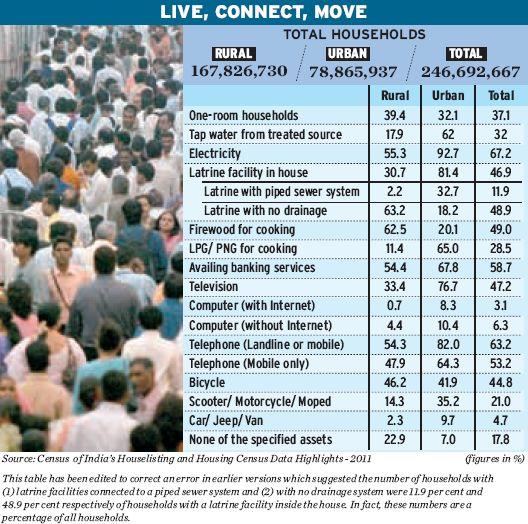
New Delhi, May 6: New census data on asset ownership among different social groups has shown that a far higher proportion of scheduled castes and higher still of scheduled tribes do not own basic consumer durables like a phone or bicycle as compared to "others".

Three states however buck this trend; across caste groupings in Punjab, Kerala and Tamil Nadu, the rate of ownership of basic consumer durables is high. In fact, the asset ownership rate for scheduled castes in these three states is better than that of OBCs and upper castes in all other states.

Newly released census 2011 data shows that while 17.8% of households across India do not own a phone, computer, TV, radio, bicycle or any vehicle, this proportion is 22.6% for scheduled castes, 37.3% for scheduled tribes and 14% for "others".

While more than half of "others" own a television, less than a quarter of scheduled tribes own a TV. Less than 2% of SC families own a TV, phone, computer and some mode of transportation, the usual signifiers of a "middle class" Indian family.

This new data fits in with the argument that economist and Indian Council of Social Science Research chairman Sukhadeo Thorat has been making. Thorat is critical of the view that economic liberalization has narrowed the gap between scheduled castes and others.

Yes, poverty is declining, but the rate of decline of poverty is much lower for the Scheduled Castes and Scheduled Tribes than for upper castes. There has undoubtedly been growth, but SCs and STs are not getting to participate equally in it," Thorat says.

There is considerable regional variation in the new census data.

Scheduled tribes are worst off in Madhya Pradesh, followed by in Rajasthan, Tripura and Maharashtra, where over 40% of STs do not own any basic consumer durable. Dalits are worst off in Bihar, Madhya Pradesh, Jharkhand and Orissa, where a third do not own any such asset. Unlike with the SCs, asset ownership for STs is worse than other social groups in all states.

While poverty among STs is fairly widespread across all states with a significant ST population, Kerala, Tamil Nadu and Punjab are the only states where the proportion of SCs who do not own basic assets is around 10% or lower, lowest of all in Tamil Nadu. Asset ownership among SCs in these three states is higher than that among "others" in all other states.

While part of the explanation for Tamil Nadu's status as the best state for dalit asset ownership might be that the previous state government ran a scheme giving free television sets to poor households, this is not the only explanation, as ownership of other consumer durables like phones and computers is also among the highest in TN. In comparison, in Bihar, where the state government ran a scheme to give all school-going girls a free cycle, less than half of all households own a bicycle.

Research by Institute of Applied Manpower Research director-general Santosh Mehrotra has shown that the human development indicators of SCs and OBCs in Kerala and Tamil Nadu are better than those of upper castes in Uttar Pradesh and Bihar. Moreover, all four states have a similar proportion of 'backward castes' in their population: so the key determinant of each of these states' human development situation is not its caste composition, but its politics and governance, Mehrotra says.

"A combination of social mobilization and good governance has lifted all boats in Kerala and Tamil Nadu," Mehrotra said. Social mobilization alone is not enough, Mehrotra adds, or the last twenty years in Uttar Pradesh would have led to tangible outcomes like improvement in health and nutrition, and not just intangibles like dignity and a sense of empowerment, as important as they are.

Comments

Add new comment

  • Coastaldigest.com reserves the right to delete or block any comments.
  • Coastaldigset.com is not responsible for its readers’ comments.
  • Comments that are abusive, incendiary or irrelevant are strictly prohibited.
  • Please use a genuine email ID and provide your name to avoid reject.
News Network
March 6,2020

Mumbai, Mar 6: Harried Yes Bank depositors rushed to ATMs to withdraw cash but faced multitude of problems including closed down machines and long queues, after the RBI placed the bank under a moratorium, capping maximum withdrawals at Rs 50,000 per account for a month.

Aggravating the problems of depositors were difficulties accessing the internet banking channel, which ensured that they can't transfer the funds online as well. At an ATM in south Mumbai's Horniman Circle, with the RBI headquarters overlooking it, the shutters were pulled down.

The guard on duty said the machine was non-operational before he reported to work late in the evening and he was ordered to shut it after 2200 hrs. In the residential area of suburban Chembur, one ATM was dispensing cash but had a long queue of anxious depositors.

One man said it was still possible to withdraw up to Rs 50,000 in multiple transactions from the machine.

However, another machine nearby had run dry within minutes of the RBI announcement, a woman said.

The regulatory actions, undertaken by the RBI and the government, came hours after finance ministry sources confirmed that SBI was directed to bail out the troubled lender.

For the next month, Yes Bank will be led by the RBI-appointed administrator Prashant Kumar, an ex-chief financial officer of SBI.

Comments

Add new comment

  • Coastaldigest.com reserves the right to delete or block any comments.
  • Coastaldigset.com is not responsible for its readers’ comments.
  • Comments that are abusive, incendiary or irrelevant are strictly prohibited.
  • Please use a genuine email ID and provide your name to avoid reject.
Agencies
January 21,2020

Pune, Jan 21: The Pune session court on Tuesday rejected the bail application of accused Vikram Bhave in the Dabholkar murder case.
Last year, Pune Sessions Court had granted an extension of 90 days to the Central Bureau of Investigation (CBI) to file a charge-sheet against Bhave.

On August 17, 2019, the court had rejected Bhave's bail plea.

During the course of hearing, Special Public Prosecutor (SPP) Prakash Suryavanshi, appearing for the CBI, had in June last year contended that Bhave helped the assailants to escape.

The CBI had arrested Bhave and another accused Sanjeev Punalekar from Mumbai on May 25, 2019 in connection with the matter.

Founder of the Maharashtra Andhashraddha Nirmoolan Samiti (MANS), Dabholkar was shot dead by bike-borne assailants while returning home from a morning walk on August 20, 2013. 

Comments

Add new comment

  • Coastaldigest.com reserves the right to delete or block any comments.
  • Coastaldigset.com is not responsible for its readers’ comments.
  • Comments that are abusive, incendiary or irrelevant are strictly prohibited.
  • Please use a genuine email ID and provide your name to avoid reject.
News Network
May 24,2020

New Delhi, May 24: India witnessed the biggest ever spike of 6,767 positive cases in the last 24 hours, taking the total number of COVID-19 cases to 1,31,868, according to the Union Ministry of Health and Family Welfare.

As many as 147 deaths have been reported in the last 24 hours, taking the death toll to 3,867.
Out of the total number of cases, 73,560 are active and 54,440 have been cured/discharged and one migrated.

Maharashtra continues to remain the worst-affected state with 47,190 COVID-19 cases. It is followed by Tamil Nadu (15,512), Gujarat (13,664), and Delhi (12,910).

The nationwide lockdown imposed as a precautionary measure to contain the spread of COVID-19 has been extended till May 31.

Comments

Add new comment

  • Coastaldigest.com reserves the right to delete or block any comments.
  • Coastaldigset.com is not responsible for its readers’ comments.
  • Comments that are abusive, incendiary or irrelevant are strictly prohibited.
  • Please use a genuine email ID and provide your name to avoid reject.