


Standard and poor? SCs, STs in Kerala, Tamil Nadu better off than others

May 6, 2012
TH14_census_NET_jpg_950870f
New Delhi, May 6: New census data on asset ownership among different social groups has shown that a far higher proportion of scheduled castes and higher still of scheduled tribes do not own basic consumer durables like a phone or bicycle as compared to "others".

Three states however buck this trend; across caste groupings in Punjab, Kerala and Tamil Nadu, the rate of ownership of basic consumer durables is high. In fact, the asset ownership rate for scheduled castes in these three states is better than that of OBCs and upper castes in all other states.

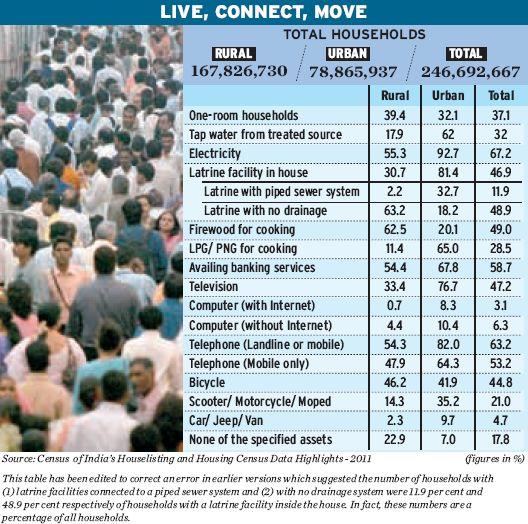
Newly released census 2011 data shows that while 17.8% of households across India do not own a phone, computer, TV, radio, bicycle or any vehicle, this proportion is 22.6% for scheduled castes, 37.3% for scheduled tribes and 14% for "others".

While more than half of "others" own a television, less than a quarter of scheduled tribes own a TV. Less than 2% of SC families own a TV, phone, computer and some mode of transportation, the usual signifiers of a "middle class" Indian family.

This new data fits in with the argument that economist and Indian Council of Social Science Research chairman Sukhadeo Thorat has been making. Thorat is critical of the view that economic liberalization has narrowed the gap between scheduled castes and others.

Yes, poverty is declining, but the rate of decline of poverty is much lower for the Scheduled Castes and Scheduled Tribes than for upper castes. There has undoubtedly been growth, but SCs and STs are not getting to participate equally in it," Thorat says.

There is considerable regional variation in the new census data.

Scheduled tribes are worst off in Madhya Pradesh, followed by in Rajasthan, Tripura and Maharashtra, where over 40% of STs do not own any basic consumer durable. Dalits are worst off in Bihar, Madhya Pradesh, Jharkhand and Orissa, where a third do not own any such asset. Unlike with the SCs, asset ownership for STs is worse than other social groups in all states.

While poverty among STs is fairly widespread across all states with a significant ST population, Kerala, Tamil Nadu and Punjab are the only states where the proportion of SCs who do not own basic assets is around 10% or lower, lowest of all in Tamil Nadu. Asset ownership among SCs in these three states is higher than that among "others" in all other states.

While part of the explanation for Tamil Nadu's status as the best state for dalit asset ownership might be that the previous state government ran a scheme giving free television sets to poor households, this is not the only explanation, as ownership of other consumer durables like phones and computers is also among the highest in TN. In comparison, in Bihar, where the state government ran a scheme to give all school-going girls a free cycle, less than half of all households own a bicycle.

Research by Institute of Applied Manpower Research director-general Santosh Mehrotra has shown that the human development indicators of SCs and OBCs in Kerala and Tamil Nadu are better than those of upper castes in Uttar Pradesh and Bihar. Moreover, all four states have a similar proportion of 'backward castes' in their population: so the key determinant of each of these states' human development situation is not its caste composition, but its politics and governance, Mehrotra says.

"A combination of social mobilization and good governance has lifted all boats in Kerala and Tamil Nadu," Mehrotra said. Social mobilization alone is not enough, Mehrotra adds, or the last twenty years in Uttar Pradesh would have led to tangible outcomes like improvement in health and nutrition, and not just intangibles like dignity and a sense of empowerment, as important as they are.

Comments

Add new comment

  • Coastaldigest.com reserves the right to delete or block any comments.
  • Coastaldigset.com is not responsible for its readers’ comments.
  • Comments that are abusive, incendiary or irrelevant are strictly prohibited.
  • Please use a genuine email ID and provide your name to avoid reject.
Agencies
February 27,2020

New Delhi, Feb 27: The US Commission on International Religious Freedom (USCIRF) has said that the Delhi violence in which over 30 people were killed, was specifically targeted against the Muslims.

Expressing "grave concern over the ongoing violence taking place in Delhi", the USCIRF in a statement said that as President Donald Trump's inaugural visit to India winds down, North-East Delhi has been rocked by deadly rioting, with reports of violence and mobs specifically targeting Muslims.

"These incidents are even more concerning in the context of efforts within India to target and potentially disenfranchise Muslims across the country, in clear violation of international human rights standards," USCIRF Commissioner Anurima Bhargava said.

"According to reports, several mosques have also been set alight or vandalized. Many Muslim residents have been forced to flee the area. This unrest comes in the wake of widespread protests against the Citizenship (Amendment) Act following its passage in December 2019.

"The brutal and unchecked violence growing across Delhi cannot continue," Bhargava said adding that the Indian government must take swift action to ensure the safety of all of its citizens.

"Instead, reports are mounting that the Delhi police have not intervened in violent attacks against Muslims, and the government is failing in its duty to protect its citizens."

USCIRF Chair Tony Perkins said the ongoing violence in Delhi and the reported "attacks against Muslims, their homes and shops, and their houses of worship are greatly disturbing".

One of the essential duties of any responsible government, he said, is to provide protection and physical security for its citizens, regardless of faith.

"We urge the Indian government to take serious efforts to protect Muslims and others targeted by mob violence."

In its annual report last year, the USCIRF classified India as a "Tier 2" country for engaging in or tolerating religious freedom violations that meet at least one of the elements of the "systematic, ongoing, egregious standard for designations as a "country of particular concern (CPC)", under the International Religious Freedom Act.

The ongoing violence in North-East Delhi erupted after clashes between pro and anti-CAA protesters on Sunday.

Besides the casualties, over 200 others have been injured in the deadliest violence in the national capital in decades.

Comments

Add new comment

  • Coastaldigest.com reserves the right to delete or block any comments.
  • Coastaldigset.com is not responsible for its readers’ comments.
  • Comments that are abusive, incendiary or irrelevant are strictly prohibited.
  • Please use a genuine email ID and provide your name to avoid reject.
News Network
April 11,2020

New Delhi, Apr 11: Calling upon chief ministers to popularise Aarogya Setu app, Prime Minister Narendra Modi on Saturday said it will an essential tool in India's fight against coronavirus and referred to the possibility of the app being an "e-pass which could subsequently facilitate travel from one place to other".

Interacting with chief ministers through video conference, the Prime Minister mentioned how South Korea and Singapore had got success in contact tracing and said India has made its own effort through the app amid efforts to contain the spread of coronavirus.

A PMO release said that the Prime Minister spoke about popularizing the Aarogya Setu app to ensure downloads in greater numbers.

"He referred to how South Korea and Singapore got success in contact tracing. Based on those experiences, India has made its own effort through the app which will be an essential tool in India's fight against the pandemic, he said. He also referred to the possibility of the app being an e-pass which could subsequently facilitate travel from one place to another," the release said.

The Prime Minister had earlier this week urged people to download the app saying it is an important step in the fight against COVID-19 and its effectiveness will increase as more people use it.

"Aarogya Setu is an important step in our fight against COVID-19. By leveraging technology, it provides important information. As more and more people use it, it's effectiveness will increase. I urge you all to download it," he had said in a tweet.

The app launched earlier this month in public-private partnership enables people to themselves assess the risk for their catching the coronavirus infection.

The app makes its calculations based on a person's interaction with others, using Bluetooth technology, algorithms and artificial intelligence.

Comments

Add new comment

  • Coastaldigest.com reserves the right to delete or block any comments.
  • Coastaldigset.com is not responsible for its readers’ comments.
  • Comments that are abusive, incendiary or irrelevant are strictly prohibited.
  • Please use a genuine email ID and provide your name to avoid reject.
News Network
May 30,2020

New Delhi, May 30: As the NDA government completes one year of its second term, Prime Minister Narendra Modi listed several achievements and initiatives taken by his government in the past year in an audio message addressed to the people of the country.

PM Modi said, "This day last year began a golden chapter in the history of Indian democracy. It was after several decades that the people of the country voted back a full-term government with a full majority."

"Your role has played a pivotal role in creating this chapter. In such a situation, this day is an opportunity for me to bow to the citizens of the country and the democratic ethos of our nation," said PM Modi.

"Had the situation been normal, I would have got the chance to meet you. Your affection and active support in the past year have given me new energy and inspiration. During this period, the way you have shown the collective powers of democracy, they have become an example for the whole world," he added.

PM Modi talked about several important initiatives taken by his government in 2014 as well as India's demonstration of its mettle through the surgical strike and airstrike.

"Six years ago in 2014, the people of this country voted to bring a major change in the country. You voted to change the country's policy and manner. During that tenure where surgical strike and airstrike took place, one rank one pension, one nation one tax GST, and better MSP for farmers were also fulfilled. That period was dedicated to fulfilling many needs of the country."

He further said that in these years the country has seen systems coming out of the quagmire of inertia and corruption. The country has seen governance change to make life easier for the poor.

"During that period, India's stature in the world increased. By opening bank accounts of poor people, by giving them gas connections, by providing free electricity connections, by building washrooms, by building houses, the dignity of the poor has also been increased," said PM Modi.

Comments

Add new comment

  • Coastaldigest.com reserves the right to delete or block any comments.
  • Coastaldigset.com is not responsible for its readers’ comments.
  • Comments that are abusive, incendiary or irrelevant are strictly prohibited.
  • Please use a genuine email ID and provide your name to avoid reject.