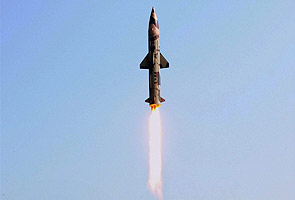
India's missile defence shield ready: Defence Research and Development Organisation

May 7, 2012
prithvi2_295

New Delhi, May 7: India has developed its own missile defence shield which can be put in place at short notice to protect at least two cities, bringing the country at par with an elite group of few nations. The shield, developed by the Defence Research and Development Organisation (DRDO), has been tested successfully and an incoming ballistic missile with the range of up to 2,000 kms can be destroyed.

"The Ballistic Missile Defence (BMD) shield is now mature. We are ready to put phase one in place and it can be put in very short time," DRDO chief V K Saraswat told PTI in an interview.

He said the shield, as part of phase one of the programme, can be put in place in two cities in the country, where the infrastructure is available. However, the two places have not yet been identified and the selection will be made at the political level. The DRDO used variants of Prithvi missiles as simulated targets and successfully intercepted missiles in test-firings.

The system was first test-fired in November 2006 elevating India into the elite club of countries to have successfully developed an Anti-ballistic missile system, after United States, Russia and Israel.

"We have carried out six successful launches and demonstrated the capability for 2,000 km targets. We have demonstrated it in two layers that is endo-atmospheric (inside the Earth's atmosphere) and exo-atmospheric (outside the Earth's atmosphere)," Mr Saraswat said.

The DRDO chief said the Indian missile defence system is comparable with the US Patriot 3 system, which was successfully used during the 1990 Gulf War against Iraq.

He said all the elements such as long-range radars and tracking devices, real-time datalink and mission control system required for the missile system have been "realised" successfully.

Under the phase two of the project, the premier defence research agency would upgrade the system to handle ballistic missiles with range of 5,000 km. This phase is expected to be ready by 2016.

The system required for phase-II of the project is being developed, he said, adding that for this purpose, ships are being built from where the target missiles would be launched.

Talking about the advancement of the system, he said the missile defence shield has been "automated" to an extent where human intervention would be required only if the mission has to be aborted.

As part of its efforts to protect itself from enemy missiles, India is developing this two-tier BMD which can intercept enemy missiles at altitudes of 80 km and 150 km.

The DRDO is thinking of intercepting the missiles at higher altitudes as it would give it more response time in case the first attempt is a miss and the second layer of the system can be put into action.

Comments

Add new comment

  • Coastaldigest.com reserves the right to delete or block any comments.
  • Coastaldigset.com is not responsible for its readers’ comments.
  • Comments that are abusive, incendiary or irrelevant are strictly prohibited.
  • Please use a genuine email ID and provide your name to avoid reject.
Agencies
June 7,2020

New Delhi, Jun 7: The Islamic Centre of India on Saturday issued an advisory for those visiting mosques in view of the Centre’s decision to allow reopening of religious places from June 8.

Islamic Centre of India chairman Maulana Khalid Rasheed Farangi Mahali advised people above 65 years and under 10 years of age not to visit mosques and instead offer prayers at home.

He also advised against crowding in mosques, stressing that not more than five people should be present at a time and social distancing be maintained, with the ‘namazis’ using masks and keeping a distance of six feet among themselves while offering prayers.

He added that the situation would be reviewed after 15 days and if required, another advisory would be issued.

Comments

Add new comment

  • Coastaldigest.com reserves the right to delete or block any comments.
  • Coastaldigset.com is not responsible for its readers’ comments.
  • Comments that are abusive, incendiary or irrelevant are strictly prohibited.
  • Please use a genuine email ID and provide your name to avoid reject.
Agencies
July 23,2020

Jerusalem, Jul 23: Merging Israel's technological expertise with India's mass production capabilities, experts from the two countries have joined hands to develop rapid testing for Covid-19 in under 30 seconds.

Israel will soon send a high-level research delegation to India to conduct a series of "final stages of testing" as part of the joint effort to develop the rapid testing kits for Covid-19 .

A high ranking team from the Directorate of Defence Research and Development (DDR&D), in the Ministry of Defense, which has been working with India's DRDO to develop rapid testing for Covid-19 in under 30 seconds, is to leave from Tel Aviv to New Delhi on a special flight in a few days, Israel's Ministry of Defence said in a statement on Thursday.

Israel's Ministry of Foreign Affairs (MFA) and Ministry of Health are also involved in this unprecedented cooperation between the two countries which aims at "merging Israeli technology with Indian development and production capabilities to allow a swift resumption of normal life alongside the virus".

The DDR&D team will conduct a series of "final stages of testing" to determine the effectiveness of a number of rapid diagnostic solutions with their Indian counterparts.

Since the start of the pandemic, the DDR&D has tested dozens of diagnostic technologies. Some of them have matured and passed initial trials in Israel, however in order to complete testing and prove their effectiveness, these must be tested on a wide range of patients, IMoD said.

The four tech systems that will be tested are - voice test, breathalyzer test based on terra-hertz waves, isothermal test, and polyamino acids test.

"What they all have in common is the ability to detect the presence of the virus in the body quickly- usually within minutes. Developing diagnostic capabilities is a goal for the State of Israel and of many additional countries around the world. It is the most effective way to cut off 'chains of infection', prevent prolonged quarantine and enable the reopening of the global economy," the statement said.

"We hope that the research and development led by the DDR&D together with our excellent industries and academic institutions, will lead to a breakthrough that will change the way we diagnose and fight the virus, while giving the boost necessary to 'restart' our economy," Defense Minister Benny Gantz said.

Foreign Minister Gabi Ashkenazi noted that this cooperation provides a unique opportunity for scientific and technological cooperation that can assist Israel, India and the world in coping both with the pandemic and with the economic crisis that came with it.

The cooperation between Israel and India will enable the delegation and its Indian counterparts, to collect tens of thousands of samples in just ten days, and analyze them using computer systems based on artificial intelligence. This massive sampling will shorten processes and advance the approval of effective technology. All tests will be validated using PCR tests.

"The cooperation between India and Israel on Covid-19 is a good example of harnessing the scientific and technological strengths that the two countries have for larger, common good. It will also further deepen our strategic ties,” India's Ambassador Sanjeev Singla told PTI.

The flight will be carrying some breakthrough emerging Israeli technologies for combatting Covid-19, which have been donated by the Israeli foreign ministry and the private sector, in order to bolster India’s response to the virus outbreak.

The plane will also deliver mechanical ventilators which were given special permission by Israel for export to India.

Prime Minister Narendra Modi and his Israeli counterpart Benjamin Netanyahu have held three telephonic conversations since the outbreak of the pandemic and promised mutual assistance in dealing with the virus, committing to joint technological and scientific research between the countries.

The Israeli media widely reported that Modi lifted a ban on the export of Hydroxychloroquine at Netanyahu's request.

"The past few years have cemented the strategic relations between India and Israel and have included two historical visits of the Prime Ministers in Israel and in India," a press statement from the ministry of defence said.

"India seeks to integrate advanced technologies in its hospitals as they prepare to treat massive waves of Covid-19 patients on an Indian scale. The Israeli companies chosen by the MFA, MOD and Israel Defence Forces to be sent to India are potentially given unique access to one of the largest economies in the world to provide monitoring and treatment technologies while significantly reducing contact between the patients and the medical staff," it said.

"By opening the door to India’s market with its development and production capabilities, these Israeli technologies can be mass produced at a lower cost and could in future be jointly exported to third countries," it said.

"The COVID-19 pandemic is a global challenge, so it is only right that the solution be a global scientific cooperation between countries. India and Israel’s military R&D cooperation is well known for its success. I have no doubt the same will be seen in the private sector joined by brilliant scientific minds from both countries to introduce a breakthrough in swift and simple testing procedures,” said Prof. Nati Keller, an infectious diseases specialist from Sheba Medical Center, who is leading the medical side of the delegation.


Comments

Add new comment

  • Coastaldigest.com reserves the right to delete or block any comments.
  • Coastaldigset.com is not responsible for its readers’ comments.
  • Comments that are abusive, incendiary or irrelevant are strictly prohibited.
  • Please use a genuine email ID and provide your name to avoid reject.
Agencies
February 11,2020

New Delhi, Feb 11: Votes between Hindus and Muslims were ''completely polarised'', said Congress party's Alka Lamba, as she trailed at Chandni Chowk assembly seat on Tuesday.

"I accept the result, but don't give up. Hindu-Muslim votes were completely polarised. The #Congress Party will now have to prepare for a new fight with new faces and a long struggle for the people of #Delhi. If you fight today, you will also win tomorrow," Ms. Lamba tweeted in Hindi.

As per the Election Commission (EC) website, Ms. Lamba is in third position with just 1,229 votes so far. AAP's Parlad Singh Sawhney is ahead with 23,281 votes followed by Suman Kumar Gupta of BJP.

Ms. Lamba, who had won from Chandni Chowk on an AAP ticket in the 2015 polls, was expelled from AAP last year after she joined Congress, citing differences with Delhi Chief Minister Arvind Kejriwal.

As per the EC official trends, AAP is maintaining a strong lead on 58 seats, while the BJP is far behind at 12. Congress has failed to open its account so far.

The counting of votes for 70 seats of the Delhi Assembly began at 8 am today amid tight security.

Delhi went to polls in a single-phase on February 8. AAP, BJP, Congress are the main political parties in the fray.

Comments

Add new comment

  • Coastaldigest.com reserves the right to delete or block any comments.
  • Coastaldigset.com is not responsible for its readers’ comments.
  • Comments that are abusive, incendiary or irrelevant are strictly prohibited.
  • Please use a genuine email ID and provide your name to avoid reject.