


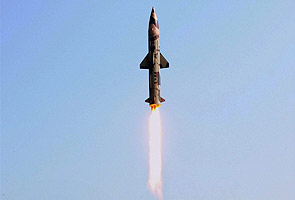
India's missile defence shield ready: Defence Research and Development Organisation

May 7, 2012
prithvi2_295

New Delhi, May 7: India has developed its own missile defence shield which can be put in place at short notice to protect at least two cities, bringing the country at par with an elite group of few nations. The shield, developed by the Defence Research and Development Organisation (DRDO), has been tested successfully and an incoming ballistic missile with the range of up to 2,000 kms can be destroyed.

"The Ballistic Missile Defence (BMD) shield is now mature. We are ready to put phase one in place and it can be put in very short time," DRDO chief V K Saraswat told PTI in an interview.

He said the shield, as part of phase one of the programme, can be put in place in two cities in the country, where the infrastructure is available. However, the two places have not yet been identified and the selection will be made at the political level. The DRDO used variants of Prithvi missiles as simulated targets and successfully intercepted missiles in test-firings.

The system was first test-fired in November 2006 elevating India into the elite club of countries to have successfully developed an Anti-ballistic missile system, after United States, Russia and Israel.

"We have carried out six successful launches and demonstrated the capability for 2,000 km targets. We have demonstrated it in two layers that is endo-atmospheric (inside the Earth's atmosphere) and exo-atmospheric (outside the Earth's atmosphere)," Mr Saraswat said.

The DRDO chief said the Indian missile defence system is comparable with the US Patriot 3 system, which was successfully used during the 1990 Gulf War against Iraq.

He said all the elements such as long-range radars and tracking devices, real-time datalink and mission control system required for the missile system have been "realised" successfully.

Under the phase two of the project, the premier defence research agency would upgrade the system to handle ballistic missiles with range of 5,000 km. This phase is expected to be ready by 2016.

The system required for phase-II of the project is being developed, he said, adding that for this purpose, ships are being built from where the target missiles would be launched.

Talking about the advancement of the system, he said the missile defence shield has been "automated" to an extent where human intervention would be required only if the mission has to be aborted.

As part of its efforts to protect itself from enemy missiles, India is developing this two-tier BMD which can intercept enemy missiles at altitudes of 80 km and 150 km.

The DRDO is thinking of intercepting the missiles at higher altitudes as it would give it more response time in case the first attempt is a miss and the second layer of the system can be put into action.

Comments

Add new comment

  • Coastaldigest.com reserves the right to delete or block any comments.
  • Coastaldigset.com is not responsible for its readers’ comments.
  • Comments that are abusive, incendiary or irrelevant are strictly prohibited.
  • Please use a genuine email ID and provide your name to avoid reject.
News Network
February 28,2020

Feb 28: National oil marketer Indian Oil Corporation (IOC) on Friday said it is ready to supply low emission BS-VI fuels from April 1 and that there will be a marginal increase in retail prices.

The largest oil supplier has spent over Rs 17,000 crore to upgrade its refineries to produce the low-sulfur diesel and petrol, the company's chairman Sanjiv Singh told reporters here.

Without disclosing the quantum of price increase, Singh said, “there will definitely be a marginal increase in retail prices of the fuels from April 1 when the whole country will be run on new fuels, which will have a sulphur content of only 10 parts per million (ppm) as against the present 50 ppm.

“But let me assure you, we will not be burdening the consumers with a steep hike,” Singh said.

He said, state-run oil marketing companies (OMCs) have invested Rs 35,000 crore to upgrade their refineries, of which Rs 17,000 crore have been spent by IOC alone.

Earlier this week, the sell-off bound BPCL said it had invested around Rs 7,000 crore for the same. ONGC-run HPCL has not so far disclosed its readiness for BS-VI supplies or its capex on the same.

HPCL had said from February 26-27 it was ready with BS-VI fuels and that it would sell only the new fuels from March 1.

IOC switched to BS-VI fuel production a fortnight ago and all its depots and containers are ready now, Singh said.

However, he said some remote locations, where the intake is very low, will take some more time to switch. But the company is planning to drain out the entire BS-IV stock and replenish the new fuels at such locations, he added.

Further, it has been reported that the companies will have to increase prices by 70-120 paise a litre, but Singh said, to arrive such a weighted average is not possible given the complexities of each refinery.

He, however, asserted that the price hike will not be a burden on consumers.

We are not looking at this investment from a pure return on investment basis, but this is a national mandate and we have done it.

Having said that, all those countries that moved to low emission fuels are charging higher prices; and from April 1, our prices will also be benchmarked against Euro VI prices as against the present practice of the cost-plus model, Singh concluded.

Comments

Add new comment

  • Coastaldigest.com reserves the right to delete or block any comments.
  • Coastaldigset.com is not responsible for its readers’ comments.
  • Comments that are abusive, incendiary or irrelevant are strictly prohibited.
  • Please use a genuine email ID and provide your name to avoid reject.
Agencies
May 1,2020

New Delhi, May 1: Amid the lockdown due to the COVID-19 pandemic, the University Grants Commission (UGC) and the Human Resource Development Ministry are planning to conduct the PhD and MPhil exams through online mediums in various universities across the country. The universities have been informed by the UGC and the MHRD about this.

Union Human Resource Development Minister Ramesh Pokhriyal 'Nishank' said, "Phd, MPhil exams, practicals, viva etc can be conducted through Skype or any other meeting apps."

When this system is implemented in colleges, students will not have to wait long for various types of examinations. Especially internal examinations can be taken online. Students' viva tests can also be conducted via Skype or any other similar meeting apps.

Regular classes in the universities will resume after the lockdown is removed. The classes for the first year will start from September 1 while for the second and third years the classes will start from August 1. However, students of various colleges will have to appear for basic exams in July.

A special committee constituted by the UGC has emphasized on conducting examinations online. The committee in its recommendation said that various colleges and universities should conduct online examinations including internal exams of colleges for 25 per cent marks.

The National Testing Agency (NTA), on the advice of the Ministry of Human Resource Development, has extended the date of filling the entrance examination forms for various universities.

According to the orders of the NTA, the date of filling the form for the entrance examinations of Jawaharlal Nehru University, National Council for Hotel Management 'G' and for Phd and MBA from IGNOU has been extended till May 15.

Comments

Add new comment

  • Coastaldigest.com reserves the right to delete or block any comments.
  • Coastaldigset.com is not responsible for its readers’ comments.
  • Comments that are abusive, incendiary or irrelevant are strictly prohibited.
  • Please use a genuine email ID and provide your name to avoid reject.
News Network
June 1,2020

Jun 1: Gold prices rose on Monday as riots in major U.S. cities rattled investors already reeling from strained Sino-U.S. relations and boosted demand for the safe-haven metal, with a weaker dollar lending further support.

Spot gold gained 0.8% to $1,739.75 per ounce by 0242 GMT. U.S. gold futures ticked up 0.1% to $1,752.60.

"Concerns about the unrest in the United States at the moment appear to be weighing on market sentiment," said Michael McCarthy, chief strategist at CMC Markets, adding that rising tensions between the world's top two economies provided further support to gold.

Protesters have flooded the streets in the United States over the death of George Floyd in police custody, in a wave of outrage sweeping a politically and racially divided nation.

The closely packed crowds and demonstrators not wearing masks have sparked fears of a resurgence of COVID-19, which has killed more than 101,000 Americans.

In Asia, China's state media and the government of Hong Kong lashed out on Sunday at U.S. President Donald Trump's pledge to end Hong Kong's special status if Beijing imposes new national security laws on the city.

Gold is often used as a safe store of value during times of political and financial uncertainty.

Indicative of sentiment, holdings of SPDR Gold Trust, the world's largest gold-backed exchange-traded fund, rose 0.3% to 1,123.14 tonnes on Friday, a fresh seven-year high.

Further supporting gold's appeal, the dollar index fell 0.4% against its rivals.

Elsewhere, silver jumped 2% to $18.20 per ounce, its highest since Feb. 26, before retreating slightly to trade 1.8% higher at $18.16.

Speculators cut their bullish positions in COMEX gold and increased them in silver contracts in the week to May 26, the U.S. Commodity Futures Trading Commission said on Friday.

Palladium rose 0.7% to $1,958.25 per ounce, while platinum declined 0.3% to $835.56.

Comments

Add new comment

  • Coastaldigest.com reserves the right to delete or block any comments.
  • Coastaldigset.com is not responsible for its readers’ comments.
  • Comments that are abusive, incendiary or irrelevant are strictly prohibited.
  • Please use a genuine email ID and provide your name to avoid reject.