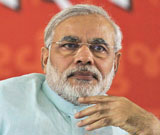
Gujarat riots: Probe Modi, says Supreme Court amicus curiae

May 7, 2012

narendra-modi

New Delhi/Ahmedabad, May 7: Gujarat Chief Minister Narendra Modi's role in the 2002 riots in the state should be probed, Raju Ramachandran, the amicus curiae appointed by the Supreme Court in the case, has said in his final report.

According to the report dated July 25, 2011 which was released Monday, there was a need for examining Modi's role in the wake of the Godhra train burning to find out whether a message was mesage was conveyed that the state machinery would not step in to prevent the communal riots that followed.

Ramachandran says the chairman of the Supreme Court-appointed Special Investigation Team (SIT) had found that a meeting had indeed taken place at Modi's residence at 11 p.m. on February 27, 2002 that was attended by senior bureaucrats and police officers.

The report terms as incorrect the claim of Indian Police Service officer Sanjiv Bhatt, the then Deputy Commissioner of Police (Intelligence), that he was present at the meeting.

Meanwhile, a court in Ahmedabad on Monday handed over a copy of the SIT report on the Gulbarg Society massacre to Zakia Jafri, a month after the SIT found no prosecutable evidence against Modi. The report is 25,000-pages long.

The court has asked Jafri to file an application on May 10 if she feels there are discrepancies in the report or that documents are incomplete. Jafri has asked for two months' time before arguments can begin in the case.

The SIT report had sought a closure in the probe as it found no evidence against Modi.

Zakia Jafri is the widow of former Congress MP Ehsan Jafri who was among 69 persons killed in the Gulbarg society carnage. She had named Modi and 57 others for alleged criminal conspiracy in the 2002 riots. Zakia has also been given a copy of the amicus curiae's report.

Comments

Add new comment

  • Coastaldigest.com reserves the right to delete or block any comments.
  • Coastaldigset.com is not responsible for its readers’ comments.
  • Comments that are abusive, incendiary or irrelevant are strictly prohibited.
  • Please use a genuine email ID and provide your name to avoid reject.
News Network
January 12,2020

Patna, Jan 12: Prashant Kishor, national vice-president of the Janata Dal (United), a key ally of the BJP-led NDA, has thanked Congress general secretary Priyanka Gandhi and former AICC chief Rahul Gandhi for their support in opposing CAA (Citizenship Amendment Act) and NRC (National Register of Citizens).

Perceived as one of the closest associates of Bihar Chief Minister Nitish Kumar, who is also the party’s national president, PK (as Prashant is fondly called) also assured the two top Congress leaders that the contentious legislation would not be implemented in Bihar where JD (U) is ruling the State with the support of the BJP.

“I join my voice with all to thank #Congress leadership for their formal and unequivocal rejection of #CAA_NRC. Both @rahulgandhi and @priyankagandhi deserve special thanks for their efforts on this count….also would like to reassure to all – CAA/NRC won’t be implemented in Bihar,” tweeted PK on Sunday.

The development assumes significance as a day back, the Congress Working Committee (CWC) meeting, chaired by Sonia Gandhi, had strongly opposed CAA/NRC/NPR as it was aimed at “sinister design of the present regime to divide Indian people into religious lines.”

The latest tweet by PK is also being seen as a rebuff to the BJP, which again recently reiterated that “the BJP should project its own chief ministerial candidate during the 2020 Bihar Assembly elections.”

The JD (U) had taken umbrage over such provocative statements by BJP leaders and asked the saffron camp to rein in its ‘loudmouths’ as BJP chief Amit Shah had already made it clear that the next Assembly polls in Bihar would be fought under the leadership of Nitish.

Of late, PK has been quite vocal about his opposition to the Centre’s policies, particularly the contentious issues of NRC and CAA. Besides, he even dubbed senior BJP leader Sushil Modi as the man who became Bihar’s Deputy Chief Minister due to ‘circumstances’ as the BJP was decisively decimated during the 2015 Assembly elections.

Nitish never reprimanded PK for his jibe against Modi, thereby giving rise to speculations whether Bihar was again heading for a political churning ahead of Assembly polls slated for October this year.

Comments

Add new comment

  • Coastaldigest.com reserves the right to delete or block any comments.
  • Coastaldigset.com is not responsible for its readers’ comments.
  • Comments that are abusive, incendiary or irrelevant are strictly prohibited.
  • Please use a genuine email ID and provide your name to avoid reject.
News Network
January 24,2020

New Delhi, Jan 24: Although India's Ujjwala programme encouraged adoption of liquefied petroleum gas (LPG) for cooking among the poor, households availing the scheme have not shifted away from using highly polluting fuels like firewood, a study reveals.

The researchers, including those from the University of British Columbia (UBC) in Canada, found that additional incentives to encourage regular use of cooking gas are necessary for a complete transition to clean cooking fuel among poor rural households.

They noted that about 2.9 billion people across Asia, Africa, and Latin America burn solid fuels like firewood to meet their cooking energy needs.

This has significant negative implications for public health, the environment, and societal development, according to the researchers.

Through the Pradhan Mantri Ujjwala Yojana (PMUY), India has provided capital cost subsidies to poor women to adopt a clean-burning cooking fuel or LPG.

The researchers explained that within the first 40 months of the scheme, more than 80 million households obtained LPG stoves.

However, the full benefits of LPG adoption depend on near complete replacement of polluting fuels with LPG, according to a research-based policy brief published in the journal Nature Energy.

The scientists said this cannot be assumed solely on the basis of LPG presence in the household.

"Our research shows that Ujjwala was able to attract new consumers rapidly, but those consumers did not start using LPG on a regular basis," Abhishek Kar, a postdoc at Columbia University in the US, told PTI.

The study analysed LPG sales data for over 25,000 consumers, including PMUY beneficiaries, as well as general rural LPG consumers in Koppal district of Karnataka.

The scientists employed data covering all LPG purchases of PMUY beneficiaries through their first year in the programme.

They also assessed the general rural population's purchases during their first five years as consumers to assess the effect of experience on use.

The findings estimate that an average rural family needs to purchase five 14.2 kilogramme-cylinders annually to meet half of their cooking needs.

However, the study said just seven per cent of PMUY beneficiaries in Koppal purchased five or more cylinders annually, suggesting that the beneficiaries seldom use LPG.

The general (nonPMUY) consumers in this region use on average two times more LPG cylinders than PMUY beneficiaries, the researchers noted.

Yet, only 45 per cent of nonPMUY consumers use five or more cylinders per year -- even after several years of experience with LPG, they said.

The team assessed price and seasonal factors affecting LPG use among the general population over a three-year period.

It found that LPG consumers are sensitive to price and seasonality -- LPG cylinder refill rates are lower in the summer when agricultural activity is limited, and cash is scarce.

"There was no scheme incentives to promote use, except general LPG subsidies which is available to all, including the urban middle class," said Kar, who was a Ph.D. scholar at UBC when the research was published.

"If there is no additional income, what cost would a poor family on an already tight budget cut to pay for an extra expense on a regular basis.

"Ujjwala has started the scheme of 5 kg-cylinder in response, but the impact of that on LPG sales is still publicly unknown," he said.

These findings, the researchers noted, suggest the need for additional measures to promote regular LPG use for all rural populations.

Although the finding come from a single district in Southern India, it may also apply to other areas with similar socio-economic conditions, they said.

A more expansive evaluation of PMUY would help design targeted incentives to transform infrequent users to regular users, according to the researchers.


Comments

Add new comment

  • Coastaldigest.com reserves the right to delete or block any comments.
  • Coastaldigset.com is not responsible for its readers’ comments.
  • Comments that are abusive, incendiary or irrelevant are strictly prohibited.
  • Please use a genuine email ID and provide your name to avoid reject.
News Network
July 21,2020

New Delhi, Jul 21: With a spike of 37,148 cases and 587 deaths reported in India in the last 24 hours, the total number of COVID-19 cases stands at 11,55,191, according to the Union Ministry of Health and Family Welfare.

The total number of cases include 4,02,529 active cases, 7,24,578 cured/discharged/migrated and 28,084 deaths, the ministry informed.

Maharashtra remains the worst affected state with 3,18,695 cases and 12,030 deaths.
The second worst-hit state, Tamil Nadu has reported 1,75,678 COVID-19 cases so far while Delhi has reported 1,23,747 cases, according to the Health Ministry.

Meanwhile, as per the information provided by the Indian Council of Medical Research (ICMR), 1,43,81,303 samples have been tested for COVID-19 up to July 20. Of these 3,33,395 were tested yesterday.

Comments

Add new comment

  • Coastaldigest.com reserves the right to delete or block any comments.
  • Coastaldigset.com is not responsible for its readers’ comments.
  • Comments that are abusive, incendiary or irrelevant are strictly prohibited.
  • Please use a genuine email ID and provide your name to avoid reject.