



RBI tells exporters to sell dollars to give rupee a leg up

May 11, 2012

markets_india_rupee_14033010

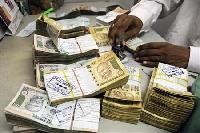
Mumbai, May 11: The Reserve Bank of India ordered exporters to convert half of their foreign exchange earnings kept in bank accounts into Indian rupee to prop up the worst-performing BRICS currency, a day after it closed at a record low, prompting fears of a further slide.

But the relief lasted only a few hours before the rupee resumed its decline since the order could bring in just about $3 billion, enough to cover five days of deficit.

The RBI also cut banks' intra-day positions in currency trade to five times of the net overnight open positions, which is set by the central bank as part of curbs announced on December 15. The overnight positions are not disclosed by the central bank.

More measures, including funding crude imports from foreign exchange reserves, a new US dollar mobilisation scheme, or even a sovereign dollar bond sale to boost the currency, could be on the cards, traders speculated.

The early rally faded soon with the rupee coming off highs of 52.95 to the US dollar to close at 53.44. Its all-time closing low was 53.83, on Wednesday.

Most currencies falling against dollar

Despite a series of measures from the central bank, many believe that weak macroeconomic variables such as fiscal and current account deficits, and worsening global liquidity due to deteriorating European sovereign credit crisis may diminish the effectiveness of its response.

"The RBI announced two measures that will ease, (and) slightly reverse near-term pressure on INR, but neither fixes the underlying problems that are causing INR to depreciate," said Rajiv Mallik, senior economist, CLSA Singapore. "Further, USD squeeze also has adverse implications for onshore INR liquidity."

Half the balances in the so-called Exchange Earners' Foreign Currency (EEFC) accounts should be converted into rupee balances within a fortnight and that holds true for future earnings as well, said the central bank in a notification. Exporters will be allowed to buy foreign exchange only after exhausting US dollar deposits in their accounts.

Most currencies are sliding against the greenback as global investors retreat to the safety of US dollar amid resurgence of doubts over the future of the Euro.

The rupee has been hurt more than others since India needs US dollars from outside to pay for imports as it does not export enough to pay for imports. Most big emerging countries have a surplus since they earn more US dollars from exports than needed to pay for imports.

"The facility of EEFC scheme is intended to enable exchange earners to save on conversion, transaction costs while undertaking forex transactions in future," said the central bank. "This facility is not intended to enable exchange earners to maintain assets in foreign currency, as India is still not fully convertible on capital account."

Some recent measures of the central bank are akin to its actions during the Asian crisis of 1997-98, when it ordered companies to bring in the proceeds of share sales in the form of Global Depository Receipts.

In December last year, the central bank brought in measures to curb speculation, which helped the rupee rally in the March quarter. It has reversed since due to the government's tax policies directed at overseas investors that have increased uncertainty and also because of lack of economic reforms.

With the current account deficit, the excess of imports over exports, at 4.3% of the gross domestic product and portfolio flows tapering off, the currency could be under renewed pressure if either exports do not rise sharply, or imports do not slow.

Both are unlikely now given the state of the economy. Subsidised petroleum products keep demand high, and import of gold continues due to high inflation expectation. Slowing European economies cap export growth.

Trade deficit for April stood at $13.4 billion in April, after hitting a record of $185 billion last fiscal. Exports rose 3.2% while imports grew 3.8% to $37.9 billion.

A breather could come in the form of unconventional measures, as in the past. "There could be some unconventional measures such as the IMD (India Millennium Deposits), or the RIB (Resurgent India Bonds)," said Rohit Bammi, partner at consultants KPMG. "There's a possibility of routing crude imports through foreign exchange reserves to take out the volatility."

At the turn of the century, India raised funds through the Resurgent India Bonds, and India Millennium Deposits to improve the reserves position. These involved paying high interest rates to lure overseas Indians.

Although neither the government nor the central bank has committed to such programmes, speculation is rife due to the sliding rupee. Indeed, some believe it may be the right time to float USD sovereign bonds that could bring in some fiscal discipline and also create a benchmark for Indian corporates keen to borrow overseas.

Comments

Add new comment

  • Coastaldigest.com reserves the right to delete or block any comments.
  • Coastaldigset.com is not responsible for its readers’ comments.
  • Comments that are abusive, incendiary or irrelevant are strictly prohibited.
  • Please use a genuine email ID and provide your name to avoid reject.
Agencies
July 23,2020

Jaipur, Jul 23: Four days after the Special Operation Group (SOG) sent a notice to Union minister Gajendra Singh Shekhawat in connection with the purported audio clips indicating his alleged involvement in horse trading of MLAs in Rajasthan, a city court has directed the Rajasthan police to probe a complaint alleging Shekhawat's role in a credit society scam worth Rs 840 crore.

The additional district judge Pawan Kumar, on Tuesday, directed the additional chief judicial magistrate's court to send the complaint against Shekhawat to the SOG.

Shekhawat, his wife and other partners have been named in the complaint in the Sanjivani Credit Cooperative Society scam in which around 50,000 investors allegedly lost about Rs 840 crore.

The Jaipur unit of the SOG has been probing the scam since last year after an FIR was registered on August 23, 2019.

Now, Jaipur ADJ Court-8 ordered a fresh inquiry in the case against Gajendra Singh accepting the revised application filed by Lagu Singh and Guman Singh and said that "this is a serious matter and hence SOG should investigate this".

Both the applicants had invested a huge amount in Sanjivani credit cooperative society.

It is alleged in the complaint that a multi-storey building has been built with the money instead of a theatre which was proposed earlier and many properties were also bought in Ethiopia with the money.

An SOG investigation also reveals that a large amount of money has been deposited into accounts of Shekhawat and his wife at different time spans, said sources.

Earlier, Shekhawat was not mentioned in the chargesheet filed by the SOG in connection with the case. Later, a magistrate's court also rejected the application to include him in the chargesheet. The applicants then approached the additional district judge's court with a revised application.

Comments

Add new comment

  • Coastaldigest.com reserves the right to delete or block any comments.
  • Coastaldigset.com is not responsible for its readers’ comments.
  • Comments that are abusive, incendiary or irrelevant are strictly prohibited.
  • Please use a genuine email ID and provide your name to avoid reject.
News Network
June 2,2020

New Delhi, Jun 2: Prime Minister Narendra Modi on Tuesday said India will definitely get its economic growth back as the government continues to pursue various reforms.

Speaking at industry association CII's annual session, he said the government has taken tough steps to fight the coronavirus pandemic and has also taken care of the economy.

"On the one hand we have to safe lives of our people and on the other hand we have to stabilise the economy and speed up the economy," he said.

He said he gets the confidence from farmers, small businesses and entrepreneurs for getting the economic growth back.

"Corona may have slowed our speed (of growth) but India has now moved ahead from lockdown with the phase one of unlock. Unlock Phase-1 has reopened a large part of the economy," he said.

He said intent, inclusion, investment, infrastructure and innovation are crucial for India to revert back to a high-growth trajectory.

Comments

Add new comment

  • Coastaldigest.com reserves the right to delete or block any comments.
  • Coastaldigset.com is not responsible for its readers’ comments.
  • Comments that are abusive, incendiary or irrelevant are strictly prohibited.
  • Please use a genuine email ID and provide your name to avoid reject.
News Network
March 6,2020

Mumbai, Mar 6: Harried Yes Bank depositors rushed to ATMs to withdraw cash but faced multitude of problems including closed down machines and long queues, after the RBI placed the bank under a moratorium, capping maximum withdrawals at Rs 50,000 per account for a month.

Aggravating the problems of depositors were difficulties accessing the internet banking channel, which ensured that they can't transfer the funds online as well. At an ATM in south Mumbai's Horniman Circle, with the RBI headquarters overlooking it, the shutters were pulled down.

The guard on duty said the machine was non-operational before he reported to work late in the evening and he was ordered to shut it after 2200 hrs. In the residential area of suburban Chembur, one ATM was dispensing cash but had a long queue of anxious depositors.

One man said it was still possible to withdraw up to Rs 50,000 in multiple transactions from the machine.

However, another machine nearby had run dry within minutes of the RBI announcement, a woman said.

The regulatory actions, undertaken by the RBI and the government, came hours after finance ministry sources confirmed that SBI was directed to bail out the troubled lender.

For the next month, Yes Bank will be led by the RBI-appointed administrator Prashant Kumar, an ex-chief financial officer of SBI.

Comments

Add new comment

  • Coastaldigest.com reserves the right to delete or block any comments.
  • Coastaldigset.com is not responsible for its readers’ comments.
  • Comments that are abusive, incendiary or irrelevant are strictly prohibited.
  • Please use a genuine email ID and provide your name to avoid reject.