



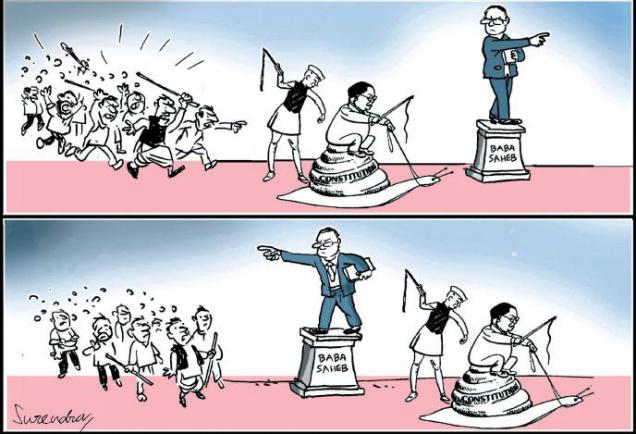
Scholars quit textbook body as government bans 1949 cartoon

May 12, 2012

cartoon

New Delhi, May 12: Two eminent scholars have resigned their positions as advisers to the National Council of Educational Research and Training (NCERT) after a furore in Parliament led Human Resource Development Minister Kapil Sibal to withdraw a book on the Constitution because it contained a cartoon some legislators said was offensive.

Yogendra Yadav and Suhas Palshikar, both eminent political scientists, resigned hours after the cartoon provoked a furore in Parliament.

The 11th-class textbook, Indian Constitution at Work, includes a cartoon which shows Dr. B.R. Ambedkar sitting on a snail, a whip in hand, while Prime Minister Jawaharlal Nehru stands behind him, also armed with a whip.

A caption accompanying the drawing, which was made by the legendary cartoonist K. Shankar Pillai in 1949, explains that it illustrated “the ‘snail's pace' with which the Constitution was made.”

Dr. Yadav said: “The heated and not very well-informed debate in Parliament did not do justice to the responsibility that a democratic society has towards future generations.” He pointed out that the decision implied “a law must be passed to ban all cartoons.” Dr. Palshikar was not available for comment.

Shankar regularly drew cartoons for his weekly, Shankar's Weekly. His depiction of Ambedkar and Nehru triggered no controversy at the time and his public service was recognised by successive governments which awarded him the Padma Shri, Padma Bhusan and Padma Vibhusan.

Furore in Parliament

Responding to the furore in both Houses, Mr. Sibal said he had “directed the NCERT to stop the distribution of these textbooks. A committee had been set up to review not just the cartoons but the content of these textbooks as well.” “For the next year,” Mr. Sibal assured MPs, “we will remove all these cartoons. But even this year, till we review the situation, the present textbooks will not be distributed.”

The government would not allow Dr. Ambedkar's memory to be “disparaged.” “When I got information [on this issue] in the beginning of April,” he said, “I wrote a letter to NCERT that such a cartoon should not be there as it is objectionable.” The government would also examine whether those who drew the allegedly objectionable cartoon had committed a criminal offence. Mr. Pillai died in 1989.

Earlier, Viduthalai Chiruthaigal Katchi member Thol. Thirumavalavan, who raised the issue in the Lok Sabha, said the cartoon had insulted both Nehru and Dr. Ambedkar. He sought Mr. Sibal's resignation and withdrawal of the book. In the Rajya Sabha, BSP leader Mayawati sought criminal action against those responsible.

Lok Jan Shakti Party leader Ram Vilas Paswan sought dismissal of those responsible for allowing the cartoon to be published.

Finance Minister Pranab Mukherjee described Dr. Ambedkar as the Ved Vyas of the Constitution, and said the cartoon was “totally wrong.”

D. Raja (CPI) said the matter was “serious” as tension prevailed in Tamil Nadu after this incident came to light.

The AIADMK, the CPI, the CPI(M), the SP, the RJD, the LJP, the BJP, the TDP and the BSP also joined in the attack on the textbook.

Comments

Add new comment

  • Coastaldigest.com reserves the right to delete or block any comments.
  • Coastaldigset.com is not responsible for its readers’ comments.
  • Comments that are abusive, incendiary or irrelevant are strictly prohibited.
  • Please use a genuine email ID and provide your name to avoid reject.
News Network
April 19,2020

New Delhi, Apr 19: The government on Sunday prohibited the sale of non-essential items through e-commerce platforms during the ongoing lockdown, four days after allowing such companies to sale mobile phones, refrigerators and ready-made garments.

Union Home Secretary Ajay Bhalla issued an order excluding the non-essential items from sale by the e-commerce companies from the consolidated revised guidelines, which listed the exemption given to the services and people from the purview of the lockdown.

The order said the following clause "E-commerce companies. Vehicles used by e-commerce operators will be allowed to ply with necessary permissions" is excluded from the guidelines.

The previous order had said such items were allowed for sale through e-commerce platforms from April 20.

However, the reason for reversing the order is not known immediately.

Comments

Add new comment

  • Coastaldigest.com reserves the right to delete or block any comments.
  • Coastaldigset.com is not responsible for its readers’ comments.
  • Comments that are abusive, incendiary or irrelevant are strictly prohibited.
  • Please use a genuine email ID and provide your name to avoid reject.
Agencies
June 6,2020

New Delhi, Jun 6: Bookings for select destinations in the USA, Canada, UK and Europe etc under Phase3 of Mission Vande Bharat opened at 5 pm on Friday, according to Air India.

"#FlyAI: Bookings for select destinations in USA, Canada, UK & Europe etc under Phase3 of #MissionVandeBharat opened at 5pm today. Around 60 million hits received till 7pm on our website & 1700 seats sold through website alone in 2 hrs. Bookings continue & tickets are being issued," the national carrier said in a tweet on Friday.

The third phase of the mission will begin from June 11 and continue till June 30.

Air India will operate five flights in the third phase of Vande Bharat Mission to evacuate almost 1,200 Indians nationals stranded in the United Kingdom between June 18 to June 23.

Air India will operate 70 flights in the third phase of Mission Vande Bharat to evacuate Indians stranded in the US and Canada between June 11 to June 30, Civil Aviation Minister Hardeep Singh Puri had said. 

Comments

Add new comment

  • Coastaldigest.com reserves the right to delete or block any comments.
  • Coastaldigset.com is not responsible for its readers’ comments.
  • Comments that are abusive, incendiary or irrelevant are strictly prohibited.
  • Please use a genuine email ID and provide your name to avoid reject.
News Network
April 23,2020

Washington, Apr 23: Air pollution over northern India has plummeted to a 20-year-low for this time of the year, according to satellite data published by US space agency National Aeronautics and Space Administration (NASA).
The US space agency's satellite sensors observed aerosol levels at a 20-year low post the countrywide lockdown, implemented to slow the spread of the novel coronavirus.

"We knew we would see changes in atmospheric composition in many places during the lockdown," said Pawan Gupta, a Universities Space Research Association (USRA) scientist at NASA''s Marshall Space Flight Center. "But I have never seen aerosol values so low in the Indo-Gangetic Plain at this time of year," added Mr Gupta.

Acting Assistant Secretary of State for South and Central Asia Alice G Wells tweeted, "These images from NASA were taken each spring starting in 2016 and show a 20-year low in airborne particle levels over India. When India and the world are ready to work and travel again, let's not forget that collaborative action can result in cleaner air."

The data published with maps show aerosol optical depth (AOD) in 2020 compared to the average for 2016-2019. Aerosol optical depth is a measure of how light is absorbed or reflected by airborne particles as it travels through the atmosphere.

If aerosols are concentrated near the surface, an optical depth of 1 or above indicates very hazy conditions. An optical depth, or thickness, of less than 0.1 over the entire atmospheric vertical column is considered "clean." The data were retrieved by the Moderate Resolution Imaging Spectroradiometer (MODIS) on NASA's Terra satellite.

In the first few days of the lockdown, it was difficult to observe a change in the pollution signature. "We saw an aerosol decrease in the first week of the shutdown, but that was due to a combination of rain and the lockdown," said Mr Gupta.

Around March 27, heavy rain poured over vast areas of northern India and helped clear the air of aerosols. Aerosol concentrations usually increase again after such heavy precipitation.

"After the rainfall, I was really impressed that aerosol levels did not go up and return to normal. We saw a gradual decrease and things have been staying at the level we might expect without anthropogenic emissions," Mr Gupta said.

On March 25, the Indian government placed its 1.3 billion citizens under a strict lockdown to reduce the spread of COVID-19. The countrywide mandate decreased activity at factories and severely reduced car, bus, truck and airplane traffic. Every year, aerosols from anthropogenic (human-made) sources contribute to unhealthy levels of air pollution in many Indian cities.

Aerosols are tiny solid and liquid particles suspended in the air that reduce visibility and can damage the human lungs and heart.

In southern India though, the story is a little hazier. Satellite data show aerosol levels have not yet decreased to the same extent. In fact, levels seem to be slightly higher than in the past four years. The reasons are unclear but could be related to recent weather patterns, agricultural fires, winds or other factors.

"This a model scientific experiment," Robert Levy, program leader for NASA's MODIS aerosol products, said about the lockdown and its effects on pollution.

"We have a unique opportunity to learn how the atmosphere reacts to sharp and sudden reductions in emissions from certain sectors. This can help us separate how natural and human sources of aerosols affect the atmosphere," Mr Levy added.

Comments

Add new comment

  • Coastaldigest.com reserves the right to delete or block any comments.
  • Coastaldigset.com is not responsible for its readers’ comments.
  • Comments that are abusive, incendiary or irrelevant are strictly prohibited.
  • Please use a genuine email ID and provide your name to avoid reject.