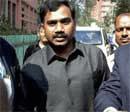
After 15 months in jail, Raja gets bail

May 15, 2012

raja_copy

New Delhi, May 15: Former telecommunications minister A. Raja was Tuesday granted bail in the 2G spectrum allocation case. He is the last of the 14 individuals charged in the case still in prison.

The bail was granted by Central Bureau of Investigation (CBI) special judge O.P. Saini. Raja has been in the capital's Tihar jail since February last year. Raja's counsel told reporters that the judge called Raja towards him and told him: "Your bail application is allowed."

The announcement triggered wild slogan shouting and cheering by his DMK supporters mainly from Tamil Nadu, who raised slogans in Tamil like: "Raja, vazhga!" (Long Live Raja!)

Besides the 14 individuals, three companies were also charged in the case. "Thirteen people had already got bail, and Raja was the last to get bail," the counsel said.

"Raja had not moved bail until all other 13 were granted bail," he added. "Now all the accused are on bail. The case will go on."

The counsel pointed out that Raja had got bail despite the CBI's opposition. The CBI had opposed Raja's bail application, saying he faced charges of accepting bribes of Rs.200 crore, which makes his case different from former telecom secretary Siddharth Behura, who was granted bail by the Supreme Court last week.

Raja, in his bail application, has requested the court to release him on the ground of parity. The agency said that important prosecution witnesses of department of telecommunications and other private people, especially connected to alleged bribe transaction of Rs. 200 crore from DB Group companies to Kalaignar TV, are yet to be examined.

It told the court that if the accused was released on bail at this crucial stage of trial, then he may influence the vital witness as some of them belong to his state Tamil Nadu.

Raja resigned as minister Nov 14, 2010 in the wake of the Comptroller and Auditor General reporting that his 2008 decision to allocate 2G spectrum on a first-come-first-served basis had caused the exchequer a presumptive loss of Rs.1.76 lakh crore. The CBI arrested him Feb 2, 2011.

The Supreme Court in February cancelled 122 spectrum licences allocated during Raja's tenure. It also ruled that all natural resources should be allocated through an auction, which the government is now preparing to do in the case of the cancelled licences.

Comments

Add new comment

  • Coastaldigest.com reserves the right to delete or block any comments.
  • Coastaldigset.com is not responsible for its readers’ comments.
  • Comments that are abusive, incendiary or irrelevant are strictly prohibited.
  • Please use a genuine email ID and provide your name to avoid reject.
News Network
February 12,2020

Washington, Feb 12: US President Donald Trump said on Tuesday he would sign a trade deal with Prime Minister Narendra Modi if 'it was the right one'.

The two countries have been trying to reach a limited trade pact with lower tariffs, but talks have run into problems over issues with data privacy and e-commerce controls.

Trump further said that he is looking forward to his visit to India later this month where millions of people would welcome him. "He (Modi) is a great gentleman and I look forward to going to India. So, we'll be going at the end of the month," Trump told reporters in his Oval Office, a day after the White House announced dates of his anticipated India trip.

Responding to a question, the president indicated that he is willing to sign a trade deal with India if it is the right one. "They (Indians) want to do something and we'll see... if we can make the right deal, (we) will do it," said Trump, a fortnight ahead of his visit to the country as the 45th US president.

India's new Ambassador to the US, Taranjit Singh Sandhu told PTI that Trump's forthcoming visit is a "reflection of the strong personal rapport" between Trump and Modi. "It also demonstrates their strong desire to take the relationship to new heights," said Sandhu, who had presented his credentials to Trump in Oval Office last week.

Over the last three years, Trump and Modi have developed a personal friendship and in 2019, the duo met four times including their joint address before a strong 50,000 crowd of Indian Americans in Houston.

This year, they have spoken over the phone on two occasions, including the one over the weekend. "Just spoke with Prime Minister Modi," Trump told reporters on Tuesday in response to a question on his India visit.

Excited to travel to India later this month, said Trump referring to his conversation with Modi during which the prime minister apparently told him about the hundreds and thousands of Indians who would be there to welcome him in Ahmedabad.

Trump jokingly told reporters that now he will "not feel good" about the size of the crowd that he addresses in the US which is usually between 40,000 to 50,000. "He (Modi) said we will have millions and millions of people. My only problem is that last night we probably had 40 or 50,000 people... I'm not going to feel so good... There will be five to seven million people just from the airport to the new stadium (in Ahmedabad)," Trump said.

"And you know (it) is the largest stadium in the world. He's (Modi) building it now. It's almost complete and it's the largest in the world," Trump said. The two leaders are expected to joint address a massive public rally at the newly build Motera Stadium in Ahmedabad.

Being built at an estimated cost of USD 100 million, the Motera Stadium with a seating capacity of 100,000 spectators will be the world's largest cricket stadium overtaking the Melbourne Cricket Ground in Australia.

Comments

Ahmed Ali
 - 
Wednesday, 12 Feb 2020

Waste of money and time.....!!!

Add new comment

  • Coastaldigest.com reserves the right to delete or block any comments.
  • Coastaldigset.com is not responsible for its readers’ comments.
  • Comments that are abusive, incendiary or irrelevant are strictly prohibited.
  • Please use a genuine email ID and provide your name to avoid reject.
News Network
June 9,2020

Jun 9: Prime Minister Narendra Modi wants all 1.3 billion Indians to be “vocal for local” — meaning, to not just use domestically made products but also to promote them. As an overseas citizen living in Hong Kong, I’m doing my bit by very vocally demanding Indian mangoes on every trip to the grocery. But half the summer is gone, and not a single slice so far.

My loss is due to India’s COVID-19 lockdown, which has severely pinched logistics, a perennial challenge in the huge, infrastructure-starved country. But more worrying than the disruption is the fruity political response to it. Rather than being a wake-up call for fixing supply chains, the pandemic seems to be putting India on an isolationist course. Why?

Granted that the liberal view that trade is good and autarky bad isn’t exactly fashionable anywhere right now. What makes India’s lurch troublesome is that the pace and direction of economic nationalism may be set by domestic business interests. The Indian liberals, many of whom are Western-trained academics, authors and — at least until a few years ago — policy makers, want a more competitive economy. They will be powerless to prevent the slide.

Modi’s call for a self-reliant India has been echoed by Home Minister Amit Shah, the cabinet’s unofficial No. 2, in a television interview. If Indians don’t buy foreign-made goods, the economy will see a jump, he said. The strategy — although it’s too nebulous yet to call it that — has a geopolitical element. A military standoff with China is under way, apparently triggered by India’s completion of a road and bridge near the common border in the tense Himalayan region of Ladakh. It’s very expensive to fight even a limited war there. With India’s economy flattened by COVID, New Delhi may be looking for ways to restore the status quo and send Beijing a signal.

Economic boycotts, such as Chinese consumers’ rejection of Japanese goods over territorial disputes in the East China Sea, are well understood as statecraft. In these times, it’s not even necessary to name an enemy. An undercurrent of popular anger against China, the source of both the virus and India’s biggest bilateral trade deficit, is supposed to do the job. But is it ever that easy?

A hastily introduced policy to stock only local goods in police and paramilitary canteens became a farcical exercise after the list of banned items ended up including products by the local units of Colgate-Palmolive Co., Nestle SA, and Unilever NV, which have had significant Indian operations for between 60 and 90 years, as well as Dabur India Ltd., a New Delhi-based maker of Ayurveda brands. The since-withdrawn list demonstrates the practical difficulty of bureaucrats trying to find things in a globalized world that are 100% indigenous.

Free-trade champions fret that the prime minister, whom they saw as being on their side six years ago, is acting against their advice to dismantle statist controls on land, labor and capital to help make the country more competitive. Engage with the world more, not less, they caution. But Modi also has to satisfy the Rashtriya Swayamsevak Sangh, the umbrella Hindu organisation that gets him votes. Its backbone of small traders, builders and businessmen — the RSS admits only men — was losing patience with the anemic economy even before the pandemic. Now, they’re in deep trouble, because India’s broken financial system won’t deliver even state-guaranteed loans to them.

The U.S.-China tensions — over trade, intellectual property, COVID responsibility and Hong Kong’s autonomy — offer a perfect backdrop. A dire domestic economy and trouble at the border provide the foreground. Big business will dial economic nationalism up and down to hit a trifecta of goals: Block competition from the People's Republic; make Western rivals fall in line and do joint ventures; and tap deep overseas capital markets. The first goal is being achieved with newly placed restrictions on investment from any country that shares a land border with India. The second aim is to be realized by corporate lobbying to influence India's whimsical economic policies. As for the third objective, with the regulatory environment becoming tougher for U.S.-listed Chinese companies like Alibaba Group Holding Ltd., an opportunity may open up for Indian firms.

All this may bring India Shenzhen-style enclaves of manufacturing and trade, but it will concentrate economic power in fewer hands, something that worries liberals. They’re moved by the suffering of India’s low-wage workers, who have borne the brunt of the COVID shutdown. But when their vision of a more just society and fairer income distribution prompts them to make common cause with the ideological Left, they’re quickly repelled by the Marxist voodoo that all cash, property, bonds and real estate held by citizens or within the nation “must be treated as national resources available during this crisis.” Who will invest in a country that does that instead of just printing money?

At the same time, when liberals look to the business class, they see a sudden swelling of support for ideas like a universal basic income. They wonder if this isn’t a ploy by industry to outsource part of the cost of labor to the taxpayer. Slogans like Modi’s vocal-for-local stir the pot and thicken the confusion. The value-conscious Indian consumer couldn’t give two hoots for calls to buy Indian, but large firms will know how to exploit economic nationalism. One day soon, I’ll get my mangoes — from them.


Comments

Add new comment

  • Coastaldigest.com reserves the right to delete or block any comments.
  • Coastaldigset.com is not responsible for its readers’ comments.
  • Comments that are abusive, incendiary or irrelevant are strictly prohibited.
  • Please use a genuine email ID and provide your name to avoid reject.
News Network
March 20,2020

New Delhi, Mar 20: The four men convicted of the gang rape and murder of a Delhi woman on December 16, 2012 were hanged in the darkness of pre-dawn on Friday, ending a horrific chapter in India's long history of sexual assault that had seared the nation's soul. Mukesh Singh (32), Pawan Gupta (25), Vinay Sharma (26) and Akshay Kumar Singh (31) were executed at 5.30 am for the savage assault in an empty moving bus on the 23-year-old physiotherapy intern who came to be known the world over as Nirbhaya, the fearless one.

This is the first time that four men have been hanged together in Tihar Jail, South Asia's largest prison complex that houses more than 16,000 inmates. The executions were carried out after the men exhausted every possible legal avenue to escape the gallows. Their desperate attempts only postponed the inevitable by less than two months after the first date of execution was set for January 22.

They were hanged at 5.30 am, Director General of Prison Sandeep Goel said.

After raping and brutalising the woman, the men, one of whom was a juvenile at the time, dumped her on the road and left for dead on the cold winter night. Her friend who was with her was also severely beaten and thrown out along with her. She was so severely violated that her insides were spilling out when she was taken to hospital. She died in a Singapore hospital after battling for her life for a fortnight.

Six people, including the four convicts and the juvenile, were named as accused.

While Ram Singh allegedly committed suicide in the Tihar Jail days after the trial began in the case, the juvenile was released in 2015 after spending three years in a correctional home.

The road to the gallows was a long and circuitous one, going through the lower courts, the High Court, the Supreme Court and the president's office before going back to the Supreme Court that heard and rejected various curative petitions.

The death warrants were deferred by a court thrice on the grounds that the convicts had not exhausted all their legal remedies and that the mercy petition of one or the other was before the president.

On March 5, a trial court issued fresh death warrants for March 20 at 5.30 am as the final date for the execution.

Comments

Add new comment

  • Coastaldigest.com reserves the right to delete or block any comments.
  • Coastaldigset.com is not responsible for its readers’ comments.
  • Comments that are abusive, incendiary or irrelevant are strictly prohibited.
  • Please use a genuine email ID and provide your name to avoid reject.