


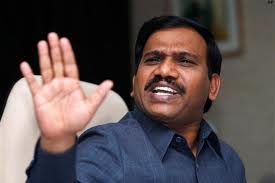
After 15 months in jail, Raja gets bail

May 15, 2012

raja_copy_copy


New Delhi, May 15: Former telecommunications minister A. Raja was Tuesday granted bail in the 2G spectrum allocation case. He is the last of the 14 individuals charged in the case still in prison.

The bail was granted by Central Bureau of Investigation (CBI) special judge O.P. Saini. Raja has been in the capital's Tihar jail since February last year. Raja's counsel told reporters that the judge called Raja towards him and told him: "Your bail application is allowed."

The announcement triggered wild slogan shouting and cheering by his DMK supporters mainly from Tamil Nadu, who raised slogans in Tamil like: "Raja, vazhga!" (Long Live Raja!)

Besides the 14 individuals, three companies were also charged in the case. "Thirteen people had already got bail, and Raja was the last to get bail," the counsel said.

"Raja had not moved bail until all other 13 were granted bail," he added. "Now all the accused are on bail. The case will go on."

The counsel pointed out that Raja had got bail despite the CBI's opposition. The CBI had opposed Raja's bail application, saying he faced charges of accepting bribes of Rs.200 crore, which makes his case different from former telecom secretary Siddharth Behura, who was granted bail by the Supreme Court last week.

Raja, in his bail application, has requested the court to release him on the ground of parity. The agency said that important prosecution witnesses of department of telecommunications and other private people, especially connected to alleged bribe transaction of Rs. 200 crore from DB Group companies to Kalaignar TV, are yet to be examined.

It told the court that if the accused was released on bail at this crucial stage of trial, then he may influence the vital witness as some of them belong to his state Tamil Nadu.

Raja resigned as minister Nov 14, 2010 in the wake of the Comptroller and Auditor General reporting that his 2008 decision to allocate 2G spectrum on a first-come-first-served basis had caused the exchequer a presumptive loss of Rs.1.76 lakh crore. The CBI arrested him Feb 2, 2011.

The Supreme Court in February cancelled 122 spectrum licences allocated during Raja's tenure. It also ruled that all natural resources should be allocated through an auction, which the government is now preparing to do in the case of the cancelled licenses.

Comments

Add new comment

  • Coastaldigest.com reserves the right to delete or block any comments.
  • Coastaldigset.com is not responsible for its readers’ comments.
  • Comments that are abusive, incendiary or irrelevant are strictly prohibited.
  • Please use a genuine email ID and provide your name to avoid reject.
News Network
June 2,2020

New Delhi, Jun 2: Congress leader Rahul Gandhi on Monday took a jibe at Prime Minister Narendra Modi over Moody's Investors Service downgrading India's sovereign rating to the lowest investment rate and said that the global rating agency has rated his handling of the country's economy "a step above junk".

"Moody's has rated Modi's handling of India's economy a step above JUNK. Lack of support to the poor and the MSME sector means the worst is yet to come," the Congress leader tweeted citing a media report on Moody's downgrading the nation.

On Monday, Moody's downgraded the country's rating to "Baa3" from "Baa2". This comes at a time when the government is facing criticism from the Opposition over its handling of the COVID-19 situation and measures to boost the economy.

The government has already announced a stimulus package of Rs 20 lakh crore to deal with the situation.

Comments

Add new comment

  • Coastaldigest.com reserves the right to delete or block any comments.
  • Coastaldigset.com is not responsible for its readers’ comments.
  • Comments that are abusive, incendiary or irrelevant are strictly prohibited.
  • Please use a genuine email ID and provide your name to avoid reject.
News Network
June 25,2020

India has jumped past 4.5 lakh coronavirus cases and 14,476 people have succumbed to the viral infection so far. In this backdrop, speaking to IANS in an exclusive interview, AIIMS Director Randeep Guleria said India is also vulnerable to second wave of coronavirus and people should continue to follow social distancing, wearing mask and other precautions, after cases begin to decline.

He added that in order to contain the outbreak of Covid-19, a limited lockdown in hotspots, where volume of cases is very high, may be considered along with a micro-plan to prevent leakage of cases from these areas to other non-containment areas. Excerpts of the interview are below:

Q: Reports say China and South Korea are witnessing a second wave of coronavirus infection, what is this second wave, is India also vulnerable to this?

A: When cases come down significantly, people tend to drop their guard against the viral infection, and this leads to the second wave (which means a sudden increase in the number of cases). After cases begin to decline, people should continue to follow the precautions -- continue to maintain social distancing and wear masks regularly. See what happened in Singapore, it was struck by a second wave of coronavirus. Look, what happened in the 1918 pandemic, people dropped their guard and the second wave of viral infection struck back. If people do not follow social distancing then the spike in cases is apparent. We need to take these precautions at least for one year. India is also vulnerable to this second wave.

Q: If Covid-19 cases continue to rise rapidly, do you think we need another lockdown in areas where volume of cases are very high?

A: A large volume of cases is concentrated in specific areas like hotspots, and in order to maintain things in order, we may need a limited lockdown in these areas. This should be followed by a micro-plan which entails extensive testing of people and also extensive contact tracing of people who have got in touch with positive people. Need to ensure there is no leakage of cases from these areas. People from these areas should not mix with others in non-containment areas. This will aid in containing the outbreak of the virus. People who have developed symptoms should get themselves tested, especially in the containment areas.

Q: With more than 4.5 lakh cases and close to 14,500 deaths, do you think India has reached its peak and a decline in cases is prominent?

A: The cases will continue to increase for some time. The doubling time of cases has also increased. But, the cases will also begin to flatten. Though, it is difficult to give an exact time period in this viral infection, it seems, the growth in cases will flatten in the end of July or beginning of August. A decline will come to this viral infection, but it does not mean that people should drop their guard. As a measure, we need to decrease community participation and citizens should continue to follow social distancing. People should get themselves tested. All these efforts will help in preventing people from contracting this virus. These precautions will also prevent us from the second wave, and we must continue to take precautions. The virus has not gone away, it is still lurking.

Q: India has crossed the 4.5 lakh coronavirus cases so far, although our recovery rate is good, but still 10,000 to 15,000 cases are reported daily. Why do cases continue to spiral, what is the reason?

A: We have to remember a few things -- the bulk of cases are in 10 cities, nearly 70 per cent, and if we take into account cases per million population, the number is not very high, as compared with countries including countries in Europe. Many European countries put together still do not add up to the Indian population. Do not compare India to countries like Italy, Spain etc. We need to focus on hotspots, which contribute to between 70 -80 per cent of cases, and we have to identify cases in these areas at an early stage. The population density is very high in these cities. People in lower socio-economic status are highly vulnerable to the viral infection, as many live together in small spaces and there is a lot of mixing of people happening there. Look at the market places, people are not following social distancing and not wearing masks. In fact, many are in close vicinity of each other.

Comments

Add new comment

  • Coastaldigest.com reserves the right to delete or block any comments.
  • Coastaldigset.com is not responsible for its readers’ comments.
  • Comments that are abusive, incendiary or irrelevant are strictly prohibited.
  • Please use a genuine email ID and provide your name to avoid reject.
News Network
April 19,2020

New Delhi, Apr 19: The government on Sunday prohibited the sale of non-essential items through e-commerce platforms during the ongoing lockdown, four days after allowing such companies to sale mobile phones, refrigerators and ready-made garments.

Union Home Secretary Ajay Bhalla issued an order excluding the non-essential items from sale by the e-commerce companies from the consolidated revised guidelines, which listed the exemption given to the services and people from the purview of the lockdown.

The order said the following clause "E-commerce companies. Vehicles used by e-commerce operators will be allowed to ply with necessary permissions" is excluded from the guidelines.

The previous order had said such items were allowed for sale through e-commerce platforms from April 20.

However, the reason for reversing the order is not known immediately.

Comments

Add new comment

  • Coastaldigest.com reserves the right to delete or block any comments.
  • Coastaldigset.com is not responsible for its readers’ comments.
  • Comments that are abusive, incendiary or irrelevant are strictly prohibited.
  • Please use a genuine email ID and provide your name to avoid reject.