



Food prices double in UPA’s term

May 16, 2012

hitting_roof

New Delhi, May 16: If inflation has broken the back of the aam aadmi, the biggest contributor to the pain in the UPA's term is food prices.

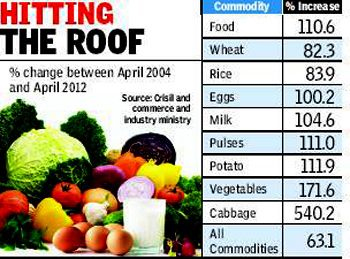
Government data on wholesale price index (WPI) shows that there has been a 63% increase in the price of all commodities between April 2004, a month before UPA took charge, and April 2012, the latest period for which data is available. But when it comes to food products, the index has more than doubled from 98 to 206.4. So, you are now spending at least twice the amount you spent in April 2004 just to meet your basic consumption needs.

Of the 60-odd items analyzed by TOI and Crisil, there is just one case - ginger - where the price has decreased, going by the index. In all other cases, there has been an increase. Within these commodities, there are only eight products - guava, coconut, garlic, papaya, onions, turmeric, tea and chicken - where the rise in prices is less than 63%.

For households, especially the poor, food inflation can have the most damaging impact, given that a bulk of spending in the lower income strata is on this segment. While the poor can draw some comfort from the fact that cereal prices are not among the commodities which have seen the maximum jump, the overall increase is still over 90% with wheat and rice, on an average, seeing over 80% increase.

While protein-rich items such as milk, egg, meat and fish have seen prices more than double, it is vegetables that have caused the maximum dent to the housewife's monthly budget. This segment has seen a 171% jump. So, if you spent Rs 3,000 a month on vegetables seven years ago, you would now be spending over Rs 5,000. Given that cabbage now costs six-and-a-half times more than April 2004, you can draw comfort from the fact that during this period, potato and brinjal prices have only gone up by 111% and 140%, respectively. Similarly, bhindi now costs four-and-a-half times more.

Even fruits have seen a lower spurt of around 90% with prices of mangoes, oranges, apples and pineapple more than doubling. When it comes to spices, black pepper has seen the biggest jump (335%). Coffee makes up the top five commodities in terms of price rise with an increase of 269%.

Comments

Add new comment

  • Coastaldigest.com reserves the right to delete or block any comments.
  • Coastaldigset.com is not responsible for its readers’ comments.
  • Comments that are abusive, incendiary or irrelevant are strictly prohibited.
  • Please use a genuine email ID and provide your name to avoid reject.
Agencies
February 16,2020

New Delhi, Feb 16: Despite the fact that Aam Aadmi Party (AAP) managed to clean sweep in the recently-concluded 2020 Delhi Assembly polls with eight women candidates winning, Chief Minister Arvind Kejriwal's new cabinet does not have a single woman.

This, even as eight AAP women candidates -- Atishi Marlena, Rakhi Birla, Raj Kumari Dhillon, Preeti Tomar, Dhanwati Chandela, Parmila Tokas, Bhavna Gaur and Bandana Kumari emerged victorious in the 2020 Assembly polls.

Also, AAP's poll campaign had put the spotlight on women's issues- free bus rides for women, safety etc.

This year, AAP had fielded nine female candidates out of which only woman candidate Sarita Singh from Rohtas Nagar suffered defeat. In 2015, the party had fielded six women candidates, all of whom won the election.

Atishi Marlena, who won the election from Kalkaji, has served as a key advisor to the AAP leader Manish Sisodia primarily on education policies that transformed public school education in the capital.

Just like Marlena, incumbent MLA Rakhi Birla from Mangolpuri constituency has also failed to comeback to the Cabinet in this term even after bagging over 74,100 votes, with a margin of over 30,000 votes and 58 per cent of the vote share.

She was charged with the Cabinet Ministry of Women and Child, Social Welfare and Languages, for a few months in AAP's first term from 2013 to 2014. During this, period she came to the spotlight as she became the youngest ever cabinet minister of Delhi at the age of 26 and was even called "giant killer" for defeating four-time Congress MLA Raj Kumar Chouhan in 2013 Delhi polls.

Another candidate of AAP, Raj Kumari Dhillon swept Hari Nagar against BJP's Tajinder Pal Singh Bagga by a margin of over 20,100 votes.

Apart from these three, Preeti Tomar (Tri Nagar), Dhanwati Chandela (Rajouri Nagar), Pramila Tokas (RK Puram), Bhavna Gaur (Palam), and Bandana Kumari (Shalimar Bagh)- the other five who won for AAP- do not figure in the new cabinet.

Today at Ramlila Maidan, AAP national convenor Arvind Kejriwal was sworn-in as Chief Minister of Delhi.

Besides him, Manish Sisodia, Satyender Jain, Gopal Rai, Kailash Gehlot, Imran Hussain, and Rajendra Gautamas took oath as the ministers in Delhi.

AAP achieved a landslide victory in the Assembly elections with a clear majority of 62 seats out of 70. 

Comments

Add new comment

  • Coastaldigest.com reserves the right to delete or block any comments.
  • Coastaldigset.com is not responsible for its readers’ comments.
  • Comments that are abusive, incendiary or irrelevant are strictly prohibited.
  • Please use a genuine email ID and provide your name to avoid reject.
News Network
January 12,2020

New Delhi, Jan 12: As many as 109 children were sexually abused every day in India in 2018, according to the data by the National Crime Records Bureau, which showed a 22 per cent jump in such cases from the previous year.

According to the recently released NCRB data, 32,608 cases were reported in 2017 while 39,827 cases were reported in 2018 under the Protection of Children from Sexual Offences Act (POCSO).

POCSO Act, 2012 is a comprehensive law to provide for the protection of children from offences of sexual assault, sexual harassment and pornography. It requires special treatment of cases relating to child sexual abuse such as setting-up of special courts, special prosecutors, and support persons for child victims.

As many as 21,605 child rapes were recorded in 2018 which included 21,401 rapes of girls and 204 of boys, the data showed.

The highest number of child rapes were recorded in Maharashtra at 2,832 followed by Uttar Pradesh at 2023 and Tamil Nadu at 1457, the data showed.

Overall crimes against children has increased steeply over six times in the decade over 2008-2018, from 22,500 cases recorded in 2008 to 1,41,764 cases in 2018, according to the NCRB data from 2008 and 2018.

In 2017, 1,29,032 cases of crime against children were recorded.

Priti Mahara, Director of Policy Research and Advocacy at CRY – Child Rights and You (CRY) said, that while on the one hand, the increasing numbers of crimes against children are extremely alarming, it also suggests an increasing trend in reporting which is a positive sign as it reflects people's faith in the system.

"It also provides a direction in which government interventions must be made and evidence needs to be created. While some major efforts have been taken to ensure child protection, a lot more is needed to see expected results on the ground," Mahara said.

In percentage terms, major crime against children during 2018 were kidnapping and abduction which accounted for 44.2 per cent followed by cases under POCSO, which accounted for 34.7 per cent, the data showed.

A total of 67,134 children (19,784 male,47,191 female and 159 transgender) were reported missing in 2018. During the year 2018, a total of 71,176 children (22,239 male, 48,787 female and 150 transgender) were traced, the NCRB data said.

As many as 781 cases of use of child for pornography or storing child pornography material was also recorded in 2018, more than double that of  2017 when 331 such cases were recorded, the data showed.

The state-wise segregation of crimes against children reveals Uttar Pradesh, Madhya Pradesh, Maharashtra, Delhi and Bihar accounted for 51 per cent of all crimes in the country, the data said.

While Uttar Pradesh tops the list with 19,936 recorded crimes against children (14 per cent of total crimes), Madhya Pradesh and Maharashtra are the close second and third with 18,992 and 18,892 crimes registered respectively.

The report also showed that cases of sexual harassment in shelter homes against women and children reportedly increased by 30 per cent, from 544 cases recorded in 2017 to 707 cases in 2018.

Mahara suggested that financial investments must be adequately increased with a focus on prevention of crimes against children and the identification of vulnerable children and families.

"Strengthening community-level child protection system is also a key to prevention. While there is growing evidence of the precarious lives that children in India are leading, it is essential that this evidence is used to effectively inform policy and programme initiatives," she said.

As many as 501 incidences were also recorded under The Prohibition of Child Marriage Act, a 26 per cent jump from 2017 when 395 cases were reported under the Act.

Comments

Add new comment

  • Coastaldigest.com reserves the right to delete or block any comments.
  • Coastaldigset.com is not responsible for its readers’ comments.
  • Comments that are abusive, incendiary or irrelevant are strictly prohibited.
  • Please use a genuine email ID and provide your name to avoid reject.
News Network
January 1,2020

Kolkata, Jan 1: US-based Bangladeshi author and playwright Sharbari Zohra Ahmed feels that the people of the country of her origin are more alike than different from Indians as they were originally Hindus.

But Bangladeshis now want to forget their Hindu roots, said the author, who was born in Dhaka and moved to the United States when she was just three weeks old.

Ahmed, who is the co-writer of the Season 1 of 'Quantico', a popular American television drama thriller series starring Priyanka Chopra, rues that her identity as a Bengali is getting lost in Bangladesh due to the influence of right-wing religious groups.

"How can Bangladesh deny its Hindu heritage? We were originally Hindus. Islam came later," Ahmed said while speaking to PTI here recently.

"The British exploited us, stole from us and murdered us," she said about undivided India, adding that the colonialists destroyed the thriving Muslin industry in Dhaka.

Ahmed said the question of her belief and identity in Bangladesh, where the state religion is Islam, has prompted her to write her debut novel 'Dust Under Her Feet'.

The British exploitation of India and the country's partition based on religion has also featured in her novel in a big way.

Ahmed calls Winston Churchill, the British prime minister during World War II, a "racist".

"He took the rice from Bengal to feed his soldiers and didn't care when he was told about that.

"During my research, I learnt that two million Bengalis died in the artificial famine that was created by him. When people praise Churchill, it is like praising Hitler to the Jews. He was horrible," she said.

The author said her novel is an effort to tell the readers what actually happened.

"Great Britain owes us three trillion dollars. You have to put in inflation. Yet, they (the British) still have a colonial mentality and white colonisation is on the rise again," Ahmed, who was in the city to promote her novel, said.

The novel is based in Kolkata, then Calcutta, during World War II when American soldiers were coming to the city in large numbers.

The irony was that while these American soldiers were nice to the locals, they used to segregate the so-called "black" soldiers, the novelist said.

"Calcutta was a cosmopolitan and the rest of the world needs to know how the city's people were exploited, its treasures looted, people divided and hatred instilled in them," she said.

"Kolkata was my choice of place for my debut novel since my mother was born here. She witnessed the 'Direct Action Day' when she was a kid and was traumatised. She saw how a Hindu was killed by Muslims near her home in Park Circus area (in the city)," Ahmed said.

Direct Action Day, also known as the Great Calcutta Killings, was a massive communal riot in the city on August 16, 1946 that continued for the next few days.

Thousands of people were killed in the violence that ultimately paved the way for the partition of India.

'Dust Under Her Feet' is set in the Calcutta of the 1940s and Ahmed in her novel examines the inequities wrought by racism and colonialism.

The story is of young and lovely Yasmine Khan, a doyenne of the nightclub scene in Calcutta.

When the US sets up a large army base in the city to fight the Japanese in Burma, Yasmine spots an opportunity.

The nightclub is where Yasmine builds a family of singers, dancers, waifs and strays.

Every night, the smoke-filled club swarms with soldiers eager to watch her girls dance and sing.

Yasmine meets American soldier Lt Edward Lafaver in the club and for all her cynicism, finds herself falling helplessly for a married man who she is sure will never choose her over his wife.

Outside, the city lives in constant fear of Japanese bombardment at night. An attack and a betrayal test Yasmine's strength and sense of control and her relationship with Edward.

Ahmed teaches creative writing in the MFA program in Manhattanville College and is artist-in-residence in Sacred Heart University's graduate film and television programme.

Comments

abdullah
 - 
Wednesday, 1 Jan 2020

Is she trying to take over Shoorpanakhi Taslim Nasreen? 

Add new comment

  • Coastaldigest.com reserves the right to delete or block any comments.
  • Coastaldigset.com is not responsible for its readers’ comments.
  • Comments that are abusive, incendiary or irrelevant are strictly prohibited.
  • Please use a genuine email ID and provide your name to avoid reject.