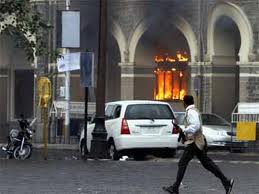
Mumbai attack plan used Google Earth, says US commander

May 17, 2012

mumbaiMay17

Washington, May 17: Citing the example of the 26/11 Mumbai terror attack, a top US military commander has warned of the dangers posed by "democratisation" of technology in future warfare.

"Now, in many ways, technology has been democratised," Marine Corps Lt. Gen. George J. Flynn said at the sixth annual 2012 Joint Warfighting Conference at Virginia Beach Tuesday.

Referring to the greater availability of information potentially empowering conventional and non-traditional state actors, he cited a Harvard Business Review article detailing the November 2008 Mumbai terrorist attack as an example.

"All the mission planning was done via Google Earth," he said. "There was no investment in technology of [intelligence, surveillance and reconnaissance] platforms or anything like that."

Flynn said the terrorists used cellular phone networks as command and control and social media to track and thwart the efforts of Indian commandos.

"How much technology or how much investment was made to create that terrorist capability?" he asked.

The future operating environment -- both the technology and the threat -- will continue to increase at greater rates of change due to the accessibility of information, Flynn said.

"Space and cyber will continue to play an increased role in events, with each becoming

increasingly contested domains -- so it's a new domain that we're going to have to contest."

"Security challenges will have both local and global aspects, we think, with events occurring across the globe,"he said. "So the bottom line [is that] if you liked the past challenges of the past 11 years, you will like the future."

Comments

Add new comment

  • Coastaldigest.com reserves the right to delete or block any comments.
  • Coastaldigset.com is not responsible for its readers’ comments.
  • Comments that are abusive, incendiary or irrelevant are strictly prohibited.
  • Please use a genuine email ID and provide your name to avoid reject.
News Network
April 22,2020

New Delhi, Apr 22: Prime Minister Narendra Modi on Wednesday said that The Epidemic Diseases (Amendment) Ordinance, 2020, manifests his government's commitment to protecting healthcare workers braving COVID-19 on the frontline.
"The Epidemic Diseases (Amendment) Ordinance, 2020, manifests our commitment to protect each and every healthcare worker, who is bravely battling COVID-19 on the frontline. It will ensure the safety of our professionals. There can be no compromise on their safety!," Prime Minister Modi tweeted.
The Central government on Wednesday brought an ordinance to end the violence against health workers, making it a cognizable, non-bailable offence with the imprisonment of up to seven years for those found guilty.

"We have brought an ordinance under which any attack on health workers will be a cognizable, non-bailable offence. In the case of grievous injuries, the accused can be sentenced from 6 months to 7 years. They can be penalised from Rs 1 lakh to Rs 5 lakh," Union Minister Prakash Javadekar briefed media after the meeting of the Cabinet.

"Such crime will now be cognisable and non-bailable. An investigation will be done within 30 days. Accused can be sentenced from three months to five years, and penalised from Rs 50,000 up to Rs 2 lakh," said Javadekar.

Moreover, if the damage is done to vehicles or clinics of healthcare workers, then a compensation amounting to twice the market value of the damaged property will be taken from the accused, said Javadekar.

Comments

Add new comment

  • Coastaldigest.com reserves the right to delete or block any comments.
  • Coastaldigset.com is not responsible for its readers’ comments.
  • Comments that are abusive, incendiary or irrelevant are strictly prohibited.
  • Please use a genuine email ID and provide your name to avoid reject.
News Network
June 18,2020

New Delhi, Jun 18: The border clash between Indian and Chinese soldiers in Ladakh broke the brittle quiet – and also the sense of security for anxious Chinese nationals in India who fear a backlash with anti-Chinese sentiment spiralling in the country.

With the high altitude violent face-off in eastern Ladakh’s Galwan Valley spurring hashtags such as “Boycott China” and “Teach Lesson to China” and leading to street protests, the undercurrents of tension were evident.

Wary of being identified, some said they had been reassured by their friends but were still apprehensive for themselves and their families.

"They (Chinese families) don''t want to speak to the media. They are not going out and are worried about their security and well being. Their families are also worried back home," Mohammed Saqib, secretary general of the India China Economic & Cultural Council, told PTI.

He added that his Chinese friends in India been calling him since they heard news about Monday night’s clashes in which 20 Indian soldiers were killed -- the worst military confrontation in five decades -- and expressed concern over growing anti-China sentiments.

A Chinese national from Beijing working in Gurgaon for a Chinese mobile firm initially refused to talk, saying he did not want to speak to the media and later shared his thoughts only on condition of anonymity.

"There is talk of border standoff and tensions, but we know Indians are very warm people and that is why I have told my family that all is fine here and they should not worry," he said.

Another Chinese national working in Gurgaon said he and his family are feeling the stress amid the spiralling conflict between India and China, but many friends have been reassuring him.

"They (Chinese in India) are under a lot of stress naturally. Such a conflict puts a lot of stress as they could bear the brunt and the same applies to Indians in China," B R Deepak, professor at the Centre for Chinese and South East Asian Studies of the Jawaharlal Nehru University said.

He said it was unfortunate that the border standoff derailed the commemorative programmes aimed at strengthening ties at a time the two countries were gearing to celebrate 70 years of establishment of diplomatic ties.

Experts also feel the border clash is likely to have a significant negative impact on the economic and people to people ties.

There are scores of Chinese in India working in various Chinese firms and also those who are studying in universities like JNU.

About 3,000 Chinese people, doing business or studying in big cities in India, were stranded in India at the start of the COVID-19 crisis, and about half of them returned to China before the lockdown began on March 25.

The Chinese Embassy in New Delhi announced on May 25 that they will arrange for flights to take back students, tourists and businesspersons to five Chinese cities, including Shanghai and Guangzhou.

"It will impact the psychology of the Chinese here. There are 2,000 Chinese firms in various sectors in India which are going to be impacted," Deepak said.

Future investments from the Chinese side could also be impacted, he said.

Moreover, as far as people-to-people contacts are concerned, the number of Chinese students choosing India as a preferred destination is likely to go down, Deepak said.

Alka Acharya, another China expert, said there are two kinds of impacts of such an incident -- short term and medium term.

Usually after the initial nationalistic reaction in the short term things tend to normalise in the medium term, but with such a border clash happening for the first time in decades clearly the resonance would be much more in both India and China, said Acharya, professor at the Centre for East Asian Studies, School of International Studies, in JNU.

“Due to the impact of the COVID-19 crisis on the economy, whether India can take a hardline in terms of economics towards China, is a tricky question,” she said.

In the immediate context, there may be a dip in economic ties with calls for boycott of Chinese goods and services, Acharya said.

The manner in which this crisis is resolved will affect how ties will be affected in the medium term, she said.

The headlines have added to the anxiety.

A group of ex-armymen gathered near the Chinese embassy to protest the killing of 20 Indian Army personnel in Ladakh’s Galwan Valley. And another group of around 10 protesters belonging to the Swadeshi Jagaran Manch protested near the Teen Murti roundabout in Central Delhi.

The anti-China sentiment prevalent among the common public is also finding a reflection in government policy with sources saying the Department of Telecom (DoT) is set to ask state-owned Bharat Sanchar Nigam Ltd (BSNL) not to use Chinese telecom gear in its 4G upgradation.

Trade bodies like CAIT are also calling for a boycott of Chinese products.

And Chinese handset maker Oppo cancelled the livestream launch of its flagship 5G smartphone in the country amid protests.

Monday night’s clashes between the Chinese and Indian troops in Galwan Valley significantly escalated the already volatile border standoff between the two countries.

The casualties on the Chinese side are not yet known. However, government sources, citing an American intelligence report, claimed the total number of soldiers killed and seriously wounded could be 35.


Comments

Add new comment

  • Coastaldigest.com reserves the right to delete or block any comments.
  • Coastaldigset.com is not responsible for its readers’ comments.
  • Comments that are abusive, incendiary or irrelevant are strictly prohibited.
  • Please use a genuine email ID and provide your name to avoid reject.
News Network
May 19,2020

New Delhi, May 19: The number of coronavirus cases crossed the one lakh mark in the country on Tuesday, while the death toll due to the infection touched 3,163, according to the Union Health Ministry.

A total of 134 deaths and 4,970 COVID-19 cases were reported in the country in the past 24 hours since 8 pm on Monday, it said.

The total number of coronavirus cases has risen to 1,01,139, the ministry said.

The number of active COVID-19 cases stood at 58,802 while 39,173 people have recovered and one patient has migrated, it said.

"Thus, around 38.73 per cent patients have recovered so far," a senior health ministry official said.

The total confirmed cases include foreigners.

Of the 134 deaths reported since Monday morning, 51 were in Maharashtra, 35 in Gujarat, 14 in Uttar Pradesh, eight in Delhi, seven in Rajasthan, six in West Bengal, four in Madhya Pradesh, three in Tamil Nadu, two each in Punjab and Jammu and Kashmir, and one each in Bihar and Telangana.

Of the 3,163 fatalities, Maharashtra tops tally with 1,249 deaths. Gujarat comes second with 694 deaths, followed by Madhya Pradesh at 252, West Bengal at 244, Delhi at 168, Rajasthan at 138, Uttar Pradesh at 118, Tamil Nadu at 81 and Andhra Pradesh at 50.

The death toll reached 37 each in Karnataka and Punjab and 35 in Telangana.

Jammu and Kashmir has reported 15 fatalities due to the disease, Haryana has 14 deaths while Bihar has registered nine and Kerala and Odisha each have reported four deaths.

Jharkhand, Chandigarh and Himachal Pradesh each have recorded three COVID-19 fatalities, while Assam has reported two deaths.

 Meghalaya, Uttarakhand and Puducherry have reported one fatality each, according to the data provided by the ministry.

According to the ministry's website, more than 70 per cent of the deaths are due to comorbidities, the existence of multiple disorders in the same person.

According to the health ministry's data updated in the morning, the highest number of confirmed cases in the country are from Maharashtra at 35,058, followed by Tamil Nadu at 11,760, Gujarat at 11,745, Delhi at 10,054, Rajasthan at 5,507, Madhya Pradesh at 5,236 and Uttar Pradesh at 4,605.

The number of COVID-19 cases has gone up to 2,825 in West Bengal, 2,474 in Andhra Pradesh and 1,980 in Punjab.

It has risen to 1,597 in Telangana, 1,391 in Bihar, 1,289 in Jammu and Kashmir, 1,246 in Karnataka and 928 in Haryana.

Odisha has reported 876 coronavirus infection cases so far, while Kerala has 630 cases. A total of 223 people have been infected with the virus in Jharkhand and 196 in Chandigarh.

Tripura has reported 167 cases, Assam has 107, Uttarakhand and Chhattisgarh have 93 cases each, Himachal Pradesh has 90 and Ladakh has registered 43 cases so far.

Goa has reported 38 COVID-19 cases, while the Andaman and Nicobar Islands has registered 33 infections.

Puducherry has registered 18 cases, Meghalaya has 13 and Manipur has seven cases. Mizoram, Arunachal Pradesh and Dadar and Nagar Haveli have reported a case each till how.

"814 cases are being reassigned to states," the ministry said on its website, adding "our figures are being reconciled with the ICMR".

State-wise distribution is subject to further verification and reconciliation, it said.

Comments

Add new comment

  • Coastaldigest.com reserves the right to delete or block any comments.
  • Coastaldigset.com is not responsible for its readers’ comments.
  • Comments that are abusive, incendiary or irrelevant are strictly prohibited.
  • Please use a genuine email ID and provide your name to avoid reject.