



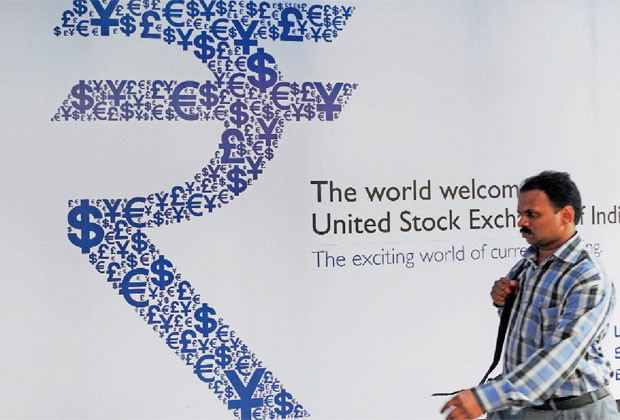
Indian rupee hits all-time low

May 17, 2012

indian_rupee

New Delhi, May 17: The Indian rupee plummeted to an all time low on Wednesday to 54.46 rupees to the dollar, or up to Rs14.81 to the dirham, breaching its previous record low of 54.39 struck on December 15.

Local money exchanges witnessed “higher than normal footfalls” as non residents rushed to remit money as the rupee’s value against the dollar-pegged UAE currency declined to over 20 per cent during the past 12 months.

The Reserve Bank of India said it was closely observing the rupee’s movement and will act if needed.

Although the immediate trigger for the rupee plunge was a sudden surge in demand for dollar amid deepening uncertainty over the eurozone debt crisis, analysts blamed it on India’s deteriorating macro-economic conditions, most importantly its twin financial setbacks — current account defcit and the fiscal deficit that are among the highest among emerging Asian economies.

“In the backdrop of the Greek crisis, fiscal deficit and policy paralysis, the currency looks weaker, and could remain so for few days to come, if not more,” said Y. Sudhir Kumar Shetty, chief operating officer, Global Operations, UAE Exchange. Remittances, especially big-ticket transactions, where people send money for investments or savings, are on the rise, which is a natural outcome of currency weakening, said Shetty.

“But blue collar remittances, which are usually sent for family maintenance, maintain a steady level irrespective of the currency movements, which is discernible now. Reserve Bank of India hasn’t taken any significant corrective measures, which indicates that the currency could weaken further,” he said.

Sajith Kumar P K, director and CEO of JRG International Brokerage, said the chances are high that the rupee touch 57 to 58 levels to the dollar in the medium- to long-term basis if the prevailing situation continues. Next support levels are 55.80, 57.80 and resistance levels are 54.40, 52.20.

Kumar said urgent action from policy makers are needed at this juncture to stop a further steep fall of the currency.

“While more steps are needed to restore the confidence level of foreign institutional investors, policy makers should initiate more avenues for foreign direct investments to strengthen the rupee,” he said.

Some analysts suggest that it was time that the rupee is allowed to depreciate and left to find its own level that could slow imports and help raise exports.

“The pressure on the rupee has been mostly due to inadequate dollar supplies to meet India’s rising import bill. About 20 per cent of it is to fund its crude oil imports. India’s weak fundamentals, aggravated by imprudent subsidies, are getting increasingly exposed at a time when unfriendly tax proposals keep at bay foreign investors,” one analyst said.

India government’s lack of determination to push ahead with policy reforms had been a further deterrent to foreign investments into the country, analysts said. “The need of the hour are sound fundamentals to attract capital inflows that are needed to fund the current-account shortfall,” they said.

Foreign portfolio investors have started going slow on investments into the country. In April, they pulled out close to $1 billion from the Indian markets. On the other hand, the country’s import bill has risen due to high crude and commodity prices amid a slower growth in exports.

According to ING Vysya Bank Ltd, India’s economic fundamentals are pressuring the currency more than global factors. The trade deficit swelled to a record $184.9 billion in the year ended March 31 and industrial output shrank 3.5 per cent in March from a year earlier, government figures showed this month. Standard & Poor’s cut the outlook on the nation’s BBB- sovereign debt rating to negative on April 25.

Comments

Add new comment

  • Coastaldigest.com reserves the right to delete or block any comments.
  • Coastaldigset.com is not responsible for its readers’ comments.
  • Comments that are abusive, incendiary or irrelevant are strictly prohibited.
  • Please use a genuine email ID and provide your name to avoid reject.
News Network
July 23,2020

New Delhi, Jul 23: A Delhi court Thursday allowed 198 Indonesians to walk free on payment of varying fines, after they accepted mild charges under the plea bargain process, related to various violations including visa norms while attending the Tablighi Jamaat event here during the COVID-19 lockdown.

Metropolitan Magistrate Vasundhara Azad allowed 100 Indonesians to walk free on payment of a fine of Rs 7,000 each, said advocates Ashima Mandla, Fahim Khan and Ahmed Khan, appearing for them.

Metropolitan Magistrate Swati Sharma allowed 98 Indonesians to walk free on payment of a fine of Rs 5,000 each.

The court directed the 98 Indonesians to deposit their fines to PM CARES Fund.

The Sub-divisional magistrate of Defence Colony, who was the complainant in the case, Assistant Commissioner of Police of Lajpat Nagar and Inspector of Nizamuddin said they have no objection to it.

However, one Indonesian did not plead guilty to the charges against them and claimed trial before the court.

Under plea bargaining, the accused plead guilty to the offence praying for a lesser punishment. The Criminal Procedure of Code allows for plea bargaining in cases where the maximum punishment is 7-year imprisonment; offences don''t affect the socio-economic conditions of the society and the offence is not committed against a woman or a child below 14 years.

The foreigners were chargesheeted for attending the religious congregation at Nizamuddin Markaz event in the national capital by allegedly violating visa conditions, indulging in missionary activities illegally and violating government guidelines, issued in the wake of Covid-19 outbreak in the country.

They were granted bail earlier by the court on a personal bond of Rs 10,000 each.

Comments

Add new comment

  • Coastaldigest.com reserves the right to delete or block any comments.
  • Coastaldigset.com is not responsible for its readers’ comments.
  • Comments that are abusive, incendiary or irrelevant are strictly prohibited.
  • Please use a genuine email ID and provide your name to avoid reject.
News Network
May 13,2020

New Delhi, May 13: With an increase of 3,525 COVID-19 cases reported in the last 24 hours, India's tally of positive coronavirus cases rises to 74,281 cases, as of Wednesday, said the Ministry of Health and Family Welfare.

The tally is inclusive of 47,480 patients who are active coronavirus cases and 24,385 patients who have been cured/discharged and one patient migrated.

With an increase of 122 deaths due to COVID-19 reported in the last 24 hours, the number of deaths in the country now stands at 2,415.

According to the ministry, Maharashtra has the most number of positive COVID-19 cases with 24,427 positive cases that include 5,125 patients recovered and 921 fatalities.

Gujarat has reported 8,903 COVID-19 cases inclusive of 3,246 recovered patients and 537 deaths due to the coronavirus.

Tamil Nadu reported 8,718 positive coronavirus cases with 2,134 patients recovering from the disease and 61 succumbing to the infection.

Delhi's tally of COVID-19 cases stands at 7,639 cases with 2,512 patients recovering and 86 patients died due to coronavirus.

Meanwhile Arunachal Pradesh (one case reported--now recovered), Goa (seven cases reported--all seven recovered), Manipur (two cases reported--both recovered) and Mizoram (one case reported--now recovered) have reported no new cases of COVID-19.

Comments

Add new comment

  • Coastaldigest.com reserves the right to delete or block any comments.
  • Coastaldigset.com is not responsible for its readers’ comments.
  • Comments that are abusive, incendiary or irrelevant are strictly prohibited.
  • Please use a genuine email ID and provide your name to avoid reject.
News Network
January 22,2020

Jan 22: India's ranking in the latest global Democracy Index has dropped 10 places to the 51st spot out of 167 owing to violent protests and threats to civil liberties challenging freedoms across the country.

Prime Minister Narendra Modi's government has been criticized by rights groups and western governments after shutting off the internet and mobile phone networks and detaining opposition politicians in Kashmir.

Modi’s government has also responded harshly to ongoing protests against a controversial, religion-based citizenship law. Muslims have said their neighborhoods have been targeted, while the central government has attempted to ban protests and urged TV news channels not to broadcast “anti-national” content. Some leaders in Modi’s ruling party called for “revenge” against protesters. India’s score in 2019 was its worst ranking since the EIU’s records began in 2006, and has fallen gradually since Modi was elected in 2014.

The Economist Intelligence Unit’s 2019 Democracy Index, which provides an annual comparative analysis of political systems across 165 countries and two territories, said the past year was the bleakest for democracies since the research firm began compiling the list in 2006.

“The 2019 result is even worse than that recorded in 2010, in the wake of the global economic and financial crisis,” the research group said in releasing the report on Wednesday.

The average global score slipped to 5.44 out of a possible 10 -- from 5.48 in 2018 -- driven mainly by “sharp regressions” in Latin America, Sub-Saharan Africa, the Middle East and North Africa. Apart from coup-prone Thailand, which improved its score after holding an election last year, there were also notable declines in Asia after a tumultuous period of protests and new measures restricting freedom across the region’s democracies.

Asia Declines

Hong Kong, meanwhile, fell three places to rank 75th out of 167 as more than seven months of violent and disruptive protests rocked the Asian financial hub. An aggressive police response early in the unrest, when protests were mostly peaceful, led to a “marked decline in confidence in government -- the main factor behind the decline in the territory’s score in our 2019 index,” the group said.

In Singapore, which ranked alongside Hong Kong at 75th, a new “fake news” law led to a deteriorating score on civil liberties.

“The government claims that the law was enacted simply to prevent the dissemination of false news, but it threatens freedom of expression in Singapore, as it can be used to curtail political debate and silence critics of the government,” EIU analysts said.

China’s score fell to just 2.26 in the EIU’s ranking, placing it near the bottom of the list at 153, as discrimination against minorities, repression and surveillance of the population intensified. Still, in China “the majority of the population is unconvinced that democracy would benefit the economy, and support for democratic ideals is absent,” the EIU said.

Comments

Add new comment

  • Coastaldigest.com reserves the right to delete or block any comments.
  • Coastaldigset.com is not responsible for its readers’ comments.
  • Comments that are abusive, incendiary or irrelevant are strictly prohibited.
  • Please use a genuine email ID and provide your name to avoid reject.