


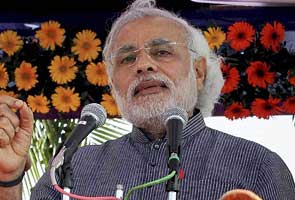
BJP confident of Modi attending Mumbai conclave

May 18, 2012

narendra-modi-PTI-shot-295

Mumbai, May 18: There are indications that Gujarat Chief Minister Narendra Modi may skip the BJP's national executive meeting to be held in Mumbai later this month, but the party's Mumbai unit has expressed confidence that Mr Modi would come.

The meeting is scheduled to take place on May 24 and 25.

"Modi is the member of the national executive and all the members have been invited. He is our esteemed leader and we are confident that he will come," Mumbai BJP president Raj Purohit said on Thursday.

He said the two-day event will be a 'no-frills' affair due to severe drought situation in Maharashtra. Earlier, national executive meetings in Mumbai were held in five-star hotels.

Mr Modi is reportedly upset about the reinduction of Sanjay Joshi, a long-time rival, into the party and his presence at the party meet. Despite Mr Modi's objections, Mr Joshi played a large role in the party's planning for the UP elections earlier this year. Mr Modi refused to campaign in UP, saying he had his own yatras to finish in election-bound Gujarat. Even when those finished, Mr Modi did not head to UP. The BJP placed a poor third.

If Mr Modi does not attend, it will be the second time he will skip a national executive meeting seemingly because of Mr Joshi's presence. He had refused to attend one held in New Delhi in October last year; his excuse then was that he did not go out of Gujarat during the Navratra festival.

But, sources say, there are other more core issues. Mr Modi, they say, is opposed to a second term for Nitin Gadkari as BJP president and staying away from the party meet would record his displeasure at RSS moves in this direction. Mr Modi's own ambition to move to a national role in the party could be tied in with this, the party sources say.

The conclave will be held this time at the Yeshwantrao Chavan Pratisthan, which is headed by Nationalist Congress Party (NCP) chief and union Agriculture Minister Sharad Pawar in South Mumbai.

Mr Purohit said issues like corruption, inflation, national security, drought and "inefficiency" of the UPA government will be discussed at the conclave.

Nearly 500 delegates are expected to attend the meeting, apart from the chief ministers of all BJP-ruled states, including Mr Modi, who will stay at the state-owned Sahaydri guest house.

The two-day event will culminate in a public rally to be organised at the Babu Genu Kamgar Maidan in Central Mumbai, and will be addressed by party president Nitin Gadkari, Sushma Swaraj and Arun Jaitley among others.

Mr Purohit said that senior leader LK Advani will not attend the rally since he has some prior engagements in Delhi.

Comments

Add new comment

  • Coastaldigest.com reserves the right to delete or block any comments.
  • Coastaldigset.com is not responsible for its readers’ comments.
  • Comments that are abusive, incendiary or irrelevant are strictly prohibited.
  • Please use a genuine email ID and provide your name to avoid reject.
News Network
July 26,2020

New Delhi, Jul 26: Union Home Minister Amit Shah on Sunday saluted the valour and grit of the Indian soldiers on the occasion of 21st anniversary of the 'Kargil Vijay Diwas'.

Shah took to Twitter and said that 'Kargil Vijay Diwas' is a symbol of India's proud, valour and steadfast leadership.

"Kargil Vijay Diwas is a symbol of India's proud, valor and steadfast leadership. I bow to the soldiers who, with their indomitable courage, drove the enemy from the inaccessible hills of Kargil and waved the tricolor there again. The country is proud of the heroes of India, who are dedicated to protecting the motherland," Shah tweeted (translated from Hindi)
The country is celebrating the anniversary of the 'Kargil Vijay Diwas'.

The Indian armed forces had defeated Pakistan on July 26, 1999. Since then, the day is celebrated as 'Kargil Vijay Diwas' to rekindle the pride and valour of the soldiers who took part in Operation Vijay.

The day marks the victory of Indian soldiers in recapturing the mountain heights that were occupied by the Pakistani Army on July 26, 1999, known as the Kargil War. 

Comments

Add new comment

  • Coastaldigest.com reserves the right to delete or block any comments.
  • Coastaldigset.com is not responsible for its readers’ comments.
  • Comments that are abusive, incendiary or irrelevant are strictly prohibited.
  • Please use a genuine email ID and provide your name to avoid reject.
News Network
January 1,2020

Jan 1: The ban on the practice of instant triple talaq, making it a penal offence and the increase in the strength of Supreme Court judges were two of the major achievements of the law ministry in 2019.

In July, Parliament gave its nod to The Muslim Women (Protection of Rights on Marriage) Bill, 2019. The new law makes talaq-e-biddat or any other similar form of talaq having the effect of instantaneous and irrevocable divorce pronounced by a Muslim husband void and illegal.

It makes it illegal to pronounce talaq three times in spoken, written or through SMS or WhatsApp or any other electronic chat in one sitting.

According to the new law, any Muslim who pronounces the illegal form of talaq upon his wife shall be punished with imprisonment for a term which may extend to three years, and shall also be liable to fine.

During the year, four new judges were appointed to the Supreme Court in September, taking its strength to 34, the highest-ever.

However, vacancies in high courts and lower courts are on the rise and convincing state governments and the 25 high courts to come on board to create an all-India judicial service to recruit judges for the subordinate courts tops the agenda of the Law Ministry in 2020.

Besides creating a consensus on setting up the All-India Judicial Services, the ministry will also have to focus on filling up vacancies in the high court. On an average, the vacancies stood at 400 throughout this year.

With more than 5,000 positions of judicial officers in district and subordinate courts lying vacant, the Law Ministry has pitched for setting up all-India judicial services.

The sanctioned strength of the judicial officers in district and subordinate courts was 22,644. The number of judicial officers in position and vacant posts is 17,509 and 5,135, respectively.

The government has proposed that while states and high courts can recruit judicial officers, the Union Public Service Commission (UPSC) can hold pan-India entrance tests.

The ministry has made it clear that such services would not encroach on the powers of the states.

As of now, the selection and appointment of judges in subordinate courts is the responsibility of the high courts and state governments concerned.

The Narendra Modi government has given a fresh push to the long-pending proposal to set up the new service to have a separate cadre for the lower judiciary in the country.

But there is a divergence of opinion among state governments and respective high courts on the constitution of the All India Judicial Service (AIJS).

One of the problems cited is that since several states have used powers under Code of Criminal Procedure (CrPC) and Code of Civil Procedure (CPC) to declare that the local language would be used in lower courts even for writing orders, a person say selected from Tamil Nadu may find it difficult to hold proceedings in states like Uttar Pradesh and Bihar.

The other point of opposition is that an all India service may hamper the career progression of state judicial services officers.

Another key issue the ministry has to handle in 2020 is vacancies in the 25 high courts.

Throughout 2019, on an average, the high courts faced a shortage of 400 judges.

According to Law Ministry data, as on September 1, the high courts had 414 vacant positions as compared to the sanctioned strength of 1,079 judges. The figure was 409 in August and 403 in July, as per the data.

A three-member Supreme Court collegium recommends the names of candidates for appointment as high court judges. In case of appointments to the Supreme Court, the collegium consists of five top judges of the top court.

High court collegiums shortlist candidates for their respective high courts and send the names to the law ministry.

The ministry, along with background check reports by the Intelligence Bureau, forwards it to the Supreme Court collegium for a final call.

The government has maintained that appointment of judges in the high courts is a "continuous collaborative process" between the Executive and the Judiciary, as it requires consultation and approval from various Constitutional authorities.

Vacancies keep arising on account of retirement, resignation or elevation of judges and increase in judges' strength. In June last year, the vacancy position stood at 399, while it was 396 in May.

In April, 399 posts of judges were vacant, while the figure was 394 in March. The vacancy position in February stood at 400 and in January, it was 392, according to the data collated by the Department of Justice.

Over 43 lakh cases are pending in the 25 high courts.

Another priority would be the finalisation of the memorandum of the procedure to guide the appointment and transfer of the Supreme Court and high court judges. The issue had now been pending for over two years now with the SC collegium and the government failing to reach a consensus.

Successive governments have also been working on making India a hub of international arbitration. It has taken several steps to change laws dealing with commercial disputes.

Comments

Add new comment

  • Coastaldigest.com reserves the right to delete or block any comments.
  • Coastaldigset.com is not responsible for its readers’ comments.
  • Comments that are abusive, incendiary or irrelevant are strictly prohibited.
  • Please use a genuine email ID and provide your name to avoid reject.
News Network
January 29,2020

Aurangabad, Jan 29: Accusing Prime Minister Narendra Modi and Union Home Minister Amit Shah of creating a conflict between Hindu and Muslim communities in the country, former JNU student leader Kanhaiya Kumar has said the Citizenship (Amendment) Act (CAA) was adding fuel to the fire.

He was speaking at a rally held on Tuesday at Pathri in Parbhani district of Maharashtra against the CAA and the National Register of Citizens (NRC). It was organised by NCP MLC Abdullah Durrani.

"Modi and Shah used to create conflicts between Hindus and Muslims during the Gujarat elections. Now they are adopting the same strategy in the country," Kumar alleged.

Citizens should keep the religious conflicts aside and question the present government about unemployment and the poor state of the economy, he said.

"Through the CAA, the government is adding fuel to the fire, which is already raging in the country," he alleged.

When anyone questions the government about the problems existing in the country, it in turn asks him about his citizenship, the former JNUSU leader alleged.

Comments

Add new comment

  • Coastaldigest.com reserves the right to delete or block any comments.
  • Coastaldigset.com is not responsible for its readers’ comments.
  • Comments that are abusive, incendiary or irrelevant are strictly prohibited.
  • Please use a genuine email ID and provide your name to avoid reject.