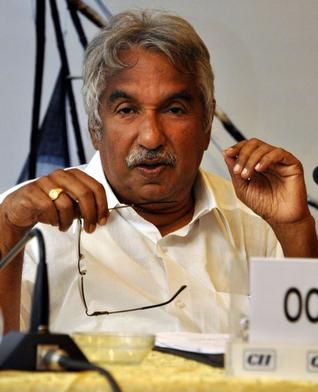
Mullaperiyar: Chandy banks on Supreme Court

May 19, 2012

chandyThiruvananthapuram, May 19: Kerala Chief Minister Oommen Chandy hopes that the long-pending dispute between Kerala and Tamil Nadu over the Mullaperiyar Dam could be resolved through legal processes, as the neighbouring state has not come forward for talks.

“We are always ready for talks, either bilateral or through the Centre’s mediation. But Tamil Nadu has not agreed for that. In this situation, we expect a solution to the issue from the Supreme Court,” Mr. Chandy said.

Making the state’s position clear, he said Kerala wanted a new dam in place of the 116-year-old structure and also to maintain the water level at 136 feet.

The state was opposed to the proposal of the Supreme Court appointed Empowered Committee to raise the water level to 142 feet. Similarly, the proposal to construct a tunnel at 50 feet below the present dam to route water to Tamil Nadu was not acceptable to Kerala, Mr. Chandy said.

The construction of the tunnel will harm the state in many ways including disappearance of the reservoir itself, he said.

“While we hold on to this position, we are not asking for the scrapping of the agreement with Tamil Nadu.Nor do we want to curtail single drop of water flowing to Tamil Nadu. Our persistent stand has been water for Tamil Nadu and safety for Kerala, Mr. Chandy, who completed one year in office, told PTI.

On concerns voiced by some quarters over the panel report, he claimed that the empowered committee had in-principle accepted the demand for a new dam.

The Mullaperiyar Dam is located in Kerala’s Idduki district but managed by Tamil Nadu on a 999-year lease period. Tamil Nadu has been maintaining that the dam was safe and the water level can be raised to 142 ft.

On Tamil Nadu’s demand that the entire power to be produced from Kudankulam Nuclear Plant be allotted to it, he said Kerala was entitled to its share from the plant and it was the Centre’s responsibility to ensure that the state received it.

“It is the responsibility of the Centre to make due share available to the state,” said Mr. Chandy, who had earlier this month written to Prime Minister Manmohan Singh seeking 500 MW from the Kudankulam plant.

Comments

Add new comment

  • Coastaldigest.com reserves the right to delete or block any comments.
  • Coastaldigset.com is not responsible for its readers’ comments.
  • Comments that are abusive, incendiary or irrelevant are strictly prohibited.
  • Please use a genuine email ID and provide your name to avoid reject.
News Network
May 30,2020

New Delhi, May 30: As the NDA government completes one year of its second term, Prime Minister Narendra Modi listed several achievements and initiatives taken by his government in the past year in an audio message addressed to the people of the country.

PM Modi said, "This day last year began a golden chapter in the history of Indian democracy. It was after several decades that the people of the country voted back a full-term government with a full majority."

"Your role has played a pivotal role in creating this chapter. In such a situation, this day is an opportunity for me to bow to the citizens of the country and the democratic ethos of our nation," said PM Modi.

"Had the situation been normal, I would have got the chance to meet you. Your affection and active support in the past year have given me new energy and inspiration. During this period, the way you have shown the collective powers of democracy, they have become an example for the whole world," he added.

PM Modi talked about several important initiatives taken by his government in 2014 as well as India's demonstration of its mettle through the surgical strike and airstrike.

"Six years ago in 2014, the people of this country voted to bring a major change in the country. You voted to change the country's policy and manner. During that tenure where surgical strike and airstrike took place, one rank one pension, one nation one tax GST, and better MSP for farmers were also fulfilled. That period was dedicated to fulfilling many needs of the country."

He further said that in these years the country has seen systems coming out of the quagmire of inertia and corruption. The country has seen governance change to make life easier for the poor.

"During that period, India's stature in the world increased. By opening bank accounts of poor people, by giving them gas connections, by providing free electricity connections, by building washrooms, by building houses, the dignity of the poor has also been increased," said PM Modi.

Comments

Add new comment

  • Coastaldigest.com reserves the right to delete or block any comments.
  • Coastaldigset.com is not responsible for its readers’ comments.
  • Comments that are abusive, incendiary or irrelevant are strictly prohibited.
  • Please use a genuine email ID and provide your name to avoid reject.
News Network
March 7,2020

Mumbai, Mar 7: Maharashtra Chief Minister and Shiv Sena president Uddhav Thackeray visited Ayodhya on Saturday to commemorate 100 days in office and pledged Rs 1 crore towards the building of the Ram Temple.

Taking a dig at BJP, Uddhav said his party had separated from its erstwhile ally but not Hindutva.

Recollecting the contribution of his father Balasaheb Thackeray, uddhav said he was forced to skip the Sarayu River 'aarti' due to Coronavirus fears but he would continue visiting Ayodhya.

Earlier in the day, the Sena, which heads the tripartite dispensation in the state, said there was no change in its ideology.

Launching a veiled attack on BJP, an editorial in the Sena mouthpiece 'Saamana' also said that Lord Ram and Hindutva is not the sole property of any single political party.

The Sena also said the Maha Vikas Aghadi (MVA) government — which also comprises the NCP and the Congress — has completed 100 days, much to the chagrin of those who were claiming that the new dispensation will not survive more than 100 hours.

“Those whose government lasted for 80 hours were claiming that the Thackeray regime will not last for even 100 hours. But this MVA government not only thrived but has instilled trust in the minds of people during this period with its performance,” the editorial said.

The Sena was apparently referring to the second inning of the erstwhile Devendra Fadnavis government which lasted for only 80 hours in November last year.

"Hence, CM Thackeray's visit to Ayodhya has to be welcomed as he is offering the flowers of works (done by the government) at the feet of Lord Shriram," it said.

The Sena said Thackeray's visit to the temple town is out of devotion for Lord Shriram. "The government in Maharashtra comprising three ideologically different parties is working as per Constitution and Thackeray is leading such government," it said.

The edit said on this background various questions were raised over Thackeray's visit to Ayodhya by his political opponents. "The government maybe backed by anyone, but Uddhav Thackeray and the Shiv Sena remain the same from within and outside. There is no change in the ideology. Lord Shriram and Hindutva is not the property of any single party," it stated.

Referring to senior RSS leader Suresh 'Bhaiyyaji' Joshi's remark that the Hindu community is not synonymous with the BJP and that opposing the BJP does not amount to opposing Hindus, the Sena said similarly Ayodhya belongs to all.

"The political and cultural battle in Ayodhya is now over. The Supreme Court cannot be thanked enough for this (for its verdict in the Ram Janmabhoomi-Babri Masjid dispute case that allowed construction of the Ram temple)," it said.

Hailing the Supreme Court's November, 2019 verdict, the Sena said the country had to fight a big battle to prove that Ayodhya belonged to Lord Shriram.

"In that battle, several (people) were unmasked. But only (late) Shiv Sena president Balasaheb Thackeray stood behind the Ayodhya (temple) campaigners like a mountain," it said.

Bal Thackeray created trust among Hindus from across the world about the creation of the temple, the Sena said. The party further said late Thackeray's assertion that he was proud if the Babri mosque was razed by Sena workers and that the temple of Lord Ram would come up in Ayodhya was akin to the thunder of "thousands of lightnings" in the sky.

"The Hindu culture got lit up in the glow of that lightning. The resplendent rays showed the path of power to the Hindu community. Hence, no one can deny the contribution of the 'Hinduhridaysamrat' (Bal Thackeray) as good as that of Lord Shriram, in creating the current political order in the country," the Sena said.

"We have experienced several times that Balasaheb lives in the mind of Ayodhya. Now Uddhav Thackeray himself is going there with the same faith. He had gone there when not in power. He is going there now after becoming chief minister with the same humility. Lord Shriram is of everyone," the Sena said.

The party said Maharashtra is being run on the path shown by Lord Shriram and Chhatrapati Shivaji Maharaj. "A Ram Rajya entails fulfilling promises made to the people. This is precisely what Mahatma Gandhi wanted, and the government following this ideology is in place in Maharashtra. It will continue work on that line. Ultimately, Lord Shriram is there to support it," the Sena said.

Thackeray completed 100 days in the office on Friday. He had assumed office as the chief minister of the Sena-led Maha Vikas Aghadi (MVA) government on November 28 last year, after the Sena joined hands with the NCP and the Congress.

Senior Sena leader Sanjay Raut had said that Thackeray will not take part in the 'aarti' programme on the banks of river Sarayu in the temple town.

Comments

Add new comment

  • Coastaldigest.com reserves the right to delete or block any comments.
  • Coastaldigset.com is not responsible for its readers’ comments.
  • Comments that are abusive, incendiary or irrelevant are strictly prohibited.
  • Please use a genuine email ID and provide your name to avoid reject.
News Network
January 1,2020

Jan 1: The ban on the practice of instant triple talaq, making it a penal offence and the increase in the strength of Supreme Court judges were two of the major achievements of the law ministry in 2019.

In July, Parliament gave its nod to The Muslim Women (Protection of Rights on Marriage) Bill, 2019. The new law makes talaq-e-biddat or any other similar form of talaq having the effect of instantaneous and irrevocable divorce pronounced by a Muslim husband void and illegal.

It makes it illegal to pronounce talaq three times in spoken, written or through SMS or WhatsApp or any other electronic chat in one sitting.

According to the new law, any Muslim who pronounces the illegal form of talaq upon his wife shall be punished with imprisonment for a term which may extend to three years, and shall also be liable to fine.

During the year, four new judges were appointed to the Supreme Court in September, taking its strength to 34, the highest-ever.

However, vacancies in high courts and lower courts are on the rise and convincing state governments and the 25 high courts to come on board to create an all-India judicial service to recruit judges for the subordinate courts tops the agenda of the Law Ministry in 2020.

Besides creating a consensus on setting up the All-India Judicial Services, the ministry will also have to focus on filling up vacancies in the high court. On an average, the vacancies stood at 400 throughout this year.

With more than 5,000 positions of judicial officers in district and subordinate courts lying vacant, the Law Ministry has pitched for setting up all-India judicial services.

The sanctioned strength of the judicial officers in district and subordinate courts was 22,644. The number of judicial officers in position and vacant posts is 17,509 and 5,135, respectively.

The government has proposed that while states and high courts can recruit judicial officers, the Union Public Service Commission (UPSC) can hold pan-India entrance tests.

The ministry has made it clear that such services would not encroach on the powers of the states.

As of now, the selection and appointment of judges in subordinate courts is the responsibility of the high courts and state governments concerned.

The Narendra Modi government has given a fresh push to the long-pending proposal to set up the new service to have a separate cadre for the lower judiciary in the country.

But there is a divergence of opinion among state governments and respective high courts on the constitution of the All India Judicial Service (AIJS).

One of the problems cited is that since several states have used powers under Code of Criminal Procedure (CrPC) and Code of Civil Procedure (CPC) to declare that the local language would be used in lower courts even for writing orders, a person say selected from Tamil Nadu may find it difficult to hold proceedings in states like Uttar Pradesh and Bihar.

The other point of opposition is that an all India service may hamper the career progression of state judicial services officers.

Another key issue the ministry has to handle in 2020 is vacancies in the 25 high courts.

Throughout 2019, on an average, the high courts faced a shortage of 400 judges.

According to Law Ministry data, as on September 1, the high courts had 414 vacant positions as compared to the sanctioned strength of 1,079 judges. The figure was 409 in August and 403 in July, as per the data.

A three-member Supreme Court collegium recommends the names of candidates for appointment as high court judges. In case of appointments to the Supreme Court, the collegium consists of five top judges of the top court.

High court collegiums shortlist candidates for their respective high courts and send the names to the law ministry.

The ministry, along with background check reports by the Intelligence Bureau, forwards it to the Supreme Court collegium for a final call.

The government has maintained that appointment of judges in the high courts is a "continuous collaborative process" between the Executive and the Judiciary, as it requires consultation and approval from various Constitutional authorities.

Vacancies keep arising on account of retirement, resignation or elevation of judges and increase in judges' strength. In June last year, the vacancy position stood at 399, while it was 396 in May.

In April, 399 posts of judges were vacant, while the figure was 394 in March. The vacancy position in February stood at 400 and in January, it was 392, according to the data collated by the Department of Justice.

Over 43 lakh cases are pending in the 25 high courts.

Another priority would be the finalisation of the memorandum of the procedure to guide the appointment and transfer of the Supreme Court and high court judges. The issue had now been pending for over two years now with the SC collegium and the government failing to reach a consensus.

Successive governments have also been working on making India a hub of international arbitration. It has taken several steps to change laws dealing with commercial disputes.


Comments

Add new comment

  • Coastaldigest.com reserves the right to delete or block any comments.
  • Coastaldigset.com is not responsible for its readers’ comments.
  • Comments that are abusive, incendiary or irrelevant are strictly prohibited.
  • Please use a genuine email ID and provide your name to avoid reject.