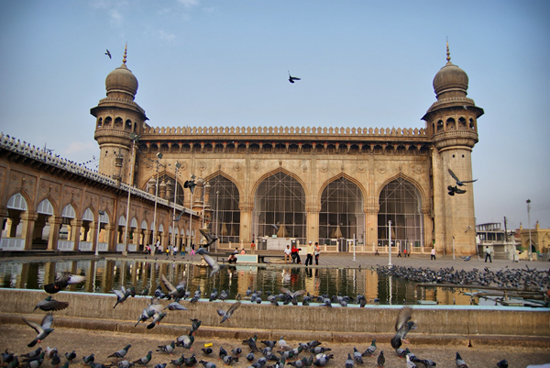
Dress code for Makkah Masjid visitors

May 20, 2012

Mecca_Masjid

Hyderabad, May 20: The custodians of the 17th century Makkah Masjid, a popular tourist destination here, have prescribed a dress code for women visitors. Women wearing jeans, sleeveless tops and skirts would not be allowed inside the historic mosque.

The authorities of the mosque said women visitors must dress appropriately keeping in view the sanctity of the place. “Women visiting the mosque should wear Saree or Salwar Kameez. The idea is to respect the sanctity of the place,” said Moulana Burhanuddin of the Mosque.

Makkah Masjid, the imposing granite structure built by the Qutub Shahi rulers, is one of the largest mosques in India. It is popular among tourists who are allowed inside premises, except during prayer hours. About 6,000 tourists visit the historic place every day.

Quite often, skimpily clad women visitors cause embarrassment to the mosque officials.

Earlier, efforts were made to impose a dress code by supplying black robes and headscarves to the visitors. However, it did not work out as the tourists raised objections over the practice. It has now been decided to allow only those visitors who are appropriately dressed, the officials said. The women are also required to wrap shawls around their shoulders.

Incidentally, tennis star from Hyderabad Sania Mirza had earned the wrath of puritans a few years ago for wearing a short skirt and top during the shooting of an ad film in the mosque premises.

A fatwa was issued against her for hurting religious sentiments. However, she later tendered an unconditional apology.

They point out that there was nothing wrong in prescribing a reasonable dress code for visitors to any place of worship. For instance, visitors to the Golden Temple in Amritsar and Hazrat Saleem Chishti’s tomb in Fatehpur Sikri are required to cover their heads.

Comments

Add new comment

  • Coastaldigest.com reserves the right to delete or block any comments.
  • Coastaldigset.com is not responsible for its readers’ comments.
  • Comments that are abusive, incendiary or irrelevant are strictly prohibited.
  • Please use a genuine email ID and provide your name to avoid reject.
News Network
March 15,2020

Bhopal, Mar 15: Madhya Pradesh Chief Minister Kamal Nath on Saturday sought the intervention of Home Minister Amit Shah for the "release" of 22 Congress MLAs in Karnataka, saying they had been held "captive" and were under "pressure".

In a letter to Shah, Chief Minister Nath said the BJP's demand for floor test had "no meaning" till the MLAs do not reach the state.

He said that the MLAs do not have any means of personal communication and all efforts to reach them have failed.

In the four-page letter, Nath said Governor Lalji Tandon had told him that the responsibility of security of those who will come to meet the Speaker should be with the CRPF but as the Chief Minister, it is his duty to ensure the security of all residents of the state including MLAs.

"I assure you that if these 22 MLAs are released by the Karnataka Police, then I will ensure maximum security by the state government so that they are able to convey their views without fear and take part in the proceedings of the assembly," Nath said.

He urged Shah to use his powers as Home Minister so that 22 MLAs safely reach Madhya Pradesh and discharge their responsibilities "without fear or greed" in the assembly session beginning on March 16."

Chief Minister Nath said that he had been informed that the MLAs had been deprived of all personal communication facilities.

He said that a father was not allowed to meet his son and two ministers who were accompanying the father of the legislator were "arrested" and manhandled by the Karnataka Police.

"My efforts to reach them as also of their relatives have failed which proves my apprehension that they are under captivity."

He said the videos released in the name of MLAs to "mislead" the people of the state were similar. "This proves that all these MLAs are under pressure and they are being forced to act in a particular way," he said.

Nath said that he was drawing Shah's attention to the developments in the state since March 3 which were aimed at destabalising the government.

He said three Congress MLAs, one BSP, and one independent MLA were taken to Gurugram and two ministers of his government were able to "rescue" the BSP legislator.

He said the three Congress MLAs and the independent MLA were later taken to Bengaluru by the BJP. He said a BJP MLA and a party functionary accompanied them.

"Later, 19 Congress MLAs were taken to Bengaluru in chartered planes and the arrangement was done by the BJP," he said, adding that they were accompanied by two former BJP MLAs and a former minister.

Kamal Nath said the number of MLAs in Bengaluru grew to 22 and they are all in the protection of the Karnataka Police.

He said some BJP leaders from Madhya Pradesh can be seen in pictures of the place where the MLAs were staying. "All reported expenses on these MLAs are being borne by the BJP," he said.

He said the BJP leaders had told the media about the resignation of MLAs and they had not presented themselves before the assembly Speaker.

Kamal Nath said he was concerned about the security of the MLAs and had written to the Governor earlier.

"You would agree with me that the demand for floor test has no meaning till the 22 MLAs are in captivity. This is unprecedented that the BJP is demanding floor test and several Congress MLAs have been kept outside the state,' he said.

Comments

Add new comment

  • Coastaldigest.com reserves the right to delete or block any comments.
  • Coastaldigset.com is not responsible for its readers’ comments.
  • Comments that are abusive, incendiary or irrelevant are strictly prohibited.
  • Please use a genuine email ID and provide your name to avoid reject.
News Network
April 24,2020

New Delhi, Apr 24: The trajectory of COVID-19 cases could have plateaued and might even fall for some weeks after the lockdown is lifted but India is likely to see a second wave in late July or August with a surge in the number of cases during the monsoon, say scientists.

The timing of the peak will depend on how India is able to control physical distancing and on the level of infection spreads after restrictions are relaxed, they said.

It looks apparent that the trajectory of daily new cases has reached a plateau and eventually it will take a downward fall, maybe for some weeks or even months, Samit Bhattacharya, associate professor at the Department of Mathematics, Shiv Nadar University, said.

Still, we may get a surge of new cases of the same coronavirus and this will be considered a second wave, Bhattacharya explained.

The second epidemic may come back in late July or August in the monsoon, although the peak timing will depend on how we control social distancing during that time, he said.

Rajesh Sundaresan, professor at Bengaluru's Indian Institute of Science (IISc), agreed.

“Once we return to normal activity levels, there is a chance that infection may begin to rise again. China is seeing this to some extent post easing of some restrictions on travel,” Sundaresan, corresponding author of a working paper by researchers at IISc and the Tata Institute of Fundamental Research (TIFR) in Mumbai, said.

On March 25, when the number of coronavirus cases was 618 with 13 deaths, the government announced a nationwide lockdown that was later extended to May 3.

On Friday, the death toll due to COVID-19 rose to 718 and the number of cases to 23,077, according to the Union Health Ministry.

In good news, officials said this week that the doubling rate of cases has slowed down in the period, going from 3.4 days before lockdown to 7.5 days, with 18 states doing better than the national average. The recovery rate has also almost doubled in the last 10 days.

"Looking at the new cases in the past few days, it seems the growth of new daily infection is much slower than earlier. This apparently indicates that we might have reached at the plateau of the growth curve, Bhattacharya said.

He noted that recent studies in China and Europe observed that the infection might relapse in those people who have already recovered from earlier phases.

So, there is no evidence that the earlier infection may help acquire immunity against the second infection. And in that way, the entire population may be vulnerable to the second wave to some extent, said the scientist.

In their study unveiled this week, IISc and TIFR researchers analysed the impact of strategies such as case isolation, home quarantine, social distancing and various post-lockdown restrictions on COVID-19 that might remain in force for some time.

The study modelled on Bengaluru and Mumbai suggests the infection is likely to have a second wave and the public health threat will remain, unless steps are taken to aggressively trace, localise, isolate the cases, and prevent influx of new infections.

The new levels and the peaking times for healthcare demand depend on the levels of infection spreads in each city at the time of relaxation of restrictions, they said.

The lockdown is currently upon us. It has given us valuable time. Let us test, trace, quarantine, isolate, practice better hygiene, search for a vaccine, etc. We should do these anyway, and these are being done. When and how to lift the lockdown is going to be a difficult decision to make, said Sundaresan.

It's clear that it's going to be phased. What our team is focusing on is to come up with tools to help the decision makers assess the public health impact of various choices, he said.

According to the experts, infectious diseases spread via contact between infectious and susceptible people. In the absence of any control measures, an outbreak will grow as long as the average number of people infected by each infectious person is more than one.

Once enough people are immune there will be fewer people susceptible to the infection and the outbreak will die.

However, when an outbreak is brought under control by social distancing and other interventions, it is possible only a small proportion of the population will have been infected and gained immunity, they said.

This means enough susceptible people may remain to fuel a second wave if controls are relaxed and infection is reintroduced.

Until the vaccine comes on the market, we have to remain alert Once sporadic cases occur here and there in the country, we immediately need to implement quarantine or social distancing locally for the people in that region, and also need to perform tests to identify positive cases irrespective of showing symptoms, Bhattacharya explained.

Note that these monsoon months are also flu season in many places of India. So, we should not ignore the early signs of the flu symptoms. Irrespective of symptoms, we need to increase tests in the hotspots to identify people and contain the surge, he said.

Sundaresan added that the timeline for a second wave will depend on a lot of circumstances which may change as the time passes.

Significant testing may have been underway, there may be behavioural changes with people becoming more careful about their hygiene, wearing masks may become more common, etc. All these responses may help restrict the second wave, he said.

A study published in The Lancet journal earlier this month modelled the potential adverse consequences of premature relaxation of interventions, and found it might lead to a second wave of infections.

The finding is critical to governments globally, because it warns against premature relaxation of strict interventions, the researchers said.

While interventions to control the spread of SARS-CoV-2 are in place, countries will need to work toward returning to normalcy; thus, knowledge of the effect of each intervention is urgently required, they said in the study.

According to a recent analysis by the Harvard Chan School of Public Health, the best strategy to ease the critical care burden and loss of life from COVID-19 might be on-again, off-again social distancing.

In the absence of such interventions, surveillance and intermittent distancing may need to be maintained into 2022, which would present a substantial social and economic burden, the researchers wrote.p


Comments

Add new comment

  • Coastaldigest.com reserves the right to delete or block any comments.
  • Coastaldigset.com is not responsible for its readers’ comments.
  • Comments that are abusive, incendiary or irrelevant are strictly prohibited.
  • Please use a genuine email ID and provide your name to avoid reject.
News Network
May 23,2020

New Delhi, May 23: On the occasion of Jumat-ul-Vida, the last Friday of the ongoing holy month of Ramzan, a select group of people offered namaz at Delhi's Jama Masjid ahead of Eid-ul-Fitr, while adhering to social distancing following relaxations in the fourth phase of the COVID-19 lockdown.

"A large number of people wanted to offer prayers today but we told them they should do so from their homes. Only the staff of the mosque and a few members of the family offered prayers here," Shahi Imam of Jama Masjid said.

The coronavirus pandemic has also marred the excitement of Eid for the vegetable and fruit vendors in neighbouring Daryaganj.

The fourth phase of nation-wide lockdown extended till May 31, began from Monday in which markets and shops were allowed to open. However, due to persisting fear of COVID-19, the sale of products is yet to pick pace.

Unlike each year, the market lacks the sheen this Eid with no bustle and people cautious about venturing out.

Salim, who has been selling cheese and curd in the market for the last 35 years, told ANI, "I have never seen such an Eid. There is an atmosphere of fear in the minds of people."

Another fruit seller Haseen Malik said that "During the month of Ramadan, most people relish fruits such as musk melon, sweet lemon and watermelon so there is some demand for it. But there is no excitement for Eid this year. The sale has been at an all-time low because of the lockdown."

In the wake of the festival and to ensure social distancing, Delhi Police has made elaborate security arrangements. 

Comments

Add new comment

  • Coastaldigest.com reserves the right to delete or block any comments.
  • Coastaldigset.com is not responsible for its readers’ comments.
  • Comments that are abusive, incendiary or irrelevant are strictly prohibited.
  • Please use a genuine email ID and provide your name to avoid reject.