



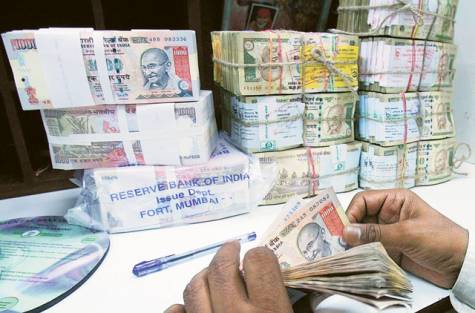
Rupee marks lowest level as investors flee

May 22, 2012

rupee_100x00

Mumbai, May 22: India's rupee fell past 55 per dollar to a record low as concern Europe's debt crisis will worsen prompted investors to pull money out of emerging-market assets.

"It has been touching lows quite regularly, said Subir Gokarn, a deputy governor at the Reserve Bank of India. "There is clearly a strong pressure on the rupee to depreciate. This is coming from a number of factors. One is clearly the current account deficit, demand from oil has been strong and the capital flows are not matching that," he said.

"We have done a number of things and will continue to do things that we think will have the impact of stabilizing the currency. But ultimately capital flows are going to be the main determinant of how the currency behaves.''

Sweeping declines

The MSCI Asia-Pacific Index of shares lost 10 per cent this month as global funds pulled $6.2 billion (Dh22.76 billion) from the stock markets of India, Indonesia, South Korea and Taiwan, according to the latest exchange data.

German and French leaders meet this week to discuss a revised plan for the euro amid concern Greece is close to an exit from the monetary union. The rupee is also weakening because India's fiscal policy is "too loose" and that is widening the current-account deficit and spurring inflation, according to BNP Paribas.

"An improvement in the situation in Europe and firmer global risk appetite is a necessary, although not sufficient, condition for the rupee to stabilise," Richard Iley, the Hong- Kong based chief economist for Asia at the French bank, wrote in a research note released yesterday. "Fiscal laxity is the root of the problem."

The rupee dropped 1.1 per cent to 55.0350 per dollar in Mumbai, according to data compiled by Bloomberg. It touched an all-time low of 55.0550 and has slumped 7.6 per cent this quarter in Asia's worst currency performance.

India's budget deficit widened to 5.9 per cent of gross domestic product in the fiscal year ended March 31, compared with a target of 4.6 per cent. finance minister Pranab Mukherjee aims to narrow the shortfall to 5.1 per cent this fiscal year.

Rising volatility

The rupee's one-month implied volatility, a measure of exchange-rate swings used to price options, was unchanged at 13 per cent. It touched this year's high of 13.27 per cent on May 18.

The central bank cut the amount of overseas income companies can hold in foreign currency this month to 50 per cent from 100 per cent, in a bid to boost dollar inflows and stem the rupee's slide.

On May 4, policy makers raised interest rates on non-rupee deposits by as much as 300 basis points and freed up borrowing costs on foreign-exchange loans to exporters.

Gold: Debt crisis dims allure

Gold declined in New York as concerns that Europe's debt crisis is worsening boosted the dollar and curbed the appeal of precious metals as alternative investments.

The euro fell as much as 0.4 per cent against the dollar as German and French officials meet today to discuss ways to contain Europe's financial turmoil. Before today, gold declined 4.3 per cent this month, while the dollar climbed 3.2 per cent against a basket of six currencies.

"The flight is towards the dollar," Bart Melek, the head of commodity strategy at TD Securities in Toronto, said in a telephone interview. "The softness in the euro is keeping gold under pressure."

Gold futures for June delivery fell 0.3 per cent to $1,587.70 an ounce at 10:01 am on the Comex in New York.

Demand for bullion in India, the world's largest consumer, dropped to the weakest since late March on May 18, UBS said in an emailed report on Monday.

Comments

Add new comment

  • Coastaldigest.com reserves the right to delete or block any comments.
  • Coastaldigset.com is not responsible for its readers’ comments.
  • Comments that are abusive, incendiary or irrelevant are strictly prohibited.
  • Please use a genuine email ID and provide your name to avoid reject.
Agencies
February 5,2020

New Delhi, Feb 5: Over five crore farmers were yet to get the third instalment of money under the Centre's ambitious PM-Kisan scheme, aimed at providing direct support of Rs 6,000 annually to them, according to the latest Ministry of Agriculture and Farmers' Welfare data.

The total amount of the scheme, which came into effect on December 1, 2018, is to be paid in three equal instalments of Rs 2,000 every four months.

The data showed about 2.51 crore farmers have not got even the second instalment and 5.16 crore of them were yet to get the third instalment.

Over 9 crore farmers have registered themselves under the scheme between December 2018 and November 2019, it said.

Of these, 7.62 crore or 84 per cent of farmers have received the first instalment.

The money through the second instalment was given to nearly 6.5 crore farmers and the amount under the third instalment was given to 3.85 crore beneficiaries, according to the data received in response to an RTI query filed by this PTI journalist.

The agriculture ministry, in its response, gave three sets of data mentioning the benefits given to farmers under the scheme between December 2018 and November 2019.

It said 4.74 crore farmers were registered between December 2018 and March 2019.

Of them, 4.22 crore received the first instalment, 4.02 crore the second and 3.85 crore the third.

There was no mention why nearly 50 lakh, 70 lakh and 90 lakh registered farmers during this period did not get the first, second and third instalment respectively.

There was no registered beneficiary in West Bengal and Sikkim, hence no amount was disbursed during this period, according to the data.

Giving details of the 3.08 crore farmers registered between April and July last year, it said 2.66 crore and 2.47 crore beneficiaries have got their first and second instalments respectively.

The RTI reply did no mention why around 40 lakh and 61 lakh registered farmers during this period did not get their first and second instalment respectively.

"The beneficiaries are eligible for the instalment for the period in which he/she gets registered and subsequent periods, thereafter. Therefore, the third instalment is not due for the beneficiaries registered in the period April 2019-July 2019," the ministry said.

There was no registered beneficiary during this period in West Bengal, Punjab and Chandigarh and therefore nobody was paid first and second instalments.

The ministry said around 1.19 crore beneficiaries were registered between August and November 30, 2019, of these nearly 73.66 lakh farmers have been given the first instalment.

There was no mention of payment of first instalment to over 45 lakh eligible beneficiaries during the period.

"The beneficiaries are eligible for the instalment for the period in which he/she gets registered and subsequent periods, thereafter. Therefore, the second and third instalments are not due for the beneficiaries registered in the period August 2019 to November 2019," it said.

The ministry was asked to provide the total number of farmers, state-wise, and the amount received by them under the Pradhan Mantri Kisan Samman Nidhi or PM-Kisan scheme.

"PM-Kisan Samman Nidhi scheme has been implemented from December 1, 2018. It is stated that PM-Kisan is a continuous and ongoing scheme, in which the financial benefits are transferred to the bank accounts of the identified beneficiaries as and when their correct and verified data is uploaded by the concerned states/union territories on PM-Kisan web portal," the ministry said in the RTI response vide its letter dated December 26, 2019.

The data of beneficiaries so uploaded by them undergoes a multi-level verification, including by banks, and only then the amount is released to the beneficiary, it said, adding that www.pmkisan.gov.in website can be accessed to get more details on the operational guidelines of the scheme.

According to the data updated on the website on February 3, around 8.82 crore farmers have been registered and 8.41 crore have received the first installment, 7.56 crore the second instalment, 6.19 crore the third and 3.03 crore have received the fourth installment.

In Assam, out of 16.97 lakh farmers registered during this period, 14.02 lakh got the first instalment, 13.72 lakh received the second and 9.87 lakh the third.

Of the 42.34 lakh registered beneficiaries in Maharashtra, 36.98 lakh got the first instalment, 31.53 lakh the second and 27.67 lakh got the third instalment.

As many as 23.83 lakh farmers in Kerala received their first instalment, 18.79 lakh got the second and 18.43 lakh the third. A total of 26.13 lakh beneficiaries were registered in the state between December 2018 and March 2019.

There was no beneficiary registered during the period from West Bengal, which has refused to implement the scheme, according to the ministry's response.

In Uttar Pradesh, nearly 9.57 lakh out of 19.64 lakh farmers have got the first instalment. In Gujarat, nearly 1.22 lakh out of 1.98 lakh registered farmers got the first instalment.

Around 9.78 lakh farmers out of the 17.18 lakh registered beneficiaries have received the first instalment in Madhya Pradesh. In Odisha, only 5,507 farmers out of 5.6 lakh registered farmers have got the first instalment, the ministry said.

None of the 7,326 farmers registered in Sikkim was paid the first instalment, according to the ministry's reply. In Delhi, 1,447 farmers out of 1,734 have got the first instalment.

Comments

Add new comment

  • Coastaldigest.com reserves the right to delete or block any comments.
  • Coastaldigset.com is not responsible for its readers’ comments.
  • Comments that are abusive, incendiary or irrelevant are strictly prohibited.
  • Please use a genuine email ID and provide your name to avoid reject.
News Network
February 3,2020

New Delhi, Feb 3: The Allahabad High Court on Monday granted bail to former BJP leader Swami Chinmayanand in the alleged rape case of a law student. He was arrested in September last year after the 23-year-old woman accused him of sexual harassment and blackmail.

The woman was a student of the Chinmayanand-controlled SS Law College in Shahjahanpur in Uttar Pradesh.

Chinmayanand is facing charges under Sections 376C (sexual intercourse by a person or persons taking advantage of their official position), 354 D (stalking), 342 (wrongful confinement) and 506 (criminal intimidation) of the Indian Penal Code (IPC).

The case is being investigated by a Special Investigation Team (SIT) formed on the directions of the Supreme Court.

The case came to light after the woman posted a video on August 23 last year on social media alleging that “a senior leader of the saint community” was harassing and threatening to kill her. The law student went missing a day later, after which her father lodged a complaint, accusing Chinmayanand of harassing his daughter.

Chinmayanand was expelled from the BJP after his arrest.

The SIT had, on November 6, submitted chargesheet in the case.

In a parallel case, the woman was charged with trying to extort money from Chinmayanad. The Allahabad High Court granted her bail in that case in December last year.

Comments

Add new comment

  • Coastaldigest.com reserves the right to delete or block any comments.
  • Coastaldigset.com is not responsible for its readers’ comments.
  • Comments that are abusive, incendiary or irrelevant are strictly prohibited.
  • Please use a genuine email ID and provide your name to avoid reject.
News Network
February 21,2020

Thiruvananthapuram, Feb 21: Hindu temples, dedicated to Lord Shiva, witnessed heavy rush on Friday as devotees celebrated Maha Shivratri festival with traditional zeal and religious fervour across Kerala.

Cutting across age barriers, devotees, including women and children, thronged small and big shrines since early morning to offer prayers and take part in special poojas and rituals on the occasion.

Devotees used to mark the auspicious occasion by observing 'orikkal' (fasting), dedicating the leaves of Koovalam plant, which is considered holy according to Hindu tradition, to the Lord and by abandoning their sleep chanting 'Om Nama Shivaya' mantras.

Ardent devotees even remain awake throughout the night and spend their whole day in temples.

The Sreekandeswaram Mahadeva Temple here, Vadakkunnathan temple in Thrissur and Maha Deva temple in Vaikom were among the major shrines which witnessed heavy rush since early morning.

Temple authorities, especially Devaswom Boards which manage many major shrines in the state, have made elaborate arrangements in Shiva temples to ensure smooth darshan for devotees.

All arrangements have been put in place on the banks of River Periyar in Aluva in Ernakulam for 'Balitharppanam', a ritual in which people pay obeisance to their ancestors.

Performing the ritual on the midnight of Shivratri is considered auspicious by devotees.

Hundreds of 'bali taras' (specially erected platforms) have been set up on the banks of the river to perform the ritual and a large number of priests have been deployed to assist devotees.

Thousands of police personnel were deployed in view of the large turnout of devotees.

Comments

Add new comment

  • Coastaldigest.com reserves the right to delete or block any comments.
  • Coastaldigset.com is not responsible for its readers’ comments.
  • Comments that are abusive, incendiary or irrelevant are strictly prohibited.
  • Please use a genuine email ID and provide your name to avoid reject.