



Rupee marks lowest level as investors flee

May 22, 2012

rupee_100x00

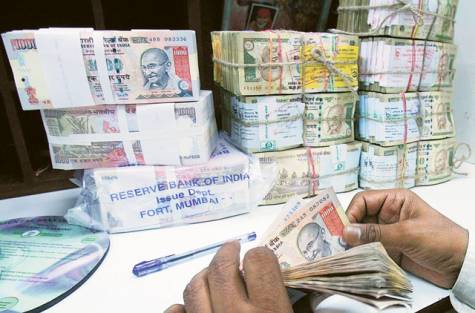
Mumbai, May 22: India's rupee fell past 55 per dollar to a record low as concern Europe's debt crisis will worsen prompted investors to pull money out of emerging-market assets.

"It has been touching lows quite regularly, said Subir Gokarn, a deputy governor at the Reserve Bank of India. "There is clearly a strong pressure on the rupee to depreciate. This is coming from a number of factors. One is clearly the current account deficit, demand from oil has been strong and the capital flows are not matching that," he said.

"We have done a number of things and will continue to do things that we think will have the impact of stabilizing the currency. But ultimately capital flows are going to be the main determinant of how the currency behaves.''

Sweeping declines

The MSCI Asia-Pacific Index of shares lost 10 per cent this month as global funds pulled $6.2 billion (Dh22.76 billion) from the stock markets of India, Indonesia, South Korea and Taiwan, according to the latest exchange data.

German and French leaders meet this week to discuss a revised plan for the euro amid concern Greece is close to an exit from the monetary union. The rupee is also weakening because India's fiscal policy is "too loose" and that is widening the current-account deficit and spurring inflation, according to BNP Paribas.

"An improvement in the situation in Europe and firmer global risk appetite is a necessary, although not sufficient, condition for the rupee to stabilise," Richard Iley, the Hong- Kong based chief economist for Asia at the French bank, wrote in a research note released yesterday. "Fiscal laxity is the root of the problem."

The rupee dropped 1.1 per cent to 55.0350 per dollar in Mumbai, according to data compiled by Bloomberg. It touched an all-time low of 55.0550 and has slumped 7.6 per cent this quarter in Asia's worst currency performance.

India's budget deficit widened to 5.9 per cent of gross domestic product in the fiscal year ended March 31, compared with a target of 4.6 per cent. finance minister Pranab Mukherjee aims to narrow the shortfall to 5.1 per cent this fiscal year.

Rising volatility

The rupee's one-month implied volatility, a measure of exchange-rate swings used to price options, was unchanged at 13 per cent. It touched this year's high of 13.27 per cent on May 18.

The central bank cut the amount of overseas income companies can hold in foreign currency this month to 50 per cent from 100 per cent, in a bid to boost dollar inflows and stem the rupee's slide.

On May 4, policy makers raised interest rates on non-rupee deposits by as much as 300 basis points and freed up borrowing costs on foreign-exchange loans to exporters.

Gold: Debt crisis dims allure

Gold declined in New York as concerns that Europe's debt crisis is worsening boosted the dollar and curbed the appeal of precious metals as alternative investments.

The euro fell as much as 0.4 per cent against the dollar as German and French officials meet today to discuss ways to contain Europe's financial turmoil. Before today, gold declined 4.3 per cent this month, while the dollar climbed 3.2 per cent against a basket of six currencies.

"The flight is towards the dollar," Bart Melek, the head of commodity strategy at TD Securities in Toronto, said in a telephone interview. "The softness in the euro is keeping gold under pressure."

Gold futures for June delivery fell 0.3 per cent to $1,587.70 an ounce at 10:01 am on the Comex in New York.

Demand for bullion in India, the world's largest consumer, dropped to the weakest since late March on May 18, UBS said in an emailed report on Monday.

Comments

Add new comment

  • Coastaldigest.com reserves the right to delete or block any comments.
  • Coastaldigset.com is not responsible for its readers’ comments.
  • Comments that are abusive, incendiary or irrelevant are strictly prohibited.
  • Please use a genuine email ID and provide your name to avoid reject.
News Network
February 29,2020

Kochi, Feb 29: When Major Abdul Rahim, a soldier in the Afghan army, died in a bomb blast in Kabul on February 19, a tear was shed for him in far away Ernakulam district of Kerala.

The major had received a transplant of hands from Eloor native T G Joseph back in 2015, and the latter’s family had grown attached to the Afghan soldier.

Maj. Abdul Rahim, a bomb disposal expert, had lost his hands in an explosion in 2012. For three years thereafter, he struggled with his handicap. Then, when 54-year-old Joseph passed away in a road accident, it was decided to give his hands to the Afghan major.

The transplant procedure was successfully performed by a team of doctors led by Dr. Subrahmania Iyer at the Amrita Institute of Medical Sciences in Kochi.

After the transplant and an intensive spell of physiotherapy, Abdul Rahim could regain a considerable part of his hands’ functions. He rejoined the army and returned to defuse bombs in his war-torn country.

In gratitude, Major Abdul Rahim would visit Kochi every year to meet Joseph’s family. 

“We were shocked to hear of the demise of Major Abdul Rahim. Though Joseph left us, a part of him lived on. Abdul Rahim was a living memorial for us. Whenever he came to the Amrita institute for a consultation, we used to visit him,” Joseph’s wife was quoted as saying by Mathrubhoomi daily.

Major Abdul Rahim struck up a good friendship with his predecessor, in a way of speaking: the first person to have had a successful hand transplant at the Amrita Institute of Medical Sciences. T R Manu became a close friend of the Afghan solider and kept regularly in touch.

Comments

Add new comment

  • Coastaldigest.com reserves the right to delete or block any comments.
  • Coastaldigset.com is not responsible for its readers’ comments.
  • Comments that are abusive, incendiary or irrelevant are strictly prohibited.
  • Please use a genuine email ID and provide your name to avoid reject.
News Network
January 7,2020

New Delhi, Jan 7: When a reign of terror was unleashed by "masked goons" in the Jawaharlal Nehru University (JNU) on Sunday, Delhi Police registered two cases against varsity students union president Aishe Ghosh, who was badly injured in the attack, within a span of five minutes.

The registration of cases on two separate complaints against Ghosh and other students filed by JNU security department on January 3 and January 4 were registered on Sunday night when the violence was on, triggering questions about the motive behind the timing.

While the FIRs against Ghosh and others were registered between 8.44 pm and 8.49 pm after the JNUSU president was admitted to AIIMS, an FIR on the Sunday violence was registered on Monday at 5.36 am against unknown persons. The Sunday violence case has been transferred to Crime Branch for further investigations.

Questions are being raised over the registration of FIRs on Sunday while the complaints were filed on the previous days. Students allege that it was an afterthought from the police and authorities, as a nationwide outrage erupted as soon as the violence was reported.

Delhi Police is under attack for not coming to the aid of students targeted by the mob of ABVP activists armed with iron rods and sticks who went on a rampage on the campus. While no single person in the Sunday violence was arrested, the police are also accused of being a "mute spectator" by allowing the rioters to leave the campus without being arrested.

In its complaints, the JNU Security Department has alleged that Ghosh and others entered into a verbal and physical scuffle with security guards, including women, when officials tried to open the Centre for Information System (CIS) that was blocked by students protesting against the fee hike and registration process.

While the January 3 complaint claims that the students switched off the power supply to the CIS and evicted staff forcefully, the January 4 complaint alleged that they damaged the information system.

They also claimed the students damaged the servers, made it dysfunctional, severely damaged optic fibre cables and broke the biometric system in the CIS. The complaint also cited a Supreme Court order that prevented any protest within 100 metres of Administration Block and claimed the students violated the direction.

The FIR filed on Sunday violence on the basis of the statement of Inspector Anand Yadav said that the first phase of violence was reported at 3.45 pm when "40-50 unidentified" people who had "covered their faces" attacked students in Periyar Hostel and the situation was brought under control.

However at around 7 pm, "50-60 people with rods in their hands" targeted students in Sabarmati Hostel in which students were attacked and public property destroyed.

The FIR said that students were injured but skipped the mention of the attack on teachers, who were injured. At least two faculty members Sucharita Sen and Ameet Parameswaran were taken to AIIMS while several other teachers suffered minor injuries.

Comments

Add new comment

  • Coastaldigest.com reserves the right to delete or block any comments.
  • Coastaldigset.com is not responsible for its readers’ comments.
  • Comments that are abusive, incendiary or irrelevant are strictly prohibited.
  • Please use a genuine email ID and provide your name to avoid reject.
News Network
January 8,2020

Howrah, Jan 8: Following the 'Bharat Bandh' called by trade unions, protesters blocked railway tracks in Howrah and Kanchrapara in North 24 Parganas on Wednesday.

They raised anti-government slogans and criticised the Center for its policies. They were holding placards, posters and banners against the government.

Commuters faced difficulties as bus services were also affected. CPI (M) protesters also stopped the operation of state transport buses. In Odisha, the public agitation started around 6 am at Talcher, Bhubaneswar, Brahmapur, Bhadrak and Kendujhargarh.

Due to the protests, the following trains are detained enroute at different stations --Bhadrak-Brahmapur passenger at Bhadrak, Kendujhargarh-Bhubaneswar passenger at Kendujhargarh, Bhubaneswar-Balangir InterCity at Bhubaneswar, Howrah-Yesvantpur Express at Brahmapur, Ichhapur-Cuttack MEMU at

Brahmapur and Puri-Rourkela passenger at Bhubaneswar.

The ten central trade unions including Centre of Indian Trade Unions (CITU), Indian National Trade Union Congress (INTUC), among others have given the call for strike with a 12-point charter of demand. Trade union Bharatiya Mazdoor Sangh (BMS) is not taking part in the strike.

Comments

Add new comment

  • Coastaldigest.com reserves the right to delete or block any comments.
  • Coastaldigset.com is not responsible for its readers’ comments.
  • Comments that are abusive, incendiary or irrelevant are strictly prohibited.
  • Please use a genuine email ID and provide your name to avoid reject.