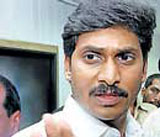
DA case: CBI continues grilling Jagan for third day

May 27, 2012

jagan

Hyderabad, May 27: Kadapa MP Y S Jaganmohan Reddy today appeared before the CBI here amid heavy security for the third consecutive day today for his questioning in the alleged disproportionate assets case registered against him.

Jagan's financial advisor Vijay Sai Reddy (another accused in the case) also accompanied him to the Dilkusha guest house.

The Kadapa MP is being grilled by the CBI since May 25 over the VANPIC project and for allegedly getting investments of several crores into his businesses from various firms and investors on quid pro quo arrangements, when his father late Y S Rajasekhara Reddy was the chief minister of Andhra Pradesh.

The YSR Congress chief, who was questioned for over eight and seven hours in the last two days, had yesterday said he had replied to clarifications sought by the CBI and has been asked to come again before the investigating agency on Sunday, after it sought further clarifications.

Jagan is likely to appear before a CBI court here in Nampally tomorrow after the court summoned him along with other accused to appear before it after taking cognisance of the first charge sheet filed in the illegal assets case.

Jagan's anticipatory bail petition will also come up for further hearing tomorrow with CBI being asked to file its counter. In view of his likely appearance before the court, Hyderabad Police have enhanced security in and around Nampally court complex by deploying additional police forces, besides installing CCTVs along the road and surroundings leading to the court. In order to prevent any untoward incident in the event of Jagan's arrest, Hyderabad police have already clamped Section 144 of CrPC in the city, besides heavy deployment of AP Special Police and RAF personnel on Raj Bhavan road where the Dilkusha guest house is located.

The CBI, which has so far filed three charge sheets in the case, charged Jagan and his father of hatching a conspiracy to defraud the government with Jagan influencing his father in doling out certain favours to various investors, who made investments of several crores into Jagan's businesses as a quid pro quo arrangement.

Comments

Add new comment

  • Coastaldigest.com reserves the right to delete or block any comments.
  • Coastaldigset.com is not responsible for its readers’ comments.
  • Comments that are abusive, incendiary or irrelevant are strictly prohibited.
  • Please use a genuine email ID and provide your name to avoid reject.
Agencies
May 26,2020

The Shopping Centres Association of India (SCAI) on Monday said the sector has lost over Rs 90,000 crore in the last two months, owing to the lockdown, and market players need much more than the repo rate cut and the loan moratorium extended by the RBI.

In a statement, the industry body said that the Reserve Bank of India's (RBI) relief measures are not adequate to support the liquidity needs of the industry.

According to the SCAI, there is a common misconception that the shopping centres' industry is centred around metros and large cities with investments only from large developers, private equity players and foreign investors.

"However, the fact is that most malls are part of the SMEs or standalone developers. i.e. more than 550 are single owned by standalone developers out of the 650-odd organised shopping centres across the country and there are 1,000+ small centres in smaller cities," it said.

Amitabh Taneja, Chairman of SCAI said: "The organised retail industry is in distress and has not earned anything since the lockdown and their survival is at stake. While the extension of the loan moratorium talks about some relief on repayment but won't help the industry in liquidity."

He said that a long term beneficial plan from the government is much required to revive the sector.

"Being the most safe, accountable, and controlled environment, unfortunately, malls have not been permitted to open which will lead to job losses and might even shut shops for a lot of mall developers," Taneja said.

In its representations to the Centre and the Reserve Bank of India, the association has also pointed out that, in absence of financial package and stimulus from the RBI, over 500 shopping centres may go bankrupt, that may lead to the banking industry staring at NPAs of Rs 25,000 crore.

The industry body has put forward its recommendations and requests to the government. It had sought moratorium till March 2021 at the least in terms of repayment of bank loans, interest, EMI and so on, without levy of any penalties or penal interest.

It has also sought a one-time loan restructuring with lower rates of interest, permitted for shopping centres and a facilitative and forward-looking support provision of short-term financing options for a period of six to 12 months, at lower interest rates, to meet the increased working capital requirements.

Among other relaxations, it had also appealed for GST rebates to offset the losses on account of and for the period of closure of business.

It also said that interest rates should be brought down to "manageable levels" of 5-6% in view of the precarious financial situation.

Comments

Add new comment

  • Coastaldigest.com reserves the right to delete or block any comments.
  • Coastaldigset.com is not responsible for its readers’ comments.
  • Comments that are abusive, incendiary or irrelevant are strictly prohibited.
  • Please use a genuine email ID and provide your name to avoid reject.
Agencies
April 24,2020

New Delhi, Apr 24: Congress leader Rahul Gandhi has termed the government decision to freeze Dearness Allowance of Central government employees for a year as "insensitive and inhuman."

The former Congress President in a tweet said: "Lakhs and crores are being spent on the Bullet Train and New Delhi's Central Vista which should have been suspended, but the government has deducted DA of Central government employees and pensioners... It is insensitive and inhuman."

"The tragic part is that by deducting this amount from January 1, 2020 up to 30th June, 2021 for a period of 1.5 years, the government of India proceeds to deduct almost Rs 38 thousand crore from the income of these middle class government employees and pensioners, who rely completely on the pay and pensions that they receive," said Randeep Surjewala, chief spokesperson of Congress.

There are about 50 lakh such serving government employees and about 62 lakh pensioners.

"Even more tragic and objectionable is the fact that the government of India has not even spared our armed forces. The government has deducted Rs 11 thousand crore of the 15 lakh serving armed forces personnel and nearly 26 lakh military pensioners. What is their fault? They are serving the nation in times of all types of crises," said Surjewala.

The Congress alleged that the government did not spare the savings scheme.

Instead of curbing the wasteful expenditure, the government has been constantly hitting at the income of government employees and the middle class, it added.

Comments

Add new comment

  • Coastaldigest.com reserves the right to delete or block any comments.
  • Coastaldigset.com is not responsible for its readers’ comments.
  • Comments that are abusive, incendiary or irrelevant are strictly prohibited.
  • Please use a genuine email ID and provide your name to avoid reject.
News Network
April 24,2020

New Delhi, Apr 24: The trajectory of COVID-19 cases could have plateaued and might even fall for some weeks after the lockdown is lifted but India is likely to see a second wave in late July or August with a surge in the number of cases during the monsoon, say scientists.

The timing of the peak will depend on how India is able to control physical distancing and on the level of infection spreads after restrictions are relaxed, they said.

It looks apparent that the trajectory of daily new cases has reached a plateau and eventually it will take a downward fall, maybe for some weeks or even months, Samit Bhattacharya, associate professor at the Department of Mathematics, Shiv Nadar University, said.

Still, we may get a surge of new cases of the same coronavirus and this will be considered a second wave, Bhattacharya explained.

The second epidemic may come back in late July or August in the monsoon, although the peak timing will depend on how we control social distancing during that time, he said.

Rajesh Sundaresan, professor at Bengaluru's Indian Institute of Science (IISc), agreed.

“Once we return to normal activity levels, there is a chance that infection may begin to rise again. China is seeing this to some extent post easing of some restrictions on travel,” Sundaresan, corresponding author of a working paper by researchers at IISc and the Tata Institute of Fundamental Research (TIFR) in Mumbai, said.

On March 25, when the number of coronavirus cases was 618 with 13 deaths, the government announced a nationwide lockdown that was later extended to May 3.

On Friday, the death toll due to COVID-19 rose to 718 and the number of cases to 23,077, according to the Union Health Ministry.

In good news, officials said this week that the doubling rate of cases has slowed down in the period, going from 3.4 days before lockdown to 7.5 days, with 18 states doing better than the national average. The recovery rate has also almost doubled in the last 10 days.

"Looking at the new cases in the past few days, it seems the growth of new daily infection is much slower than earlier. This apparently indicates that we might have reached at the plateau of the growth curve, Bhattacharya said.

He noted that recent studies in China and Europe observed that the infection might relapse in those people who have already recovered from earlier phases.

So, there is no evidence that the earlier infection may help acquire immunity against the second infection. And in that way, the entire population may be vulnerable to the second wave to some extent, said the scientist.

In their study unveiled this week, IISc and TIFR researchers analysed the impact of strategies such as case isolation, home quarantine, social distancing and various post-lockdown restrictions on COVID-19 that might remain in force for some time.

The study modelled on Bengaluru and Mumbai suggests the infection is likely to have a second wave and the public health threat will remain, unless steps are taken to aggressively trace, localise, isolate the cases, and prevent influx of new infections.

The new levels and the peaking times for healthcare demand depend on the levels of infection spreads in each city at the time of relaxation of restrictions, they said.

The lockdown is currently upon us. It has given us valuable time. Let us test, trace, quarantine, isolate, practice better hygiene, search for a vaccine, etc. We should do these anyway, and these are being done. When and how to lift the lockdown is going to be a difficult decision to make, said Sundaresan.

It's clear that it's going to be phased. What our team is focusing on is to come up with tools to help the decision makers assess the public health impact of various choices, he said.

According to the experts, infectious diseases spread via contact between infectious and susceptible people. In the absence of any control measures, an outbreak will grow as long as the average number of people infected by each infectious person is more than one.

Once enough people are immune there will be fewer people susceptible to the infection and the outbreak will die.

However, when an outbreak is brought under control by social distancing and other interventions, it is possible only a small proportion of the population will have been infected and gained immunity, they said.

This means enough susceptible people may remain to fuel a second wave if controls are relaxed and infection is reintroduced.

Until the vaccine comes on the market, we have to remain alert Once sporadic cases occur here and there in the country, we immediately need to implement quarantine or social distancing locally for the people in that region, and also need to perform tests to identify positive cases irrespective of showing symptoms, Bhattacharya explained.

Note that these monsoon months are also flu season in many places of India. So, we should not ignore the early signs of the flu symptoms. Irrespective of symptoms, we need to increase tests in the hotspots to identify people and contain the surge, he said.

Sundaresan added that the timeline for a second wave will depend on a lot of circumstances which may change as the time passes.

Significant testing may have been underway, there may be behavioural changes with people becoming more careful about their hygiene, wearing masks may become more common, etc. All these responses may help restrict the second wave, he said.

A study published in The Lancet journal earlier this month modelled the potential adverse consequences of premature relaxation of interventions, and found it might lead to a second wave of infections.

The finding is critical to governments globally, because it warns against premature relaxation of strict interventions, the researchers said.

While interventions to control the spread of SARS-CoV-2 are in place, countries will need to work toward returning to normalcy; thus, knowledge of the effect of each intervention is urgently required, they said in the study.

According to a recent analysis by the Harvard Chan School of Public Health, the best strategy to ease the critical care burden and loss of life from COVID-19 might be on-again, off-again social distancing.

In the absence of such interventions, surveillance and intermittent distancing may need to be maintained into 2022, which would present a substantial social and economic burden, the researchers wrote.p


Comments

Add new comment

  • Coastaldigest.com reserves the right to delete or block any comments.
  • Coastaldigset.com is not responsible for its readers’ comments.
  • Comments that are abusive, incendiary or irrelevant are strictly prohibited.
  • Please use a genuine email ID and provide your name to avoid reject.