



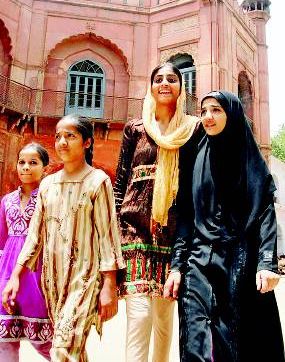
350 years on, girls enter boys-only school

May 27, 2012

girlsdelhi

New Delhi, May 27: For the first time in its history, burqas will sweep down the narrow stairs and edges of dupattas brush the ancient walls of the Anglo-Arabic Senior Secondary School. No longer only for boys, the 350-year-old school at Ajmeri Gate is girding up for the change, a massive step for a school that recruited its first woman teacher only in 2006. The banner at the entrance says, "Admission [is] open for girls" and for once, along with the students, the school has a lot of prep to do.

The Delhi high court ordering the Directorate of Education and Delhi Police to ensure the school's decision to go co-ed is "duly implemented" made it possible. By Saturday afternoon, four girls had joined - two in Class XI, one in Class VIII, the youngest in VI, and all in English-medium. The school's governing body, Delhi Education Society, is hoping they'll have at least 50 girls using their classrooms by the time term begins.

Three of the four girls were studying at local girls' schools. "I wanted commerce but my school had only arts. That's why I am joining here," says Darakshan Fatima (17). If there's one major flaw in the existing institutions for girls that compels them to seek admission at Anglo-Arabic, it's that they do not offer science or commerce, perhaps assuming girls don't have the temperament for it. "Even when we recruit, almost all the women applicants have studied arts," says Khalil Ahmed, joint secretary, Delhi Education Society. Darakshan hopes to be a chartered accountant and her fellow applicant, Mehwish Rehmani (16), wants to teach math. The other two girls, Gulafshan (12) and Ramsha (13), are sisters of Darakshan.

Having functioned in a particular way for three-and-a-half centuries, the school authorities are trying to make the transition as smooth as possible. At least one toilet has to be freed for the girls and a space cleared up for a common room. The uniform will probably be salwar-kameez-dupatta in grey and white.

"We'll make any investment to make them comfortable," says manager Atyab Siddiqui. "Immediately after school reopens, we will have a workshop with psychologists and counsellors to talk to teachers and students." Science teachers Pervez Ahmed and Aftab Alam have already started talking to their students. "I gave them the example of Hamdard Public School," says Alam. "If our Walled-City kids can attend a co-ed school there, what's wrong with having one here?" Khalil says, "A girls' school was necessary. No new school for girls has come up in the area in the last two-three decades but population has gone up." The school is planning self-defence classes for girls.

"I know Darakshan. If boys trouble her, she'll fix them," says Shahina Furquan, teaching commerce at the Anglo-Arabic Model School - a sister concern operating from the same compound. She had been asked to help draw girls to the school; she approached 60-70 sets of parents. "Most said no directly, some said they'll think about it. Parents are worried about the safety of the girls in a what has been a boys' school for so long," she says.

Only three of the 48 teachers at Anglo-Arabic are women. Faiza Nisar Ali, recruited in 2006, was the first one and was called upon to prepare the "feasibility report". "There are a number of recruitments in the pipeline. We'll give preference to women from now," says Jamia professor Azra Razzack who is the secretary of the school governing body.

All the girls, except one, are shifting from girls' schools. "We have to face boys in college anyway," says Darakshan. "We may as well get used to it now."

That Mehwish is continuing with school at all is the result of a mother's determination to see her daughter succeed. Nazma Perveen's family, even husband, had been against the idea. "But I want Mehwish to go as far as she can,' says Perveen whose academic career was cut short in Class VIII when she got married. "I don't want Mehwish's life to turn out like mine. She wants to teach math. She's very good at it," she says, adding wistfully, "I was too."

Comments

Add new comment

  • Coastaldigest.com reserves the right to delete or block any comments.
  • Coastaldigset.com is not responsible for its readers’ comments.
  • Comments that are abusive, incendiary or irrelevant are strictly prohibited.
  • Please use a genuine email ID and provide your name to avoid reject.
News Network
February 24,2020

New Delhi, Feb 24: They hail from vastly different backgrounds — Donald Trump is the son of a property tycoon while Narendra Modi is a descendant of a poor tea-seller.

Yet the two teetotallers, loved by right-wing nationalists in their home countries, share striking similarities that have seen them forge a close personal bond, analysts say.

Ahead of the American leader's first official visit to India, which begins in Modi's home state of Gujarat on Monday, the world's biggest democracy has gone out of its way to showcase the chemistry between them.

In Gujarat's capital Ahmedabad, large billboards with the words "two dynamic personalities, one momentous occasion" and "two strong nations, one great friendship" have gone up across the city.

"There's a lot that Trump and Modi share in common, and not surprisingly these convergences have translated into a warm chemistry between the two," Michael Kugelman of the Washington-based Wilson Center said.

"Personality politics are a major part of international diplomacy today. The idea of closed-door dialogue between top leaders has often taken a backseat to very public and spectacle-laden summitry."

Since assuming the top political office in their respective countries — Modi in 2014 and Trump in 2017 — the two men have been regularly compared to each other.

Trump, 73, and Modi, 69, both command crowds of adoring flag-waving supporters at rallies. A virtual cult of personality has emerged around them, with their faces and names at the centre of their political parties' campaigns.

A focus of Trump's administration has been his crackdown on migrants, including a travel ban that affects several Muslim-majority nations, among others, while critics charge that Modi has sought to differentiate Muslims from other immigrants through a contentious citizenship law that has sparked protests.

Both promote their countries' nationalist and trade protectionist movements — Trump with his "America First" clarion call and Modi with his "Make in India" mantra.

And while they head the world's largest democracies, critics have described the pair as part of a global club of strongmen that includes Russia's Vladimir Putin and Brazil's Jair Bolsonaro.

"There are many qualities that Trump and Modi share — a love for political grandstanding and an unshakable conviction that they can achieve the best solutions or deals," former Indian diplomat Rakesh Sood said.

Modi and Trump have sought to use their friendship to forge closer bonds between the two nations, even as they grapple with ongoing tensions over trade and defence.

Despite sharing many similarities in style and substance, analysts say there are some notable differences between the pair.

Modi is an insider who rose through the ranks of the Bharatiya Janata Party after starting out as a cadre in Rashtriya Swayamsevak Sangh.

Trump is a businessman and a political outsider who has in some sense taken over the Republican Party.

"Modi is a more conventional leader than is Trump in that he hasn't sought to revolutionise the office he holds in the way that Trump has," said Kugelman, a longtime observer of South Asian politics.

He added that genuine personal connections between leaders of both countries have helped to grow the partnership.

"George Bush and Manmohan Singh, Barack Obama and Singh, Obama and Modi, now Modi and Trump — there has been a strong chemistry in all these pairings that has clearly helped the relationship move forward," he added.

Trump has also stood by the Indian leader during controversial decisions, including his revocation of autonomy for Kashmir and his order for jets to enter Pakistani territory following a suicide bombing.

Analysts said the leaders would use the visit to bolster their image with voters.

A mega "Namaste Trump" rally in Ahmedabad on Monday will be modelled after the "Howdy, Modi" Houston extravaganza last year when the Indian leader visited the US and the two leaders appeared before tens of thousands of Indian-Americans at a football stadium.

"The success of this visit... will have a positive impact on his (Trump's) re-election campaign and the people of Indian origin who are voters in the US — a majority of them are from Gujarat," former Indian diplomat Surendra Kumar said.

"On the Indian side, the fact that Prime Minister Modi... (shares) such warmth, bonhomie and informality with the most powerful man on Earth adds to his stature... as well as with hardcore supporters."

Comments

Add new comment

  • Coastaldigest.com reserves the right to delete or block any comments.
  • Coastaldigset.com is not responsible for its readers’ comments.
  • Comments that are abusive, incendiary or irrelevant are strictly prohibited.
  • Please use a genuine email ID and provide your name to avoid reject.
News Network
January 9,2020

Raipur, Jan 9: An outbreak of bird flu has been reported from a state-run poultry farm in Chhattisgarh's Korea district, prompting the authorities to cull over 15,000 birds and step up vigil on poultry birds within 10 km radius of the affected area, officials said on Thursday.

So far, 15,426 chickens and quails have been culled and 30,000 eggs destroyed after the highly contagious H5N1 virus was detected among birds at the poultry farm and hatchery in Baikunthpur town, located around 300 km from here, they said.

There has been no case of infection in humans so far due to the outbreak of avian influenza, they said.

"After some chickens and quails were found dead on December 7 last year in the farm, their samples were collected and sent to local laboratories for testing," Dr R S Baghel, deputy director, veterinary department, Korea, told news agency.

When the disease was not properly detected, samples were further sent to Jabalpur in Madhya Pradesh where veterinarians suggested symptoms of chronic respiratory disease, following which their line of treatment was followed.

"Despite the treatment, the abnormal deaths of birds continued," Baghel said.

Later, the samples were sent to Bhopal-based National Institute of High-Security Animal Diseases where tests were found positive for the H5N1 virus on December 23, he said.

"Immediately after getting reports of bird flu, we took permission from the Korea district administration, as per the standard procedure, and culled all 15,426 birds (chickens and quails) and destroyed 30,000 eggs in the farm and its adjoining areas," the official said.

Of the total culled birds, nearly 641 chickens were being reared by locals within one km radius of the farm. The locals were given compensation for the culling of their birds, he said.

"We have completed the culling process and sealed the farm. After sanitising the area in 10 km of its radius, we submitted a report to the state's directorate of veterinary services on Wednesday," Baghel said.

"No human has been affected due to the outbreak and the situation is under control. We are waiting for further directives from the higher authorities," he said.

The official said for the next three months, they will be conducting surveillance in 10 km radius of the affected area during which blood samples of birds will be regularly sent to Bhopal for testing.

"We will continue our observation for next three months," he added.

Meanwhile, state veterinary services director C R Prasanna said, "No human has so far been affected due to avian influenza and workers at the poultry farm at Baikunthpur have been given medicines as a precautionary measure."

Nearly 40 villages fall within the purview of 10 km radius of the affected area from where random sampling of poultry birds will be done for next three months to check whether they are infected with avian influenza, he said.

"Necessary steps are being taken to prevent bird flu from spreading to other areas," he added.

Comments

Add new comment

  • Coastaldigest.com reserves the right to delete or block any comments.
  • Coastaldigset.com is not responsible for its readers’ comments.
  • Comments that are abusive, incendiary or irrelevant are strictly prohibited.
  • Please use a genuine email ID and provide your name to avoid reject.
Agencies
July 13,2020

Kolkata, July 13: Debendra Nath Roy, a member of the West Bengal legislative assembly (MLA) from the Bharatiya Janata Party (BJP), was found dead near his house in north Bengal’s Uttar Dinajpur district on Monday morning.

BJP leaders and his family members have alleged that he was murdered. 

BJP president JP Nadda has expressed “shock” at Roy’s “deplorable and suspected heinous killing” and condemned the incident.

He questioned the rise of “gunda raj” in West Bengal under Chief Minister Mamata Banerjee’s watch amid the worsening law and order in the state, which is slated to hold assembly polls next year, where the BJP is seen to be the primary challenger to the CM’s citadel.

“The suspected heinous killing of Debendra Nath Ray, BJP MLA from Hemtabad in West Bengal, is extremely shocking and deplorable. This speaks volumes of the gunda raj and failure of law and order in the Mamata Banerjee-led government. People will not forgive such a government in the future. We strongly condemn the incident,” he tweeted.

The BJP has demanded a Central Bureau of Investigation (CBI) probe into the lawmaker’s unnatural death.

His body was found in the balcony of a shop near his house at Bondol in Hemtabad, Uttar Dinajpur district, on Monday morning.

“The body has been sent for autopsy. We are investigating the case. No one has been detained for questioning or arrested so far,” said a police official from Uttar Dinajpur district, requesting anonymity.

“Roy was murdered. The way his body was found suggests that it was a premeditated murder and the accused tried to pass it off as a suicide. The ruling TMC (Trinamool Congress) is involved in his murder,” alleged Rahul Sinha, national secretary, BJP.

The TMC, however, refuted the BJP’s allegations.

“I heard that he (Roy) died by suicide. Police are investigating the case. Let the truth come out. If he has been murdered, then the culprits should be identified and punished as per law,” said Kanhaiyalal Agarwal, a TMC leader from Uttar Dinajpur district.

BJP leaders said some people had called Roy around 1 am on Monday and he went out of his home. His body was found on Monday morning.

Roy had won the Bengal assembly elections from Hemtabad on a Communist Party of India (Marxist) ticket in 2016, but joined the BJP last year.

Comments

Add new comment

  • Coastaldigest.com reserves the right to delete or block any comments.
  • Coastaldigset.com is not responsible for its readers’ comments.
  • Comments that are abusive, incendiary or irrelevant are strictly prohibited.
  • Please use a genuine email ID and provide your name to avoid reject.