


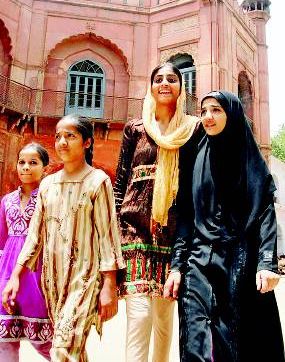
350 years on, girls enter boys-only school

May 27, 2012

girlsdelhi

New Delhi, May 27: For the first time in its history, burqas will sweep down the narrow stairs and edges of dupattas brush the ancient walls of the Anglo-Arabic Senior Secondary School. No longer only for boys, the 350-year-old school at Ajmeri Gate is girding up for the change, a massive step for a school that recruited its first woman teacher only in 2006. The banner at the entrance says, "Admission [is] open for girls" and for once, along with the students, the school has a lot of prep to do.

The Delhi high court ordering the Directorate of Education and Delhi Police to ensure the school's decision to go co-ed is "duly implemented" made it possible. By Saturday afternoon, four girls had joined - two in Class XI, one in Class VIII, the youngest in VI, and all in English-medium. The school's governing body, Delhi Education Society, is hoping they'll have at least 50 girls using their classrooms by the time term begins.

Three of the four girls were studying at local girls' schools. "I wanted commerce but my school had only arts. That's why I am joining here," says Darakshan Fatima (17). If there's one major flaw in the existing institutions for girls that compels them to seek admission at Anglo-Arabic, it's that they do not offer science or commerce, perhaps assuming girls don't have the temperament for it. "Even when we recruit, almost all the women applicants have studied arts," says Khalil Ahmed, joint secretary, Delhi Education Society. Darakshan hopes to be a chartered accountant and her fellow applicant, Mehwish Rehmani (16), wants to teach math. The other two girls, Gulafshan (12) and Ramsha (13), are sisters of Darakshan.

Having functioned in a particular way for three-and-a-half centuries, the school authorities are trying to make the transition as smooth as possible. At least one toilet has to be freed for the girls and a space cleared up for a common room. The uniform will probably be salwar-kameez-dupatta in grey and white.

"We'll make any investment to make them comfortable," says manager Atyab Siddiqui. "Immediately after school reopens, we will have a workshop with psychologists and counsellors to talk to teachers and students." Science teachers Pervez Ahmed and Aftab Alam have already started talking to their students. "I gave them the example of Hamdard Public School," says Alam. "If our Walled-City kids can attend a co-ed school there, what's wrong with having one here?" Khalil says, "A girls' school was necessary. No new school for girls has come up in the area in the last two-three decades but population has gone up." The school is planning self-defence classes for girls.

"I know Darakshan. If boys trouble her, she'll fix them," says Shahina Furquan, teaching commerce at the Anglo-Arabic Model School - a sister concern operating from the same compound. She had been asked to help draw girls to the school; she approached 60-70 sets of parents. "Most said no directly, some said they'll think about it. Parents are worried about the safety of the girls in a what has been a boys' school for so long," she says.

Only three of the 48 teachers at Anglo-Arabic are women. Faiza Nisar Ali, recruited in 2006, was the first one and was called upon to prepare the "feasibility report". "There are a number of recruitments in the pipeline. We'll give preference to women from now," says Jamia professor Azra Razzack who is the secretary of the school governing body.

All the girls, except one, are shifting from girls' schools. "We have to face boys in college anyway," says Darakshan. "We may as well get used to it now."

That Mehwish is continuing with school at all is the result of a mother's determination to see her daughter succeed. Nazma Perveen's family, even husband, had been against the idea. "But I want Mehwish to go as far as she can,' says Perveen whose academic career was cut short in Class VIII when she got married. "I don't want Mehwish's life to turn out like mine. She wants to teach math. She's very good at it," she says, adding wistfully, "I was too."

Comments

Add new comment

  • Coastaldigest.com reserves the right to delete or block any comments.
  • Coastaldigset.com is not responsible for its readers’ comments.
  • Comments that are abusive, incendiary or irrelevant are strictly prohibited.
  • Please use a genuine email ID and provide your name to avoid reject.
Agencies
February 11,2020

Bhadohi, Feb 11: With just two days left for the State Budget Session, a widow from Uttar Pradesh''s Bhadohi district has accused BJP MLA Ravindranath Tripathi and six others of sexual harassment over the years, the police said.

The incident is likely to cause considerable embarrassment to the ruling Yogi Adityanath government.

Bhadohi Superintendent of Police (SP) Ram Badan Singh said: "The woman, whose husband died in 2007, met the BJP MLA Ravindranath Tripathi''s nephew in 2014. She said that she was physically exploited by him for many years on the pretext of marriage."

The complainant also said that the nephew then got her lodged in a Bhadohi hotel for about a month during the 2017 Uttar Pradesh Assembly elections, "where she was raped by the MLA and his other family members".

The case has been handed over to the Additional Superintendent of Police for further investigations.

A case is yet to be registered.

The Uttar Pradesh Budget Session starts from Thursday.

Comments

Add new comment

  • Coastaldigest.com reserves the right to delete or block any comments.
  • Coastaldigset.com is not responsible for its readers’ comments.
  • Comments that are abusive, incendiary or irrelevant are strictly prohibited.
  • Please use a genuine email ID and provide your name to avoid reject.
News Network
May 6,2020

May 6: The government on Tuesday said that the Food Corporation of India, the nodal agency for procurement and distribution of foodgrains, has sufficient stocks in its godowns, even after meeting the requirement of additional wheat and rice provided free of cost during the lockdown period.

Food Minister Ram Vilas Paswan has given detailed information about the various steps taken by the government and the total stocks of food grains and pulses available with the government and sent to the states till now, an official statement said.

"FCI currently has 276.61 lakh tonnes rice and 353.49 lakh tonnes wheat. Hence a total of 630.10 lakh tonnes food grain stock is available," it said.

As against this, about 60 lakh tonnes of food grains is required for a month under the NFSA (National Food Security Act) and other welfare schemes.

Paswan said FCI stocks are comfortable even after fulfilling extra commitments during the lockdown.

Under the 'Pradhan Mantri Garib Kalyan Ann Yojana', the Centre is providing 5 kg of free food grains per month to 80 crore ration card holders. This free of cost wheat and rice will be provided for three months. Besides, 1 kg of pulses will also be supplied per family.

This is over and above the normal quota of 5 kg of food grains provided per month per person to about 80 crore people under the food law.

The minister informed that since the lockdown, about 69.52 lakh tonnes of food grains have been transported through 2,483 rail rakes.

Apart from rail route, transportation was also done through roads and waterways. A total of 137.62 lakh tonnes has been transported.

During the lockdown, NGOs and social institutions running relief camps can purchase wheat and rice directly from FCI Depots at Open Market Sales Scheme (OMSS) rate.

The state governments can also purchase food grains directly from FCI. Under the OMSS, the rate of rice is fixed at Rs 22 per kg and wheat at Rs 21 per kg.

Under the 'Pradhan Mantri Garib Kalyan Ann Yojana', for the next 3 months a total of 104.4 lakh tonnes rice and 15.6 lakh tonnes of wheat is required of which 59.50 lakh tonnes rice and 8.14 lakh tonnes wheat have been lifted by various states and UTs.

The Government of India is bearing 100 per cent financial burden of approximately Rs 46,000 crore under the scheme, the statement said.

For pulses, the total requirement for the next three months is 5.82 lakh tonnes.

So far, 2,20,727 tonnes of pulses have been dispatched, while 1,47,165 tonnes of pulses have reached the states/UTs and 47,490 tonnes have been delivered, it said.

Comments

Add new comment

  • Coastaldigest.com reserves the right to delete or block any comments.
  • Coastaldigset.com is not responsible for its readers’ comments.
  • Comments that are abusive, incendiary or irrelevant are strictly prohibited.
  • Please use a genuine email ID and provide your name to avoid reject.
News Network
May 28,2020

May 28: Abdul Kareem was forced out of school and into a life of odd jobs like repairing bicycles before he finally managed to pull his family out of abject poverty transporting goods across Delhi in a mini truck.

The job, and the slim financial security that came with it, was the first stepping stone to a better life.

All that is now gone as India reels under the economic impact of its protracted coronavirus lockdown. Mr Kareem's out of a job and stranded in his village in Uttar Pradesh with his wife and two children. Their minuscule savings from his Rs 9,000 a month job have been exhausted, and the money he saved for books and school uniforms is spent.

"I don't know what the job situation will be in Delhi once we go back," Mr Kareem said. "We can't stay hungry so I will do whatever I find."

At least 49 million people across the world are expected to plunge into "extreme poverty" -- those living on less than $1.90 per day -- as a direct result of the pandemic's economic destruction and India leads that projection, with the World Bank estimating some 12 million of its citizens will be pushed to the very margins this year.

Some 122 million Indians were forced out of jobs last month alone, according to estimates from the Center for Monitoring Indian Economy, a private sector think tank. Daily wage workers and those employed by small businesses have taken the worst hit. These include hawkers, roadside vendors, workers employed in the construction industry and many who eke out a living by pushing handcarts and rickshaws.

For Prime Minister Narendra Modi, who came to power in 2014 promising to lift the poorest citizens out of poverty, the fallout from the lockdown brings with it significant political risk. He won an even larger second term majority last year on the strength of his government's popular social programs that directly targeted the poor, such as the provision of cooking gas cylinders, power and public housing. The breadth and depth of this renewed economic pain will only increase the pressure on his government as it works to steer the country's economy back on track.

"Much of the Indian government's efforts to mitigate poverty over the years could be negated in a matter of just a few months," said Ashwajit Singh, managing director of IPE Global, a development sector consultancy that advises several multinational aid agencies. Noting that he did not expect unemployment rates to improve this year, Singh said: "More people could die from hunger than the virus."

Desperate Times

Mr Singh points to a United Nations University study estimating 104 million Indians could fall below the World Bank-determined poverty line of $3.2 a day for lower-middle-income countries. This will take the proportion of people living in poverty from 60% -- or 812 million currently, to 68% or 920 million -- a situation last seen in the country more than a decade ago, he said.

A World Bank report found the country had been making significant progress and was close to losing its status as the country with the most poor citizens. The impact of PM Modi's lockdown risks reversing those gains.

The World Bank and the CMIE estimates were published in late April and early May respectively. Since then the situation has only become grimmer, with harrowing images of people making desperate attempts to reach their villages, on crowded buses, the flatbeds of trucks and even on foot or on bicycles dominating media coverage.

The Rustandy Center for Social Sector Innovation at the University of Chicago Booth School of Business analyzed the unemployment data from the CMIE, collected through surveys covering about 5,800 homes across 27 states in April.

Researchers found rural areas were the hardest hit, and the economic misery was the result of the lockdown, rather than the spread of infections in the hinterland. More than 80% of households had experienced a drop income and many won't survive much longer without aid, they wrote in a report.

The government has promised cheap credit to farmers, direct transfer of money to the poor and eased access to food security programs -- but these help people who have some documentation, which many of the poorest don't. With millions of impoverished people now in transit across the country, the food security situation is dire -- news reports are emerging of people foraging through piles of rotting fruit or eating leaves.

Shattered Economy

The economy was already growing at its slowest pace in over a decade when the virus struck. The lockdown, which came into effect on March 25, has hammered it, stalling business activity and putting a lid on consumption, pushing the economy to what may be its first full-year contraction in more than four decades.

It's dire enough to warrant the country exiting its lockdown, as it has been doing incrementally since May 4, even as its infections are surging. India is now Asia's virus hotspot with infections crossing 151,000 according to data from Johns Hopkins University.

PM Modi, who has come under criticism for the pain inflicted on the poor, has said his government will spend $265 billion or about 10% of its GDP to help Asia's third-largest economy weather the pandemic's fallout. But experts say only a part of it is direct fiscal stimulus, and probably smaller than the total damage done to the economy during the lockdown period.

"What is especially worrying is the government's response," said Reetika Khera, an economics professor at the Indian Institute of Technology in Delhi. "The epidemic will magnify existing -- and already high -- inequalities in India."

Still, the economic measures aren't going to kick in for some time and industry will likely struggle to restart because of the flight of labour from industrial hubs.

And as the harsh summer unfolds more pain lies in store in the villages now dealing with returning migrant workers.

"There are no factories or industries here, there are just hills," said Surendra Hadia Damor, who had walked nearly 100 km from Ahmedabad, Gujarat, before a voluntary organisation drove him to his village in the neighboring state of Rajasthan. "We can survive for a month or two and then try and find a job nearby -- we will see what happens."

Comments

Add new comment

  • Coastaldigest.com reserves the right to delete or block any comments.
  • Coastaldigset.com is not responsible for its readers’ comments.
  • Comments that are abusive, incendiary or irrelevant are strictly prohibited.
  • Please use a genuine email ID and provide your name to avoid reject.