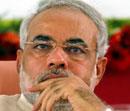
Modi tapping phones, says ex- Gujarat CM

May 30, 2012

modu

Gandhinagar, May 30: Former Gujarat chief minister Suresh Mehta Wednesday said the Narendra Modi regime was akin to the Emergency rule of 1975-77.

"Even if we are unsure that our phones are tapped or not, we don't dare to speak and discuss about Gujarat over phone,” Mehta told the media at former chief minister Keshubhai Patel's residence here.

Patel had called all old Bharatiya Janata Party (BJP) leaders to work out a strategy against Chief Minister Modi.

Mehta declined to disclose the agenda of the meet, but admitted that those gathered at Patel's residence took stock of "the present governance".

He said that even a minister's house was unsafe in Gujarat today and accused BJP vice president Purshottam Rupala of teaching party workers to bribe voters before the election code of conduct comes into effect.

Besides Keshubhai Patel, former cabinet minister Kashiram Rana, former MP K.D. Jeswani, Bhaskrao Damleji and others sidelined by Modi attended the meeting.

"I am unhappy with the BJP high command and so left a long back. But it is too early to say who we will support in the next election," he said.

He said many were pained the way the BJP leadership "succumbed to Modi".

The obvious reference was to BJP president Nitin Gadkari's decision to force Sanjay Joshi out of the party's national executive to ensure Modi's presence at the leadership meet in Mumbai this month.

Trouble has been brewing in the Gujarat BJP, with Keshubhai Patel leading those unhappy with Modi's style of functioning.

Comments

Add new comment

  • Coastaldigest.com reserves the right to delete or block any comments.
  • Coastaldigset.com is not responsible for its readers’ comments.
  • Comments that are abusive, incendiary or irrelevant are strictly prohibited.
  • Please use a genuine email ID and provide your name to avoid reject.
News Network
May 6,2020

May 6: The government on Tuesday said that the Food Corporation of India, the nodal agency for procurement and distribution of foodgrains, has sufficient stocks in its godowns, even after meeting the requirement of additional wheat and rice provided free of cost during the lockdown period.

Food Minister Ram Vilas Paswan has given detailed information about the various steps taken by the government and the total stocks of food grains and pulses available with the government and sent to the states till now, an official statement said.

"FCI currently has 276.61 lakh tonnes rice and 353.49 lakh tonnes wheat. Hence a total of 630.10 lakh tonnes food grain stock is available," it said.

As against this, about 60 lakh tonnes of food grains is required for a month under the NFSA (National Food Security Act) and other welfare schemes.

Paswan said FCI stocks are comfortable even after fulfilling extra commitments during the lockdown.

Under the 'Pradhan Mantri Garib Kalyan Ann Yojana', the Centre is providing 5 kg of free food grains per month to 80 crore ration card holders. This free of cost wheat and rice will be provided for three months. Besides, 1 kg of pulses will also be supplied per family.

This is over and above the normal quota of 5 kg of food grains provided per month per person to about 80 crore people under the food law.

The minister informed that since the lockdown, about 69.52 lakh tonnes of food grains have been transported through 2,483 rail rakes.

Apart from rail route, transportation was also done through roads and waterways. A total of 137.62 lakh tonnes has been transported.

During the lockdown, NGOs and social institutions running relief camps can purchase wheat and rice directly from FCI Depots at Open Market Sales Scheme (OMSS) rate.

The state governments can also purchase food grains directly from FCI. Under the OMSS, the rate of rice is fixed at Rs 22 per kg and wheat at Rs 21 per kg.

Under the 'Pradhan Mantri Garib Kalyan Ann Yojana', for the next 3 months a total of 104.4 lakh tonnes rice and 15.6 lakh tonnes of wheat is required of which 59.50 lakh tonnes rice and 8.14 lakh tonnes wheat have been lifted by various states and UTs.

The Government of India is bearing 100 per cent financial burden of approximately Rs 46,000 crore under the scheme, the statement said.

For pulses, the total requirement for the next three months is 5.82 lakh tonnes.

So far, 2,20,727 tonnes of pulses have been dispatched, while 1,47,165 tonnes of pulses have reached the states/UTs and 47,490 tonnes have been delivered, it said.

Comments

Add new comment

  • Coastaldigest.com reserves the right to delete or block any comments.
  • Coastaldigset.com is not responsible for its readers’ comments.
  • Comments that are abusive, incendiary or irrelevant are strictly prohibited.
  • Please use a genuine email ID and provide your name to avoid reject.
News Network
April 3,2020

Washington, Apr 3: The World Bank has approved USD 1 billion emergency funding for India to help it tackle the coronavirus pandemic, which has claimed 76 lives and infected 2,500 people in the country.

The World Bank's first set of aid projects, amounting to USD 1.9 billion, will assist 25 countries, and new operations are moving forward in over 40 nations using the fast-track process, the bank said on Thursday.

The largest chunk of the emergency financial assistance has gone to India USD 1 billion.

"In India, USD 1 billion emergency financing will support better screening, contact tracing, and laboratory diagnostics; procure personal protective equipment; and set up new isolation wards," the World Bank said after its Board of Executive Directors approved the first set of emergency support operations for developing countries around the world, using a dedicated, fast-track facility for COVID-19 response.

In South Asia, the World Bank also approved USD 200 million for Pakistan, USD 100 million for Afghanistan, USD 7.3 million for the Maldives and USD 128.6 million for Sri Lanka.

The World Bank said it was now working to grant up to USD 160 billion over the next 15 months to support measures to tackle the pandemic which will focus on the immediate health consequences and bolster economic recovery.

The broader economic program will aim to shorten the time to recovery, create conditions for growth, support small and medium enterprises, and help protect the poor and vulnerable.

"The World Bank Group is taking broad, fast action to reduce the spread of COVID-19 and we already have health response operations moving forward in over 65 countries," said World Bank Group President David Malpass.

"We are working to strengthen (the) developing nations' ability to respond to the COVID-19 pandemic and shorten the time to economic and social recovery," Malpass said.

According to the bank, USD 100 million will support Afghanistan to slow and limit the spread of COVID-19 through enhanced detection, surveillance, and laboratory systems, as well as strengthen essential health care delivery and intensive care.

In Pakistan, USD 200 million will support preparedness and emergency response in the health sector and include social protection and education measures, the bank said.

A total of 1,002,159 COVID-19 cases have been reported across more than 175 countries and territories with 51,485 deaths reported so far, according to Johns Hopkins University data.

Comments

Add new comment

  • Coastaldigest.com reserves the right to delete or block any comments.
  • Coastaldigset.com is not responsible for its readers’ comments.
  • Comments that are abusive, incendiary or irrelevant are strictly prohibited.
  • Please use a genuine email ID and provide your name to avoid reject.
Agencies
February 4,2020

New Delhi, Feb 4: Four-month-old Mohammed Jahaan accompanied his mother almost every day to the Shaheen Bagh demonstration where he was a favourite with the protesters who would take turns to hold him and often draw the tricolour on his cheeks.

Jahaan will not be seen at Shaheen Bagh anymore. He died last week after acquiring a severe cold and congestion following exposure to the winter chill at the outdoor demonstration. His mother is, however, undeterred and determined to participate in the protests, saying it is "for the future of my children".

The infant's shattered parents, Mohammed Arif and Nazia, live in a tiny shanty put together with plastic sheets and cloth in Batla House area and have two other children -- a five-year-old daughter and a one-year-old son.

Hailing from Bareilly in UP, the couple is barely able to make ends meet. Arif is an embroidery worker and also drives an e-rickshaw. His wife helps him in his embroidery work.

"I haven't been able to earn enough in the last month despite driving the battery rickshaw in addition to my embroidery work. Now with our baby's demise, we have lost everything," he said, showing a picture of little Jahaan wearing a woolen cap that read 'I Love My India'.

A visibly disturbed Nazia said Jahaan passed away in his sleep on night of January 30 after returning from the protests.

"I had returned from Shaheen Baag at around 1 AM. After putting him and other kids to sleep, even I went to sleep. In the morning, I suddenly found him motionless. He was gone in his sleep," she said.

The couple said they took their motionless baby to the nearby Alshifa Hospital on the morning of January 31 where he was declared dead on arrival.

Nazia, who had been visiting the Shaheen Bagh demonstration everyday with Jahaan since December 18, says that he died after catching a cold that turned lethal.

She said she didn't realise that his congestion was so severe. However, the baby's death certificate issued by the hospital does not mention any specific reason for the death.

Shazia, a neighbour who was present at the couple's home, said Nazia had fought with her mother and husband to visit Shaheen Bagh everyday. Nazia would gather all women in the bylane outside her house so that they could together walk to the demonstration, around 2 km away. Sometimes, Arif would drop some of them to Shaheen Bagh on his e-rickshaw.

Nazia said she strongly feels that the CAA and NRC are against the welfare of all communities and will join the Shaheen Bagh protests, but this time without her children.

"Why was I doing this? For my children and the children of all us who need a bright future in this country," she told PTI.

"The CAA divides us on religion and should never be accepted. I don't know if there is politics involved but I know that I must question what is against the future of my children."

Arif, however, blamed the NRC and CAA for his child's death.

"Had the government not brought CAA and NRC, people would not have protested and my wife would not have joined them, my son would have been alive," he said.


Comments

Angry Indian
 - 
Tuesday, 4 Feb 2020

inna lillahi inna ilaihi rajioon...so sad


Modi, delhi police and Amith Shah the biggest EVIL of india is responsible for this samll soul death...


you have to answer one day after you die...dont think this world is permenant..


you will never see heaven forever...you must root in hell


GADDAR PM & HM


Jai Hind


Add new comment

  • Coastaldigest.com reserves the right to delete or block any comments.
  • Coastaldigset.com is not responsible for its readers’ comments.
  • Comments that are abusive, incendiary or irrelevant are strictly prohibited.
  • Please use a genuine email ID and provide your name to avoid reject.