


Sonia: Opposition, civil society levelling ‘baseless’ allegations

June 4, 2012

sonia

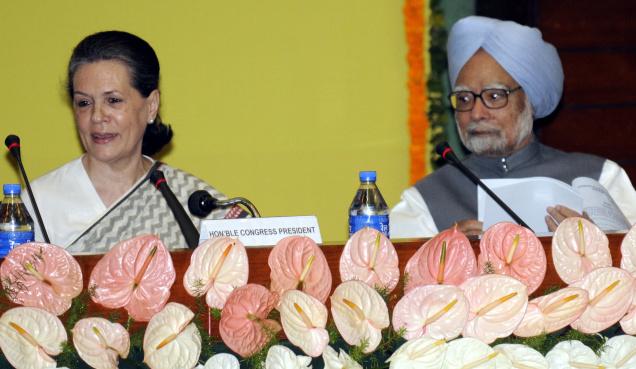
New Delhi, July 4: A combative Congress president Sonia Gandhi on Monday made a scathing attack on the Opposition and civil society for levelling “baseless” allegations against the Prime Minister and the party, saying it was part of a conspiracy and told partymen to fight back.

“In a democracy, it is the job of the Opposition to oppose but the manner, in which the Opposition and some anti-Congress elements are, as part of a conspiracy, levelling baseless allegations against the Prime Minister, the UPA government, the party and some of our colleagues, is a matter of regret,” she said in her opening remarks at the meeting of the Congress Working Committee.

“We will have to fight fiercely against such allegations at the party and the government levels,” Ms. Gandhi said with Prime Minister Manmohan Singh by her side.

Without referring to the petrol price hike, she said there have been economic challenges too that are impacting the common man. “The whole world was passing through a difficult phase and we have to face it and we are facing it.”

She said the report to the people brought out on the third anniversary on the UPA government was a “document of success in spite of the difficulties.”

Without directly referring to any particular issue, she utilised the occasion to criticise non-Congress governments in the States alleging that they are not cooperating as is expected in a democracy in implementing the policies made by the Centre.

Ms. Gandhi said that the party has to be strengthened at all levels ahead of a series of State elections as also the Lok Sabha polls in 2014.

Comments

Add new comment

  • Coastaldigest.com reserves the right to delete or block any comments.
  • Coastaldigset.com is not responsible for its readers’ comments.
  • Comments that are abusive, incendiary or irrelevant are strictly prohibited.
  • Please use a genuine email ID and provide your name to avoid reject.
News Network
June 1,2020

Jun 1: Gold prices rose on Monday as riots in major U.S. cities rattled investors already reeling from strained Sino-U.S. relations and boosted demand for the safe-haven metal, with a weaker dollar lending further support.

Spot gold gained 0.8% to $1,739.75 per ounce by 0242 GMT. U.S. gold futures ticked up 0.1% to $1,752.60.

"Concerns about the unrest in the United States at the moment appear to be weighing on market sentiment," said Michael McCarthy, chief strategist at CMC Markets, adding that rising tensions between the world's top two economies provided further support to gold.

Protesters have flooded the streets in the United States over the death of George Floyd in police custody, in a wave of outrage sweeping a politically and racially divided nation.

The closely packed crowds and demonstrators not wearing masks have sparked fears of a resurgence of COVID-19, which has killed more than 101,000 Americans.

In Asia, China's state media and the government of Hong Kong lashed out on Sunday at U.S. President Donald Trump's pledge to end Hong Kong's special status if Beijing imposes new national security laws on the city.

Gold is often used as a safe store of value during times of political and financial uncertainty.

Indicative of sentiment, holdings of SPDR Gold Trust, the world's largest gold-backed exchange-traded fund, rose 0.3% to 1,123.14 tonnes on Friday, a fresh seven-year high.

Further supporting gold's appeal, the dollar index fell 0.4% against its rivals.

Elsewhere, silver jumped 2% to $18.20 per ounce, its highest since Feb. 26, before retreating slightly to trade 1.8% higher at $18.16.

Speculators cut their bullish positions in COMEX gold and increased them in silver contracts in the week to May 26, the U.S. Commodity Futures Trading Commission said on Friday.

Palladium rose 0.7% to $1,958.25 per ounce, while platinum declined 0.3% to $835.56.

Comments

Add new comment

  • Coastaldigest.com reserves the right to delete or block any comments.
  • Coastaldigset.com is not responsible for its readers’ comments.
  • Comments that are abusive, incendiary or irrelevant are strictly prohibited.
  • Please use a genuine email ID and provide your name to avoid reject.
News Network
August 8,2020

The Kozhikode International Airport located at Karipur is not safe for the landing of flights in rainy season, according to an air-safety expert, who had warned the aviation ministry and the civil aviation regulator about this in 2011. 

The warning was particularly about the dangers of permitting passenger aircraft to land on runway 10 of the airport during rains and unfavourable wind conditions. 

Nine years later, on August 7, 2020, the warning became a reality when an Air India Express pilots landed in tailwind conditions and the aircraft overshot the tabletop runway to drop off the end and crash.

 “An aircraft landing on runway 10 in tailwind will experience poor braking action due to heavy rubber deposits … All such flights … are endangering the lives of all on board,’’ said Capt Mohan Ranganathan, in a letter sent on June 17, 2011 to then director general of civil aviation Bharat Bhushan and Nasim Zaidi, chairman of a civil aviation safety advisory committee, which was formed after the May 2010 Mangaluru air crash which killed 158 people.

“My warning issued after the Mangaluru crash was ignored. It is a table-top runway with a down slope. The buffer zone at the end of the runway is inadequate,” Capt Ranganathan said. Given the topography, he pointed out, the airport should have a buffer of 240m at the end of the runway, but it only has 90m (which the DGCA had approved). “Moreover, the space on either side of the runway is only 75m instead of the mandatory 100m,” he added.

Capt Ranganathan said there is no guideline for operations on a table-top runway when it is raining. “Runway 10 approach should not be permitted in view of the lack of runway end safety area (RESA) and the terrain beyond the end of the runway. RESA of 240m should be immediately introduced and runway length has to be reduced to make the operations safe,” his letter said.

If an aircraft is unable to stop within the runway, there is no RESA beyond the end. The ILS localiser antenna is housed on a concrete structure and the area beyond is a steep slope. “The Air India Express accident in Mangalore should have alerted AAI to make the runway conditions safe. We have brought up the issue of RESA during the initial Casac-sub group meetings. We had specifically mentioned that the declared distances for both runways have to be reduced in order to comply with ICAO Annex 14 requirement,” Capt Ranganathan said.

He said the condition of the runway strip was known to DGCA teams that have been conducting inspection and safety assessments. “Have they considered the danger involved? Did the DGCA or the airlines lay down any operational restrictions or special procedures?”

The letter also refers to Approach and Landing Accident Reduction (ALAR) training, which is supposed to be mandatory before every monsoon, but airlines don’t follow it, he said. “70% of accidents take place during approach and landing and that is why this training is essential,” he added.

stm88 info live rtp slot

slot auto scatter hitam

Comments

Add new comment

  • Coastaldigest.com reserves the right to delete or block any comments.
  • Coastaldigset.com is not responsible for its readers’ comments.
  • Comments that are abusive, incendiary or irrelevant are strictly prohibited.
  • Please use a genuine email ID and provide your name to avoid reject.
News Network
June 13,2020

New Delhi, Jun 13: About 56 per cent of children were found to have no access to smartphones which have emerged as essential tools for online learning during the coronavirus-induced lockdown, according to a new study that surveyed 42,831 students at various school levels.

The study ''Scenario amidst COVID 19 - Onground Situations and Possible Solutions'' was conducted by child rights NGO Smile Foundation with an aim of analysing the access to technology.

The findings of the study showed that 43.99 per cent of surveyed children have access to smartphones and another 43.99 per cent of students have access to basic phones while 12.02 per cent do not have access to either smartphones or basic phones.

A total of 56.01 per cent children were found to have no access to smartphones, the study said.

"Concerning television, it was noted that while 68.99 per cent have access to TV, a major chunk of 31.01 per cent does not. Hence suggesting that using smartphone interventions for enhancing learning outcomes is not the only solution," it said.

At the primary level of education (class 1 to 5) 19,576 children were surveyed while at upper primary level (class 6 to 8) 12,277 children were surveyed. At secondary level of education (class 9 to 10) 5,537 children were surveyed and at higher secondary level (class 11 to 12) 3,216 children were surveyed.

The survey based on which the study was conducted used two approaches - over the telephone wherein the NGO reached out to the children whose database it already had -- students enrolled in various education centres of the NGO -- and second was through community mobilization wherein community workers went door to door to get answers.

The survey was conducted in 23 states, including Delhi, Gujarat, Maharashtra, Karnataka, Tamil Nadu, West Bengal, Andhra Pradesh, Telangana, Uttar Pradesh, Haryana, over a period of 12 days from April 16 to April 28.

The lockdown induced by the COVID-19 pandemic in March prompted schools and colleges to move to the virtual world for teaching and learning activities. However, many experts say the digital divide in the country may turn online classes into an operational nightmare.

As per official statistics, there are over 35 crore students in the country. However, it is not clear as to how many of them have access to digital devices and Internet.

Santanu Mishra, co-founder and executive trustee, Smile Foundation, said the findings clearly show that the digital divide is a real challenge, and multiple approaches need to be implemented to cater to all across the nation.

"As an exercise before we start any programme, we do a baseline study to understand the on-ground challenges so that our programmes can bring in real work and real change. With the onset of the pandemic, following indefinite school closures, it is more important than ever to understand the situation and how can we ensure that children are given quality education. Through this, we understand that customized modules need to be built in accordance with the channel of communication," he said.  

Comments

Add new comment

  • Coastaldigest.com reserves the right to delete or block any comments.
  • Coastaldigset.com is not responsible for its readers’ comments.
  • Comments that are abusive, incendiary or irrelevant are strictly prohibited.
  • Please use a genuine email ID and provide your name to avoid reject.