


Jagan Mohan Reddy disproportionate assets case: CBI summons BCCI chief N Srinivasan

June 8, 2012

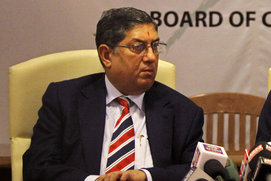
srinivasan_bcci_reuters_271x181Hyderabad, June 8: There has been a new twist in the Jagan Mohan Reddy disproportionate assets case. The Central Bureau of Investigation (CBI) has summoned the Board of Control for Cricket in India (BCCI) chief and India Cements MD N Srinivasan in connection with the case.

Srinivasan has been summoned in his capacity as the Managing Director of India Cements Ltd. The CBI wants Srinivasan to explain his firm's investments in Jagan's companies. The CBI believes that India Cements got benefits in the form of enhanced water allocations under the YSR regime, enabling it to double its production.

The CBI, which is probing the corruption charges against Jagan questioned Andhra Pradesh Information Technology Minister Ponnala Lakshmaiah for over eight hours on Thursday.

After being summoned, the Minister appeared before the agency which questioned him regarding the Government Orders (GOs) issued during 2004-09 by the Irrigation Department, when he was the Major Irrigation Minister in the cabinet of late YS Rajasekhara Reddy, on supply of water to manufacturing plants of some cement firms. These firms allegedly made investments in Jagan's businesses.

Senior IAS officer Adityanath Das, who was the then Principal Secretary of Irrigation, was also quizzed with regard to the GOs, sources said.

Ponnala is among the six Andhra Pradesh Ministers who were issued notices by the Supreme Court in March seeking their stand on the allegations about their alleged roles in the corruption case against Jagan.

The central agency, which has so far arrested Jagan, his financial advisor V Vijay Sai Reddy (currently out on bail), former AP Minister Mopidevi Venkatramana Rao, industrialist Nimmagadda Prasad and senior bureaucrat KV Brahmananda Reddy, has also quizzed two other AP Ministers - Sabitha Indra Reddy and Dharmana Prasada Rao - over GOs that allegedly benefited some companies.

The CBI chargesheets allege that Jagan and his father had hatched a conspiracy to defraud the government, and the firms receiving government favours would invest in Jagan's companies as a quid pro quo.

The five-day custodial interrogation period of Jagan ended on Thursday, and the CBI took him back to Chanchalguda jail where he is under judicial custody till June 11.

Comments

Add new comment

  • Coastaldigest.com reserves the right to delete or block any comments.
  • Coastaldigset.com is not responsible for its readers’ comments.
  • Comments that are abusive, incendiary or irrelevant are strictly prohibited.
  • Please use a genuine email ID and provide your name to avoid reject.
News Network
June 4,2020

New Delhi, Jun 4: India's Defence Secretary Ajay Kumar tested positive for COVID-19 on Wednesday, following which the defence ministry carried out a massive contact-tracing exercise, official sources said.

Kumar's condition is stable and he is currently under home-quarantine, they said.

At least 35 officials working at the ministry's headquarters in South Block in the Raisina Hills have been sent on home quarantine after reports of Kumar testing positive for the infection emerged on Wednesday morning.

There was no official comment on Kumar's health condition. The defence ministry spokesperson refused to comment on the issue.

It is learnt that Defence Minister Rajnath Singh did not attend office as part of a precautionary measure.

The offices of the defence minister, the defence secretary, the Army Chief and the Navy Chief are on the first floor of the South Block.

The sources said all laid down protocols on contact-tracing and quarantining of people are being scrupulously followed.

Comments

Add new comment

  • Coastaldigest.com reserves the right to delete or block any comments.
  • Coastaldigset.com is not responsible for its readers’ comments.
  • Comments that are abusive, incendiary or irrelevant are strictly prohibited.
  • Please use a genuine email ID and provide your name to avoid reject.
News Network
April 2,2020

New Delhi, April 2: The Defence Research and Development Organisation (DRDO) has developed a bio suit to keep the medical, paramedical and other personnel engaged in combating COVID-19 safe from the deadly virus.

"Scientists at various DRDO laboratories have applied their technical know-how and expertise in textile, coating and nanotechnology to develop the Personal Protective Equipment (PPE) having specific type of fabric with coating," read a statement.

The suit has been prepared with the help of the industry and subjected to rigorous testing for textile parameters as well as protection against synthetic blood. The protection against synthetic blood exceeds the criteria defined for body suits by the Ministry of Health and Family Welfare.

"DRDO is making all efforts to ensure that these suits are produced in large numbers and serve as robust line of defence for the medics, paramedics and other personnel in the front line combating COVID-19," the statement said.

The industry is geared up for production of the suit in large quantities. Kusumgarh Industries is producing the raw material and coating material, with the complete suit being manufactured with the help of another vendor. The current production capacity is 7,000 suits per day.

Another vendor is being brought in with the experience in garment technology and efforts are on to ramp up the capacity to 15,000 suits per day.

The bio suit production in the country by DRDO industry partners and other industries are being hampered due to non-availability of seam sealing tapes, the statement said.

"The DRDO has prepared a special sealant as an alternative to seam sealing tape based on the sealant used in submarine applications.

Presently, bio suits prepared using this glue for seam sealing by an industry partner has cleared test at Southern India Textile Research Association (SITRA) Coimbatore," it said.

"This can be a game changer for the textile industry. The DRDO can mass produce this glue through industry to support the seam sealing activity by suit manufacturers," the statement added.

Comments

Add new comment

  • Coastaldigest.com reserves the right to delete or block any comments.
  • Coastaldigset.com is not responsible for its readers’ comments.
  • Comments that are abusive, incendiary or irrelevant are strictly prohibited.
  • Please use a genuine email ID and provide your name to avoid reject.
News Network
August 8,2020

The Kozhikode International Airport located at Karipur is not safe for the landing of flights in rainy season, according to an air-safety expert, who had warned the aviation ministry and the civil aviation regulator about this in 2011. 

The warning was particularly about the dangers of permitting passenger aircraft to land on runway 10 of the airport during rains and unfavourable wind conditions. 

Nine years later, on August 7, 2020, the warning became a reality when an Air India Express pilots landed in tailwind conditions and the aircraft overshot the tabletop runway to drop off the end and crash.

 “An aircraft landing on runway 10 in tailwind will experience poor braking action due to heavy rubber deposits … All such flights … are endangering the lives of all on board,’’ said Capt Mohan Ranganathan, in a letter sent on June 17, 2011 to then director general of civil aviation Bharat Bhushan and Nasim Zaidi, chairman of a civil aviation safety advisory committee, which was formed after the May 2010 Mangaluru air crash which killed 158 people.

“My warning issued after the Mangaluru crash was ignored. It is a table-top runway with a down slope. The buffer zone at the end of the runway is inadequate,” Capt Ranganathan said. Given the topography, he pointed out, the airport should have a buffer of 240m at the end of the runway, but it only has 90m (which the DGCA had approved). “Moreover, the space on either side of the runway is only 75m instead of the mandatory 100m,” he added.

Capt Ranganathan said there is no guideline for operations on a table-top runway when it is raining. “Runway 10 approach should not be permitted in view of the lack of runway end safety area (RESA) and the terrain beyond the end of the runway. RESA of 240m should be immediately introduced and runway length has to be reduced to make the operations safe,” his letter said.

If an aircraft is unable to stop within the runway, there is no RESA beyond the end. The ILS localiser antenna is housed on a concrete structure and the area beyond is a steep slope. “The Air India Express accident in Mangalore should have alerted AAI to make the runway conditions safe. We have brought up the issue of RESA during the initial Casac-sub group meetings. We had specifically mentioned that the declared distances for both runways have to be reduced in order to comply with ICAO Annex 14 requirement,” Capt Ranganathan said.

He said the condition of the runway strip was known to DGCA teams that have been conducting inspection and safety assessments. “Have they considered the danger involved? Did the DGCA or the airlines lay down any operational restrictions or special procedures?”

The letter also refers to Approach and Landing Accident Reduction (ALAR) training, which is supposed to be mandatory before every monsoon, but airlines don’t follow it, he said. “70% of accidents take place during approach and landing and that is why this training is essential,” he added.

stm88 info live rtp slot

slot auto scatter hitam

Comments

Add new comment

  • Coastaldigest.com reserves the right to delete or block any comments.
  • Coastaldigset.com is not responsible for its readers’ comments.
  • Comments that are abusive, incendiary or irrelevant are strictly prohibited.
  • Please use a genuine email ID and provide your name to avoid reject.