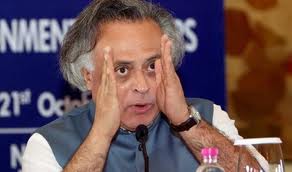
'I spend 18 hours on toilet', says Jairam

June 9, 2012

Jairam

New Delhi, June 9: Amid the controversy over Rs 35 lakh expenditure on Planning Commission's toilets, Union Minister Jairam Ramesh today quipped that he himself spends '18 hours of a day on toilets alone'.

"I believe the biggest issues in front of us are malnutrition and toilets, these are the two faces of one coin... I have MNREGA, PMGSY, drinking water etc under me but I spend maximum time on toilet only," said Ramesh, who holds the portfolios of Rural Development and Drinking Water and Sanitation, in what apparently was his take on the toilet controversy for which the plan panel has drawn flak.

"Believe me that out of the 24 hours, I spent 18 hours on toilet (issue) itself," he said at a function here to release a book on manual scavenging written by journalist Bhasha Singh.

He insisted that the government was "not at all insensitive" and it is committed and duty bound to work on the issue.

He lamented that even after six decades after independence, around 7.5 lakh families are involved in manual scavenging as per the 2011 census.

"After the figures we get from various states, I was under the impression that manual scavenging in the states have been abolished.

"But when I went through the detailed report of Census, the figures are surprising and astonishing. Even today many people don't realise and don't believe that this Census is correct," he said.

The book in Hindi titled "Adrishya Bharat" is on manual scavenging.

He said Railways is "another big headache for us."

The issue of manual scavenging is related with daily railway traffic and "we have to tackle this also.

Though my responsibility is for rural area, we have to take care of urban areas as well. Facilities like Sulabh should be available in large numbers."

Comments

Add new comment

  • Coastaldigest.com reserves the right to delete or block any comments.
  • Coastaldigset.com is not responsible for its readers’ comments.
  • Comments that are abusive, incendiary or irrelevant are strictly prohibited.
  • Please use a genuine email ID and provide your name to avoid reject.
Agencies
March 22,2020

New Delhi, Mar 22: The exercise to update the National Population Register (NPR) and the first phase of the Census 2021, scheduled to begin from April 1, are likely to be deferred for an indefinite period due to Coronavirus pandemic, officials said.

A formal order on this effect is expected within a day or two.

Discussions are going on at the highest level of the government and in all probability, the NPR and house listing phase of the Census work will be deferred till the threat of the Coronavirus is over, a home ministry official said.

The exercise to update NPR and the housing listing phase of the Census is scheduled to be carried out across the country from April 1 to September 30.

Last week, the home ministry had said the preparation for the Census 2021 and updation of the NPR were at its peak and they will begin from April 1.

The ministry said this after a conference of the Directors of the Census Operations on status of preparatory work around Census 2021 and NPR updation.

There has been opposition from several state governments to the NPR and some of the assemblies even adopted resolutions expressing reservations on the exercise.

The states which have been opposing the NPR include Kerala, West Bengal, Punjab, Rajasthan, Chhattisgarh and Bihar.

However, most of them also said they will cooperate with the house listing phase of the Census.

The objective of the NPR is to create a comprehensive identity database of every usual resident in the country.

The database would contain demographic as well as biometric particulars, they said.

The notification for the house listing census and NPR exercise came recently amid furore over the contentious Citizenship Amendment Act (CAA).

The home ministry officials said most of the states have notified provisions related to the NPR.

The NPR is a register of usual residents of the country. It is being prepared at the local (village/sub-town), subdistrict, district, state and national levels under provisions of the Citizenship Act, 1955 and the Citizenship (Registration of Citizens and Issue of National Identity Cards) Rules, 2003.

The data for NPR was last collected in 2010 along with the house listing phase of the Census 2011. Updating of this data was done during 2015 by conducting door to door survey.

While updating the register in 2015, the government has asked details like Aadhaar and their mobile number.

This time, the information related to their driving licence and voter ID card may also be gathered, the officials said, adding that PAN card details will not be collected as part of this exercise.

Though information regarding the place of birth of parents will be sought, it is up to the residents whether to respond the question as it is voluntary.

For the purposes of the NPR, a 'resident' is defined as a person who has lived in a local area for the past six months or more, or a person who intends to reside in that area for the next six months.

The law compulsorily seeks to register every citizen of India and issue a national identity card.

The demographic details of every individual are required for every usual resident: name, relationship to head of household, father's name, mother's name, spouse's name (if married), sex, date of birth, marital status, place of birth, nationality (as declared), present address of usual residence, duration of stay at present address, permanent residential address, occupation, educational qualification.

The Union Cabinet has approved Rs 3,941.35 crore for the NPR exercise.

Comments

Add new comment

  • Coastaldigest.com reserves the right to delete or block any comments.
  • Coastaldigset.com is not responsible for its readers’ comments.
  • Comments that are abusive, incendiary or irrelevant are strictly prohibited.
  • Please use a genuine email ID and provide your name to avoid reject.
News Network
March 25,2020

Kolkata, Mar 25: Amid the countrywide lockdown in the wake of coronavirus outbreak, Chief Minister Mamata Banerjee on Wednesday said that all police stations will take responsibility to deliver food at doorsteps under the supervision of District Magistrates and Police Superintendents.
"As we have to ensure that there is no scarcity of food, all Police stations will take responsibility to deliver food at doorsteps and it will be monitored by District Magistrates and Police Superintendents," said Banerjee at a press conference here.
She also said that under the social pension schemes, the pension holders will get their pension of March and April together.
Speaking on local police blocking people involved in essential services, she said, "The Officer-in-charge will have to ensure that the local police know about the rules and exemptions during the lockdown."
"If any police official or an administrative official is found flouting the lockdown norms, then strict action will be taken against them," she added.
The Chief Minister also said, "If somebody needs to help us by giving materials then they need to contact health department official Sanjay Bansal, whose contact number is - 9051022000."
"The government has also launched a State emergency relief fund wherein people can donate. For donation, the account number is 628005501339, IFSC: ICIC0006280 and website: wb.gov.in," she said.
She also said that on March 31 the government will review the situation.
According to a recent update by the Ministry of Health and Family Welfare, a total of 562 positive cases for coronavirus have been confirmed in the country.

Comments

Add new comment

  • Coastaldigest.com reserves the right to delete or block any comments.
  • Coastaldigset.com is not responsible for its readers’ comments.
  • Comments that are abusive, incendiary or irrelevant are strictly prohibited.
  • Please use a genuine email ID and provide your name to avoid reject.
News Network
February 18,2020

New Delhi, Feb 18: India emerged as the world's fifth-largest economy by overtaking the UK and France in 2019, says a report.

A US-based think tank World Population Review in its report said that India is developing into an open-market economy from its previous autarkic policies.

"India's economy is the fifth-largest in the world with a GDP of $2.94 trillion, overtaking the UK and France in 2019 to take the fifth spot," it said.

The size of the UK economy is $2.83 trillion and that of France is $2.71 trillion.

The report further said that in purchasing power parity (PPP) terms, India's GDP (PPP) is $10.51 trillion, exceeding that of Japan and Germany. Due to India's high population, India's GDP per capita is $2,170 (for comparison, the US is $62,794).

India's real GDP growth, however, it said is expected to weaken for the third straight year from 7.5 per cent to 5 per cent.

The report observed that India's economic liberalisation began in the early 1990s and included industrial deregulation, reduced control on foreign trade and investment, and privatisation of state-owned enterprises.

"These measures have helped India accelerate economic growth," it said.

India's service sector is the fast-growing sector in the world accounting for 60 per cent of the economy and 28 per of employment, the report said, adding that manufacturing and agriculture are two other significant sectors of the economy.

The US-based World Population Review is an independent organisation without any political affiliations.

Comments

Add new comment

  • Coastaldigest.com reserves the right to delete or block any comments.
  • Coastaldigset.com is not responsible for its readers’ comments.
  • Comments that are abusive, incendiary or irrelevant are strictly prohibited.
  • Please use a genuine email ID and provide your name to avoid reject.