



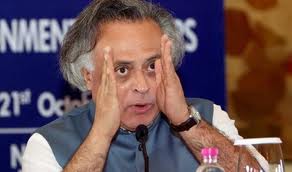
'I spend 18 hours on toilet', says Jairam

June 9, 2012

Jairam

New Delhi, June 9: Amid the controversy over Rs 35 lakh expenditure on Planning Commission's toilets, Union Minister Jairam Ramesh today quipped that he himself spends '18 hours of a day on toilets alone'.

"I believe the biggest issues in front of us are malnutrition and toilets, these are the two faces of one coin... I have MNREGA, PMGSY, drinking water etc under me but I spend maximum time on toilet only," said Ramesh, who holds the portfolios of Rural Development and Drinking Water and Sanitation, in what apparently was his take on the toilet controversy for which the plan panel has drawn flak.

"Believe me that out of the 24 hours, I spent 18 hours on toilet (issue) itself," he said at a function here to release a book on manual scavenging written by journalist Bhasha Singh.

He insisted that the government was "not at all insensitive" and it is committed and duty bound to work on the issue.

He lamented that even after six decades after independence, around 7.5 lakh families are involved in manual scavenging as per the 2011 census.

"After the figures we get from various states, I was under the impression that manual scavenging in the states have been abolished.

"But when I went through the detailed report of Census, the figures are surprising and astonishing. Even today many people don't realise and don't believe that this Census is correct," he said.

The book in Hindi titled "Adrishya Bharat" is on manual scavenging.

He said Railways is "another big headache for us."

The issue of manual scavenging is related with daily railway traffic and "we have to tackle this also.

Though my responsibility is for rural area, we have to take care of urban areas as well. Facilities like Sulabh should be available in large numbers."

Comments

Add new comment

  • Coastaldigest.com reserves the right to delete or block any comments.
  • Coastaldigset.com is not responsible for its readers’ comments.
  • Comments that are abusive, incendiary or irrelevant are strictly prohibited.
  • Please use a genuine email ID and provide your name to avoid reject.
Agencies
June 29,2020

New Delhi, Jun 29: The Supreme Court on Monday asked the Central government to find out the facts related to blacklisting and canceling of visas of foreign nationals who attended the congregation of Tablighi Jamaat in Nizamuddin area here.

A three-judge bench headed by Justice AM Khanwilkar and also comprising Justices Dinesh Maheshwari and Sanjiv Khanna asked the Centre to find out the facts related to the matter and fixed it for further hearing on July 2.

The apex court asked Solicitor General Tushar Mehta "if visas of these foreigners are canceled, then why are they still in India?"

"You (Centre) can deport them. If visas are not canceled, then, it is a different situation," the court said. The top court was hearing a number of petitions challenging blacklisting and cancellation of visas filed by few foreigners.

Mehta sought more time to file a reply on the matter, after which the court posted the matter for further hearing on July 2.

The petitions, filed by the foreign nationals from 35 countries, have sought directions to the Ministry of Home Affairs (MHA) to remove their names from the blacklist, reinstate their visas and facilitate their return to their respective countries.

The petitions sought to declare the decision of the MHA of blacklisting the foreign nationals who attended the Tablighi Jamaat congregation as "arbitrary".

"Unilateral blacklisting of 960 foreigners by the Home Ministry vide press release dated April 2, 2020, and the subsequent blacklisting of around 2500 foreigners as reported on June 4, 2020, is in violation of Article 21. Therefore, it is void and unconstitutional as the petitioners have neither been provided any hearing nor notice or intimation in this regard," the plea said.

One of the petitioners named Fareedah Cheema, a Thai national in the seventh month of her pregnancy, said she was quarantined in March, like other foreign nationals but was released from quarantine only in late May and is still at a facility under restricted movements, without the avenue to go back to her home nation and experience the birth of her child with security and dignity, with her loved ones.

These foreign nationals presently in India were blacklisted for a period of 10 years from traveling to India for their alleged involvement in Tablighi Jamaat activities.

The Home Ministry had said that foreign Tablighi Jamaat members, who were staying in India in violation of visa rules during the nationwide lockdown implemented to combat the COVID-19 spread, have been blacklisted.
A large congregation organised by Tablighi Jamaat in the national capital in March had emerged as a major COVID-19 hotspot in the country.

The government had said the decision of banning the foreign Tablighi Jamaat members was taken after details of foreigners found illegally living in mosques and religious places emerged from various states across the country.

Comments

Add new comment

  • Coastaldigest.com reserves the right to delete or block any comments.
  • Coastaldigset.com is not responsible for its readers’ comments.
  • Comments that are abusive, incendiary or irrelevant are strictly prohibited.
  • Please use a genuine email ID and provide your name to avoid reject.
Agencies
February 14,2020

Lucknow, Feb 14: Uttar Pradesh doctor Kafeel Khan was on Friday booked under the National Security Act (NSA) over his alleged anti-CAA speech at Aligarh Muslim University on December 12, 2019.

The Uttar Pradesh slapped NSA on Kafeel Khan on Friday even as the doctor waited to be released from jail despite being granted bail on Monday in connection with his alleged inflammatory speech.

SP Crime Dr Arvind said that there were sufficient grounds to book the doctor under NSA.

The suspended pediatrician, Kafeel Khan, was arrested for allegedly delivering a controversial speech during Anti-CAA protests on December 12 at the Aligarh Muslim University or AMU. While he was granted bail on Monday, his family members claimed on Thursday that he was yet to be released.

Dr Kafeel Khan's brother Adeel Ahmed Khan had issued a statement saying that despite being granted bail Mathura jail authorities had not honoured the court's order.

Dr Kafeel Khan was arrested by the UP Special Task Force from Mumbai on January 29 for participating anti-CAA protest at AMU. A case was registered against him at the Civil Lines police station here for promoting enmity between different religions.

After his arrest in Mumbai, Dr Khan was brought to Aligarh, from where he was shifted to the district jail in neighbouring Mathura.

According to police, this was done as a precautionary measure in view of the anti-CAA protests on the AMU campus and at the Eidgah grounds in the old city. Police had said that the Dr Khan's presence in the Aligarh jail could have aggravated the law and order situation in the city.

The doctor was earlier arrested for his alleged role in the death of over 60 children in one week at the BRD Medical College in Gorakhpur in August 2017. Short supply of oxygen at the children's ward was blamed at that time for the deaths.

About two years later, a state government probe cleared Khan of all major charges, prompting him to seek an apology from the Yogi Adityanath government.

Comments

Add new comment

  • Coastaldigest.com reserves the right to delete or block any comments.
  • Coastaldigset.com is not responsible for its readers’ comments.
  • Comments that are abusive, incendiary or irrelevant are strictly prohibited.
  • Please use a genuine email ID and provide your name to avoid reject.
News Network
May 6,2020

New Delhi, May 6: Taking a cue from states, the Centre announced one of the steepest hikes in duties on petrol and diesel in the recent past, by raising it by Rs 10 and Rs 13 per litre, respectively, in a notification issued late on Tuesday.

Retail prices, however, will see no change as the price hike will be absorbed by oil marketing companies against the fall in crude prices.

Road and infrastructure cess was hiked by Rs 8 for petrol and diesel and the special additional excise duty (SAED) was hiked by Rs 2 per litre and Rs 5 per litre, respectively. While the road cess will only go into the Centre’s coffers, the hike on account of SAED will be passed on to states via devolution at 42 per cent. Hence, the states will get only Rs 0.84 per litre in case of petrol and Rs 2.1 in case of diesel.

The decision comes after several states increased the value added tax (VAT) on petrol and diesel making use of the lower price regime. The Delhi government on Tuesday increased VAT on petrol and diesel to 30 per cent each, from 27 and 16.75, respectively. As a result, the price of petrol in Delhi increased by Rs 1.67 to Rs 71.26 a litre and diesel by Rs 7.10 to Rs 69.29 in Delhi on Tuesday.

Amid falling international crude oil prices, the Centre introduced an enabling provision in March to raise excise duty on petrol and diesel by Rs 8 per litre in the Finance Act. The government had on March 14 raised excise duty on petrol and diesel by? 3 per litre each, which was to help raise an additional ?39,000 crore in revenue annually.

This duty hike included Rs 2 a litre increase in SAED and Rs 1 in road and infrastructure cess. It raised SAED to Rs 10 for petrol and Rs 4 for diesel. The limit has now been increased to Rs 18 a litre in case of petrol and Rs 12 in case of diesel by way of amendment of the Eighth Schedule of the Finance Act.

Economists said the move would impact retail inflation by over half a percentage point at least. “With lower consumption, there was loss of revenue for Centre and states, who earn Rs 6 trillion annually or Rs 50,000 crore monthly from fuel. Amid lockdown in April, the collection must have come down to just Rs 5,000 crore, and this will hold for May.

This means that Centre and states have lost 20 per cent of annual revenue from fuel. Hence, they have hiked duties to recover losses,” said Madan Sabnavis, chief economist, CARE Ratings. He added that the hike will impact inflation by at least 0.6-0.7 percentage points.

According to industry experts, an estimate of the additional government revenue cannot be made as the consumption of petrol and diesel has dropped to 40 per cent of what it was before the lockdown. The duty hike comes following a drop in international crude oil prices in April, owing to lower consumption figures globally. At 11.50 pm on Tuesday, Brent was priced at $30.67 a barrel, while West Texas Intermediate (WTI) crude was seen at $24.36 a barrel. On Monday, the Indian basket of crude oil was priced at $23.38 a barrel, after touching a 15-year low last month.

Comments

Add new comment

  • Coastaldigest.com reserves the right to delete or block any comments.
  • Coastaldigset.com is not responsible for its readers’ comments.
  • Comments that are abusive, incendiary or irrelevant are strictly prohibited.
  • Please use a genuine email ID and provide your name to avoid reject.