Charges against PM on Coalgate baseless, people around Anna anti-nationals: PMO

June 10, 2012

Anna_Anti_National

New Delhi/ Chennai, June 10: Setting the stage for fresh hostilities, the Prime Minister's office on Saturday aggressively dismissed corruption allegations levelled by Team Anna against Prime Minister Manmohan Singh over coal block allegations for being devoid of evidence.

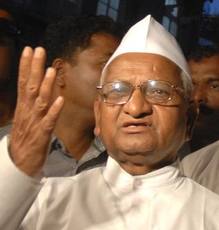
Minister of state for PMO V Narayanasamy followed up a curt letter to Hazare with a fusillade against the Gandhian leader's associates Arvind Kejriwal and Kiran Bedi, calling them "anti-nationals" and alleging their financial dealings are not above board.

"As regards allegations made against the Prime Minister, they seem to be based on a leaked draft of the CAG on coal block allocations and on media stories. You have provided no evidence to back up these allegations," said Narayanasamy in his letter to Anna Hazare.

Speaking to the media in Chennai, Narayanasamy lashed out at Team Anna, saying Kejirwal needed to explain what had happened to large funds collected by the campaign for a Lokpal and said Bedi has also faced questions over the accounts relating to her travel bills.

Team Anna members Manish Sisodia and Bedi rejected the PMO letter, reiterating plans for a protest from July 25 for passage of the Lokpal Bill around the time Parliament is due to meet for its monsoon session. "Use of hollow words like progressive laws" are not convincing, said Sisodia. "Our protest from July 25 will go on as planned," said Sisodia while Bedi said the letter was 'wishy-washy'.

The sharp exchange is an indicator that the government, already under attack for corruption and glacial governance, is feeling the heat and is likely to increasingly lash out at the activists. The government's efforts to pass the Lokpal Bill have been stymied in the Rajya Sabha where it lacks a majority and where the opposition has supported clauses the Centre is loathe to concede.

Caught between the political opposition in Parliament and Team Anna outside, the government is readying for renewed confrontation with the activists. After the PMO letter rejected the demand for a special investigation team to probe charges leveled by the Hazare group against the PM and 14 ministers, Narayanasamy said, "Anna is a simple man, but he is surrounded by anti-national elements and people who have been supported by foreign forces."

The letter and the remarks make it evident that the row can get uglier. "The government is also determined to ensure baseless and uninformed allegations made against public servants are not allowed to create fear that can lead to paralysis in decision-making and slow down growth and development," the letter said.

Comments

Add new comment

  • Coastaldigest.com reserves the right to delete or block any comments.
  • Coastaldigset.com is not responsible for its readers’ comments.
  • Comments that are abusive, incendiary or irrelevant are strictly prohibited.
  • Please use a genuine email ID and provide your name to avoid reject.
News Network
January 9,2020

New Delhi, Jan 9: Amazon founder and CEO Jeff Bezos will be visiting India next week and is likely to meet Prime Minister Narendra Modi and officials, besides industry leaders, according to sources.

The top executive will also attend SMBhav – an event focussing on small and medium businesses in India - that is slated for January 15-16 in the capital city.

When contacted, Amazon declined to comment.

Amazon, which has seen significant growth in its business in India, has also witnessed protest from a section of traders in the country who claim that e-commerce giants including Amazon and Walmart-owned Flipkart offer deep discounts and engage in unfair business practices.

Last year, the government had tightened rules for e-commerce marketplaces with foreign investment. These rules barred such platforms from offering products of sellers in which they hold a stake and banned exclusive marketing arrangements among other clauses. Following this, Amazon restructured its joint ventures to ensure compliance.

Bezos is likely to discuss regulatory issues in his meeting with the government officials.

He is also slated to engage with SMBs during the SMBhav event. The event - which will focus on discussions around how technology adoption can enable SMBs in India - is slated to see participation from industry experts, policymakers, solution providers and Amazon leadership.

Comments

Add new comment

  • Coastaldigest.com reserves the right to delete or block any comments.
  • Coastaldigset.com is not responsible for its readers’ comments.
  • Comments that are abusive, incendiary or irrelevant are strictly prohibited.
  • Please use a genuine email ID and provide your name to avoid reject.
News Network
June 8,2020

New Delhi, Jun 8: Places of worship on Monday across the country reopened after staying shut since March due to the COVID-19 induced lockdown.

Scores of temples, mosques and gurudwaras were seen opening up keeping in view the Standard Operating Procedure (SOP) issued by Union Home Ministry to prevent coronavirus spread.

As per Ministry of Health guidelines, touching of idols/holy books, choir/singing groups, etc are not allowed.

In Delhi, people gathered at Gauri Shankar Temple in Chandni Chowk to offer prayers. With national capital seeing a rise in coronavirus cases, the devotees were seen wearing masks and taking precautions. People were also seen offering prayers at Kalka Ji Temple.

Several people arrived at Sri Bangla Sahib Gurudwara to offer prayers. Devotees were made to pass through the disinfectant tunnel before entering the Gurdwara in order to prevent the virus.

In Uttar Pradesh, Chief Minister Yogi Adityanath offered prayers at Gorakhnath Temple after state government allowed re-opening of places of worship from today.

Devotees were seen offering prayers at Eidgah Mosque in Lucknow.

Devotees also offered prayers at Shree Dodda Ganapathi Temple in Basavanagudi, Bengaluru.

Hanuman Garhi Temple in Ayodhya also reopened on Monday.

Prayers were offered at Durga Mata Mandir near Jagraon Bridge in Ludhiana, as the government has allowed reopening of places of worship.

Although religious places have opened in most of the states, however, there are some states which are yet to do so.

Preparations related to Yatra of Char Dhams including Badrinath have been completed, however, local representative of the areas from where the routes of this yatra pass have requested the government to not allow the commencement of the Yatra.

Based on the assessment of the situation, the Odisha Government ordered that all religious places/places of worship for the public will continue to remain closed till June 30.

Earlier, the Union Ministry of Home Affairs (MHA) said that religious places and places of worship for public, hotels, restaurants and other hospitality services along with shopping malls will be permitted to open from June 8.

However, these facilities will not be able to resume operations inside containment zones designated by authorities in states.

Comments

Add new comment

  • Coastaldigest.com reserves the right to delete or block any comments.
  • Coastaldigset.com is not responsible for its readers’ comments.
  • Comments that are abusive, incendiary or irrelevant are strictly prohibited.
  • Please use a genuine email ID and provide your name to avoid reject.
Agencies
May 27,2020

New Delhi, May 27: India’s fourth recession since Independence, first since liberalisation, and perhaps the worst to date is here, according to rating agency, Crisil.

CRISIL sees the Indian economy shrinking 5 per cent in fiscal 2021 (on-year), because of the Covid-19 pandemic. The first quarter will suffer a staggering 25 per cent contraction.

About 10 per cent of gross domestic product (GDP) in real terms could be permanently lost. "So going back to the growth rates seen before the pandemic is unlikely in the next three fiscals", Crisil said.

Crisil has revised its earlier forecast downwards. "Earlier, on April 28, we had slashed our prediction to 1.8 per cent growth from 3.5 per cent growth. Things have only gone downhill since", it said.

While we expect non-agricultural GDP to contract 6 per cent, agriculture could cushion the blow by growing at 2.5 per cent.

In the past 69 years, India has seen a recession only thrice as per available data in fiscals 1958, 1966 and 1980. The reason was the same each time a monsoon shock that hit agriculture, then a sizeable part of the economy.

"The recession staring at us today is different," it added. For one, agriculture could soften the blow this time by growing near its trend rate, assuming a normal monsoon. Two, the pandemic-induced lockdowns have affected most non-agriculture sectors. And three, the global disruption has upended whatever opportunities India had on the exports front.

Economic conditions have slid precipitously since the April-end forecast of 1.8 per cent GDP growth for fiscal 2021 (baseline), Crisil said.

On the lockdown extension, it said that the government has extended the lockdown four times to deal with the rising number of cases, curtailing economic activity severely (lockdown 4.0 is ending on May 31).

The first quarter of this fiscal will be the worst affected. June is unlikely to see major relaxations as the Covid-19 affliction curve is yet to flatten in India.

"Not only will the first quarter be a washout for the non-agricultural economy, services such as education, and travel and tourism among others, could continue to see a big hit in the quarters to come. Jobs and incomes will see extended losses as these sectors are large employers," Crisil said.

CRISIL also foresees economic activity in states with high Covid-19 cases to suffer prolonged disruption as restrictions could continue longer.

A rough estimate based on a sample of eight states, which contribute over half of India's GDP, shows that their 'red zones' (as per lockdown 3.0) contributed 42 per cent to the state GDP on average regardless of the share of such red zones.

On average, the orange zones contribute 46 per cent, while the green zones where activity is allowed to be close to normal contribute only 12 per cent to state GDP.

The economic costs are higher than earlier expectations, according to Crisil. The economic costs now beginning to show up in the hard numbers are far worse than initial expectations.

Industrial production for March fell by over 16%. The purchasing managers indices for the manufacturing and services sectors were at 27.4 and 5.4, respectively, in April, implying extraordinary contraction. That compares with 51.8 and 49.3, respectively, in March.

Exports contracted 60.3 per cent in April, and new telecom subscribers declined 35 per cent, while railway freight movement plunged 35 per cent on-year.

"Indeed, given one of the most stringent lockdowns in the world, April could well be the worst performing month for India this fiscal," it said.

Added to that is the economic package without enough muscle. The government recently announced a Rs 20.9 lakh crore economic relief package to support the economy. The package has some short-term measures to cushion the economy, but sets its sights majorly on reforms, most of which will have payoffs only over the medium term.

"We estimate the fiscal cost of this package at 1.2 per cent of GDP, which is lower than what we had assumed in our earlier estimate (when we foresaw a growth in GDP)," it said.

"We believe a catch-up to the pre-crisis trend level of GDP growth will not be possible in the next three fiscals despite policy support. Under the base case, we estimate a 10 per cent permanent loss to real GDP (from the decadal-trend level), assuming average growth of about 7 per cent between fiscals 2022 and 2024," Crisil said.

Interestingly, after the Global Financial Crisis (GFC), a sharp growth spurt helped catch up with the trend within two years. GDP grew 8.2 per cent on average in the two fiscals following the GFC. Massive fiscal spending, monetary easing and swift global recovery played a role in a V-shaped recovery.

To catch-up would require average GDP growth to surge to 11 per cent over the next three fiscals, something that has never happened before.

The research said that successive lockdowns have a non-linear and multiplicative effect on the economy a two-month lockdown will be more than twice as debilitating as a one-month imposition, as buffers keep eroding.

Partial relaxations continue to be a hindrance to supply chains, transportation and logistics. Hence, unless the entire supply chain is unlocked, the impact of improved economic activity will be subdued.

Therefore, despite the stringency of lockdown easing a tad in the third and the fourth phases, their negative impact on GDP is expected to massively outweigh the benefits from mild fiscal support and low crude oil prices, especially in the April-June quarter. "Consequently, we expect the current quarter's GDP to shrink 25 per cent on-year," it said.

Counting lockdown 4.0, Indians have had 68 days of confinement. S&P Global estimates that one month of lockdown shaves 3 per cent off annual GDP on average across Asia-Pacific.

Since India's lockdown has been the most stringent in Asia, the impact on economic growth will be correspondingly larger.

Google's Community Mobility Reports show a sharp fall in movement of people to places of recreation, retail shops, public transport and workplace travel. While data for May shows some improvement in India, mobility trends are much below the average or baseline, and lower compared with countries such as the US, South Korea, Brazil and Indonesia.


Comments

Add new comment

  • Coastaldigest.com reserves the right to delete or block any comments.
  • Coastaldigset.com is not responsible for its readers’ comments.
  • Comments that are abusive, incendiary or irrelevant are strictly prohibited.
  • Please use a genuine email ID and provide your name to avoid reject.