


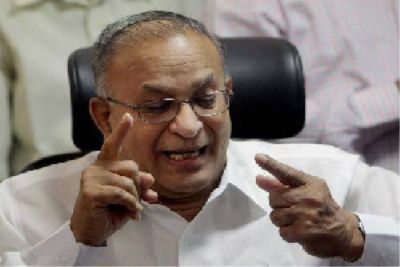
Increase duty on diesel cars up to Rs 2.5 lakh: Jaipal Reddy

June 13, 2012

Jaipal-Reddy

New Delhi, June 13: If the government accepts oil minister S Jaipal Reddy's proposal, the price of small diesel cars could soon rise by Rs 1.7 lakh while medium-to-large guzzlers could become costlier by Rs 2.55 lakh a piece.

The proposal to impose additional excise duty on diesel cars is bound to trigger protests from automakers, who have seen sales growing at the slowest pace in seven months in May. Domestic car sales declined 24% in May compared to the year-ago period due to high fuel prices and interest rates.

The proposal drew a thumbs down from analysts and private players, who described it as an excuse to avoid fuel pricing reforms. "From the RBI to C Rangarajan, head of the PM's Economic Advisory Council, everyone has recommended deregulation of fuel prices. If you can't do that for political reasons, at least fix subsidy on diesel and then let the market determine the pump price. Taxing vehicles would serve hardly any purpose," said an industry analyst requesting anonymity.

But Reddy has his arguments for seeking taxing diesel vehicles that are outpacing petrol car sales. In a June 7 letter to finance minister Pranab Mukherjee, the oil minister gave three key reasons for his proposal aimed at arresting a ballooning fuel subsidy bill.

Reddy pointed out that the proposed additional excise duties are equivalent to the minimum benefit that a diesel car owner derives from the fuel's price differential with petrol — at current prices — over a 10-year assumed life of a vehicle. Petrol in Delhi costs Rs 71.16 a litre against Rs 40.91 for diesel.

Reddy's arithmetic goes like this: he first calculates the total distance a vehicle is expected to clock in its 10-year life span, assuming an annual run of 18,000km. Then, he works out the fuel costs by taking a median mileage of 18km to a litre for small cars and 12km for medium/large vehicles. For good measure, he shaves off 10% of the total cost to level.

According to Reddy's calculation, the additional excise duty amounts to asking the diesel car buyer to pay upfront the price differential with petrol that he or she would enjoy later. A petrol car owner, in contrast, shells out every time at the pump.

Reddy also pointed out the adverse impact of increased diesel car sales on the government's earnings. Petrol attracts an excise duty of Rs 14.78 per litre against Rs 2.06 a litre for diesel. So each time a buyer opts for a diesel car instead of petrol and visits a petrol pump, the government loses Rs 12.72 in excise duty on litre of diesel. Together with the Rs 12.53 a litre subsidy on diesel, the actual price differential with petrol at Delhi works out to Rs 25.75 a litre.

To drive home the enormity of the situation arising out of this increasing dieselization, Reddy says diesel consumption rose by 7.6% in 2011-12 against 6.2% in 2010-11. In contrast, growth in petrol consumption fell from 10.7% in 2010-11 to 5.6% in 2011-12.

The Kirit Parikh Committee on fuel pricing reforms had recommended an additional excise duty of Rs 80,000 in February 2010 when duty difference on petrol and diesel was Rs 9.75 a litre and under-recovery on petrol was more at Rs 3.97 a litre than Rs 2 on diesel.

Comments

Add new comment

  • Coastaldigest.com reserves the right to delete or block any comments.
  • Coastaldigset.com is not responsible for its readers’ comments.
  • Comments that are abusive, incendiary or irrelevant are strictly prohibited.
  • Please use a genuine email ID and provide your name to avoid reject.
Agencies
April 14,2020

Mumbai, Apr 14: The Shiv Sena and NCP said Prime Minister Narendra Modis address to the nation on Tuesday lacked substance as he did not suggest ways to strengthen the economy or a relief package for the poor and those worst hit by the lockdown.

Shiv Sena spokesperson Manisha Kayande also took a dig at the prime minister, saying he thankfully did not give any activity to people this time like clanging utensils or lighting lamps.

Modi on Tuesday announced that the lockdown across the country will be extended till May 3, saying the measure has produced a significant outcome in containing the infection.

He said implementation of the lockdown will be strictly ensured in its second phase and detailed guidelines will be brought out on Wednesday to ensure that outbreak does not spread to new areas.

Some relaxations may be allowed after April 20 in places where there are no hotspots, he said.

Kayande said Modi could have announced extension of the lockdown on Wednesday itself along with the new guidelines, instead of declaring it separately.

"He could have elaborated steps to be taken to tackle the coronavirus, relaxing restrictions on movements in different areas (depending upon threat posed by the disease)," she said.

"His speech normally is more of a rhetoric than substance. Thankfully, he did not give any other event to the people like lighting up lamps or clanging utensils. There was nothing substantial (in the address), the only takeaway was that the lockdown has been extended, she added.

Maharashtra Minister and NCP national spokesman Nawab Malik noted that Modi talked about helping the poor.

"But, he could have announced a package on behalf of the central government to help the poor, those working in the unorganised sector who are the worst hit due to the lockdown.

There was no mention of it anywhere," Malik said.

Another NCP spokesman Mahesh Tapase said it was expected that the prime minister would address the economic concerns being faced by the country.

"The least to expect was the announcement of a slew of measures to kick-start the economy in a phased manner as and when the restrictions are lifted, he added.

Tapase said the employers and employees wanted to know from the government how recession and unemployment will be tackled in the time to come.

"Access to capital for business, especially for MSMEs and agriculture, is a big concern. Supply and logistics is the cornerstone of economic activity which has come to a virtual standstill," he said.

The 2020-21 fiscal looks grim and hence, the right stimulus from the government coupled with a renewed zeal by the industry will only bring the economy back on track, he suggested.

Comments

Add new comment

  • Coastaldigest.com reserves the right to delete or block any comments.
  • Coastaldigset.com is not responsible for its readers’ comments.
  • Comments that are abusive, incendiary or irrelevant are strictly prohibited.
  • Please use a genuine email ID and provide your name to avoid reject.
News Network
April 3,2020

New Delhi, Apr 3: Prime Minister Narendra Modi on Friday urged people to gather together for a unique exercise on April 5 at 9 pm to show they were together in the fight against coronavirus.

"On this Sunday, April 5, we will challenge the darkness of coronavirus threat together. On April 5, at 9 pm, I need your 9 minutes. At 9 pm, turn off all the lights in your houses and light a Diya, candle, torch or flashlight for 9 minutes at your doors, or balcony," Modi said.

The Prime Minister further said that this will send out a message that nobody among the 130 crore Indians is alone in this fight against the deadly infection.

"I have one more prayer to all of you, nobody has to gather at any place during this event. Everyone will light a Diya only at their doors, windows or balconies. The Laxman Rekha of social distancing must be followed," Modi said.
Earlier, the Prime Minister had said that 130 crore Indians are together in this fight against coronavirus and praised the countrymen for following the lockdown.

"Today when crores of people are inside homes, then some of us may think how will they fight this battle against COVID-19 alone. Such questions might come up in your mind? But please remember, none of us is alone. The strength of 130 crores of Indians is with each one of us," he said.

He also expressed gratitude towards countrymen for participating in 'Janata curfew' on March 22 and said it has become "an example for all countries" today as they are following it.

In his address to the nation on March 24, the Prime Minister had announced a 21-day lockdown in the country to contain the spread of novel coronavirus, which has infected over 2,000 people in the country.

During the last "Mann Ki Baat" on COVID-19 related issue, the Prime Minister had apologised to the countrymen for taking the tough decision of enforcing complete lockdown in the nation. "My conscience says you will forgive me," he had said.

Comments

Add new comment

  • Coastaldigest.com reserves the right to delete or block any comments.
  • Coastaldigset.com is not responsible for its readers’ comments.
  • Comments that are abusive, incendiary or irrelevant are strictly prohibited.
  • Please use a genuine email ID and provide your name to avoid reject.
News Network
July 24,2020

New Delhi, Jul 24: The Delhi High Court on Friday asked the ICMR to come out with a clarification that mobile number, government-issued identity card, photographs or even a residential proof ought not to be insisted upon for Covid-19 test of mentally ill homeless persons.

According to an Indian Council of Medical Research (ICMR) advisory of June 19, every person who was to be tested for Covid-19 has to provide a government-issued identity proof and should have a valid phone number for tracing and tracking the individual and his/her contacts.

A bench of Chief Justice D N Patel and Justice Prateek Jalan said that ICMR should issue a clarification by way of a circular or an official order that the identity proof, address proof and mobile number are not required for testing mentally ill homeless persons.

The high court said a camp can be organised for testing such persons as is being done across Delhi for others.

"Guidelines have to be given by you (ICMR). You put it in black and white for the states'' benefit. You only need to clarify in two-three lines that mobile number, address proof and identity cards are not required for testing mentally ill homeless persons," it said.

"Use your powers for the public at large. Once you do so (issue the clarification), all states will comply," the bench added.

Additional Solicitor General Chetan Sharma, appearing for ICMR, sought time to take instructions from the government regarding the observations made by the bench.

The high court, thereafter, listed the matter for further hearing on August 7.

The bench was hearing a PIL moved by advocate Gaurav Kumar Bansal seeking directions to ICMR and Delhi government to issue guidelines for Covid-19 testing of mentally ill homeless persons in the national capital.

Coronavirus India update: State-wise total number of confirmed cases, deaths on July 24

The high court on July 9 had asked the ICMR to consider the plight of the mentally ill homeless persons and see whether they can be tested without insisting upon a mobile number, government issue identity card and residential address proof.

The bench had said to ICMR that many homeless mentally ill persons are institutionalised or in shelter homes and therefore, traceable, so there was no need for their identity proof or phone numbers to test them for Covid-19.

In response to the court''s query, ICMR has filed an affidavit stating that the purpose behind the submission of government identity card and telephone number was to ensure proper tracking and treatment of positive cases and their contacts as ''Test/Track/Treat'' is the best strategy for control of Covid-19 pandemic. 

It further said that since health was a state subject, the concerned state health authority may consider adopting a suitable protocol to ensure that the strategy of ''Test/Track/Treat'' is followed and the grievance raised in the PIL is also addressed.

ICMR, in its affidavit, has said that it has only advised facilitating contact tracing as well as tracking of the Covid-19 infected patients.

"The modalities regarding the contact tracing as well as tracking of the Covid-19 infected patients completely falls under the domain of IDSP. NCDC and state health authorities. 

"ICMR is a research organization and the contact tracing, as well as tracking of the Covid-19 infected patients, is not under the domain of ICMR," it has said in its affidavit.

Bansal has claimed in his petition that the Delhi government has not taken seriously the lack of guidelines with respect to Covid-19 testing of mentally ill homeless persons.

Coronavirus Worldometer | 15 countries with the highest number of cases, deaths due to the Covid-19 pandemic

He has said the high court had on June 9 directed it to address the grievances raised by him in another PIL with regard to mentally ill homeless persons in accordance with law, rules, regulations and government policy.

He said that on June 13 he also sent a representation to the Chief Secretary of Delhi government for providing treatment to mentally ill homeless persons in the national capital who have no residence proof. 

However, nothing was done by the Delhi government, he had told the court.

Comments

Add new comment

  • Coastaldigest.com reserves the right to delete or block any comments.
  • Coastaldigset.com is not responsible for its readers’ comments.
  • Comments that are abusive, incendiary or irrelevant are strictly prohibited.
  • Please use a genuine email ID and provide your name to avoid reject.