


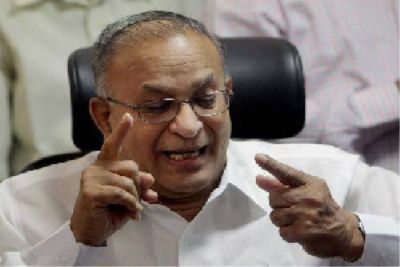
Increase duty on diesel cars up to Rs 2.5 lakh: Jaipal Reddy

June 13, 2012

Jaipal-Reddy

New Delhi, June 13: If the government accepts oil minister S Jaipal Reddy's proposal, the price of small diesel cars could soon rise by Rs 1.7 lakh while medium-to-large guzzlers could become costlier by Rs 2.55 lakh a piece.

The proposal to impose additional excise duty on diesel cars is bound to trigger protests from automakers, who have seen sales growing at the slowest pace in seven months in May. Domestic car sales declined 24% in May compared to the year-ago period due to high fuel prices and interest rates.

The proposal drew a thumbs down from analysts and private players, who described it as an excuse to avoid fuel pricing reforms. "From the RBI to C Rangarajan, head of the PM's Economic Advisory Council, everyone has recommended deregulation of fuel prices. If you can't do that for political reasons, at least fix subsidy on diesel and then let the market determine the pump price. Taxing vehicles would serve hardly any purpose," said an industry analyst requesting anonymity.

But Reddy has his arguments for seeking taxing diesel vehicles that are outpacing petrol car sales. In a June 7 letter to finance minister Pranab Mukherjee, the oil minister gave three key reasons for his proposal aimed at arresting a ballooning fuel subsidy bill.

Reddy pointed out that the proposed additional excise duties are equivalent to the minimum benefit that a diesel car owner derives from the fuel's price differential with petrol — at current prices — over a 10-year assumed life of a vehicle. Petrol in Delhi costs Rs 71.16 a litre against Rs 40.91 for diesel.

Reddy's arithmetic goes like this: he first calculates the total distance a vehicle is expected to clock in its 10-year life span, assuming an annual run of 18,000km. Then, he works out the fuel costs by taking a median mileage of 18km to a litre for small cars and 12km for medium/large vehicles. For good measure, he shaves off 10% of the total cost to level.

According to Reddy's calculation, the additional excise duty amounts to asking the diesel car buyer to pay upfront the price differential with petrol that he or she would enjoy later. A petrol car owner, in contrast, shells out every time at the pump.

Reddy also pointed out the adverse impact of increased diesel car sales on the government's earnings. Petrol attracts an excise duty of Rs 14.78 per litre against Rs 2.06 a litre for diesel. So each time a buyer opts for a diesel car instead of petrol and visits a petrol pump, the government loses Rs 12.72 in excise duty on litre of diesel. Together with the Rs 12.53 a litre subsidy on diesel, the actual price differential with petrol at Delhi works out to Rs 25.75 a litre.

To drive home the enormity of the situation arising out of this increasing dieselization, Reddy says diesel consumption rose by 7.6% in 2011-12 against 6.2% in 2010-11. In contrast, growth in petrol consumption fell from 10.7% in 2010-11 to 5.6% in 2011-12.

The Kirit Parikh Committee on fuel pricing reforms had recommended an additional excise duty of Rs 80,000 in February 2010 when duty difference on petrol and diesel was Rs 9.75 a litre and under-recovery on petrol was more at Rs 3.97 a litre than Rs 2 on diesel.

Comments

Add new comment

  • Coastaldigest.com reserves the right to delete or block any comments.
  • Coastaldigset.com is not responsible for its readers’ comments.
  • Comments that are abusive, incendiary or irrelevant are strictly prohibited.
  • Please use a genuine email ID and provide your name to avoid reject.
News Network
May 18,2020

May 18: The Central Board of Secondary Education (CBSE) on Monday announced the date sheet for the pending class 10 and 12 board exams, which will now be held from July 1 to 15.

The exams were postponed due to the nationwide lockdown imposed on March 25 to contain the spread of COVID-19.

The Class 10 board exams are pending only in the North East Delhi.

"The Class 10 exams will be staggered on four dates, starting July 1. The first paper will be Social Science, while the next day students will be required to appear for the Science exam,” said Sanyam Bhardwaj, the Controller of Examination, CBSE.

“On July 10, exams will be conducted for both courses of Hindi and on July 15 for both courses of English," he said.

On health guidelines for students, Bhardwaj said that they will be required to carry their own sanitiser bottles and wear masks to examination centres.

"Parents will have to ensure that their ward is not sick and candidates will have to strictly follow physical-distancing norms," he said.

For Class 12, the Home Science exam will be held on July 1, followed by both courses of Hindi the next day.

The Class 12 Business Studies exam has been scheduled for July 9, followed by Biotechnology on July 10 and Geography on July 11.

Comments

Add new comment

  • Coastaldigest.com reserves the right to delete or block any comments.
  • Coastaldigset.com is not responsible for its readers’ comments.
  • Comments that are abusive, incendiary or irrelevant are strictly prohibited.
  • Please use a genuine email ID and provide your name to avoid reject.
News Network
January 31,2020

New Delhi, Jan 31: Chief Economic Adviser K V Subramanian on Friday said India's GDP is expected to grow at 6-6.5 per cent next fiscal as the economic slowdown has bottomed out.

As per the first advance estimates released by the National Statistical Organisation (NSO), the country's economic growth is likely to hit an 11-year low of 5 per cent in the current fiscal ending March 2020.

The Economic Survey 2019-20, prepared by a team lead by Subramanian, has projected the GDP to expand in the range of 6-6.5 per cent during 2020-21.

The Indian economy has hit the bottom and it will see an uptick from here, he said in a media briefing post the Economic Survey.

Amidst a weak environment for global manufacturing, trade and demand, the Indian economy slowed down with GDP growth moderating to 4.8 per cent in the first half of 2019-20, lower than 6.2 per cent in H2 of 2018-19.

Based on NSO's first advance estimates of GDP growth for 2019-20 at 5 per cent, an uptick in GDP growth is expected in the second half of the fiscal, it said.

According to it, the uptick in second half of 2019-20 would be mainly due to ten positive factors like picking up of Nifty India Consumption Index for the first time this year, an upbeat secondary market, higher FDI flows, build-up of demand pressure, positive outlook for rural consumption, rebound of industrial activity, steady improvement in manufacturing, growth in merchandise exports, higher build-up of foreign exchange reserves and positive growth rate of GST revenue collection.

The survey also emphasised that merger of public sector banks may increase the financial strength of the merged entities, lower the risk aversion and result in lowering of lending rates.

Further, as the implementation of GST further settles down, the increased unification of the domestic market may reduce business costs and facilitate fresh investment.

Reforms in land and labour market may further reduce business costs, said the survey, presented a day before Sitharaman's Union Budget 2020-21.

Comments

Add new comment

  • Coastaldigest.com reserves the right to delete or block any comments.
  • Coastaldigset.com is not responsible for its readers’ comments.
  • Comments that are abusive, incendiary or irrelevant are strictly prohibited.
  • Please use a genuine email ID and provide your name to avoid reject.
News Network
January 28,2020

Kolkata, Jan 28: West Bengal chief minister Mamata Banerjee Tuesday said she is ready for talks with Prime Minister Narendra Modi on the issue of Citizenship Amendment Act but the Centre has to first withdraw the contentious law.

Banerjee said protesting against the decisions of the centre doesn't make opposition parties anti-national and iterated that she will not implement CAA, NRC or NPR in the state.

"It is good that the prime minister is ready for talks but the Citizenship Amendment Act (CAA) must be revoked first. They (Centre) did not call an all-party meeting before taking a decision on Kashmir and CAA.

"We are ready for talks but first withdraw this Citizenship Amendment Act," Banerjee, a staunch critic of the BJP, said addressing a protest programme against CAA through paintings.

The West Bengal assembly had on Monday passed a resolution against the CAA to become the fourth state after Kerala, Punjab and Rajasthan, to do so. The state assembly had on September 6, 2019, passed a resolution against the NRC.

Comments

Add new comment

  • Coastaldigest.com reserves the right to delete or block any comments.
  • Coastaldigset.com is not responsible for its readers’ comments.
  • Comments that are abusive, incendiary or irrelevant are strictly prohibited.
  • Please use a genuine email ID and provide your name to avoid reject.