


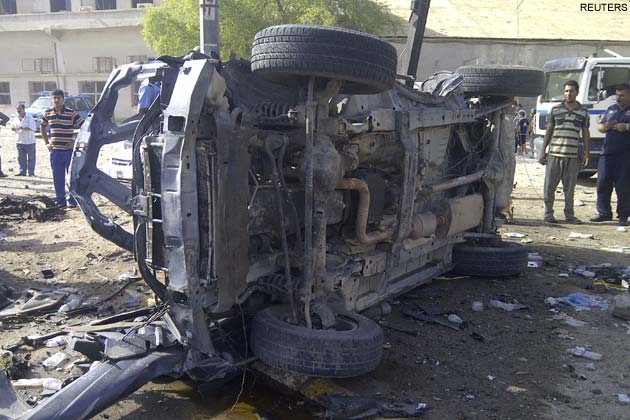
Coordinated bombs kill 56 during Iraq pilgrimage

June 13, 2012
iraq-blast-630

Baghdad, June 13: Coordinated car bombs in four Iraqi cities targeting Shiite pilgrims killed at least 56 people and wounded dozens more early on Wednesday in Iraq's latest wave of sectarian-fuelled violence, officials said.

The death toll was expected to rise in the attacks, which included car bombs that tore into Shiite religious processions at four different locations across Baghdad. It was the third attack in the capital this week targeting the annual pilgrimage commemorating the 8th century death of a revered imam.

Two police officers said the first bomb struck pilgrims in a procession at around 5 a.m. in the northern Baghdad neighbourhood of Taji, killing seven and wounding 22 people.

Within hours, three more explosions hit other processions in different parts of the Iraqi capital, killing at least 19 more people and wounding more than 50, police officers said. All officials spoke on condition of anonymity because they were not authorized to talk to the media.

In the city of Hillah, 95 kilometers (60 miles) south of Baghdad, two car bombs exploded minutes apart at dawn in the center of town, killing 21 people and wounding 53, according to two police officers and one health worker.

Nearby, in the southern city of Karbala, a parked car exploded at about 8 a.m. near another group of Shiite pilgrims, killing two people and injuring 22 others, a police official and health official said. Karbala is 55 miles (90 kilometers) south of Baghdad.

And north of Baghdad, in the Shiite town of Balad, two simultaneously car bombs killed seven pilgrims and injured 34 others, a police official and health official said. Balad is 50 miles (80 kilometers) north of the capital, near the city of Tikrit.

The bombs went off as the pilgrims started to make their way to Baghdad for the commemorations marking the death of al-Kadhim, one of the 12 principal Shiite saints, who is said to be buried in a shrine there. The attacks were launched against the backdrop of a prolonged sectarian-based political crisis that some fear is opening the door to renewed violence.

Last year's pilgrimage to the al-Kadhim shrine passed without incident, and Iraqi security officials at the time hailed their troops' work as a huge success.

However, Shiite pilgrims have been frequent targets of attack by Sunni insurgents, some with links to al-Qaida. Iraq's bloodiest wave of sectarian fighting was triggered by a bomb blast in February 2006 that ravaged a Shiite shrine in the city of Samarra.

Prime Minister Nouri al-Maliki, a Shiite, has been accused of amassing power and cutting coalition partners, mainly minority Sunnis and Kurds, out of decision making. Disgruntled coalition politicians have been trying to unseat al-Maliki with a vote of no confidence in parliament, but so far have been unable to muster the necessary backing.

Comments

Add new comment

  • Coastaldigest.com reserves the right to delete or block any comments.
  • Coastaldigset.com is not responsible for its readers’ comments.
  • Comments that are abusive, incendiary or irrelevant are strictly prohibited.
  • Please use a genuine email ID and provide your name to avoid reject.
News Network
June 3,2020

Jammu, Jun 3: A mob on Tuesday disrupted the last rites of a coronavirus victim in Jammu and Kashmir and forced his family members to flee with the half-burnt body, prompting intervention by the administration which later ensured the cremation at another place as per protocol.

A 72-year-old man, hailing from Doda district, became the fourth victim of the novel coronavirus to die in Jammu region. He breathed his last at the Government Medical College (GMC) hospital on Monday.

"We had set out for the funeral along with a revenue official and a medical team, and had lit the pyre at a cremation ground in Domana area when a large group of local residents appeared at the scene and disrupted the last rites," son of the deceased said.

Only close relatives of the deceased, including his wife and two sons, were present during the cremation. They had to flee with the half-burnt body in an ambulance to save their skin from the mob which pelted stones and attacked them with sticks.

"We had sought permission from the government to take the body to our home district for the last rites, but we were told that all necessary arrangements were in place, and that we would not face any trouble during the cremation," the victim's son said.

He also alleged that the security officials present at the scene were of no help.

Two policemen who were present there failed to act against the unruly crowd, while the accompanying revenue official went missing, he said.

"The ambulance driver and other staff from the hospital helped us a lot and managed to take us back to the GMC hospital with the body the government should have come out with a better plan to conduct the last rites of coronavirus victims, taking into consideration the past experience and problems encountered during the funeral of such victims," the victim's son said.

Later, the body was taken to a cremation ground at Bhagwati Nagar area of the city, where it was consigned to flames in the afternoon in presence of senior civil officials, including additional deputy commissioner and sub-divisional magistrate under tight security.

"My uncle was admitted in the hospital last week and died on Monday afternoon. He was suffering from various ailments, especially lungs and heart diseases. Before shifting him to GMC hospital Jammu, he underwent a coronavirus test in Doda which came negative," nephew of the deceased said.

However, he said, the victim's second test after his admission in the GMC hospital came positive on Sunday.

Comments

Add new comment

  • Coastaldigest.com reserves the right to delete or block any comments.
  • Coastaldigset.com is not responsible for its readers’ comments.
  • Comments that are abusive, incendiary or irrelevant are strictly prohibited.
  • Please use a genuine email ID and provide your name to avoid reject.
News Network
June 24,2020

New Delhi, Jun 24: In a stinging attack on the Gandhi family of the Congress, BJP president J P Nadda on Wednesday said a dynasty and its courtiers have "grand delusions" of the opposition being about itself and stated that a "rejected and ejected" family is not equal to the entire opposition.

In his tweets, Nadda said it was the time for unity and solidarity, and the "relaunch of the scion for the nth time can wait", an apparent dig at Rahul Gandhi, who has been aggressive in his attacks on Prime Minister Narendra Modi for his handling of the border row with China.

Nadda said India lost thousands of square kilometres of land due to the "misadventures of one dynasty" and claimed that the Siachen glacier, where the Indian Army has a strong presence, was almost gone. No wonder India has rejected them, he said.'

The BJP president posted a news report to back his assertions about Siachen.

"One 'royal' dynasty and their 'loyal' courtiers have grand delusions of the Opposition being about one dynasty. A dynast throws tantrums and his courtiers peddle that fake narrative. The latest one relates to the Opposition asking questions to the Government," Nadda said.

Though he did not directly name the Gandhi family or any of its members, the reference was clear.

He said it was the opposition's right to ask questions and added that the all-party meeting called by Prime Minister Narendra Modi saw healthy deliberations, with several opposition leaders giving their valuable inputs.

They also fully supported the Centre in determining the way ahead, Nadda said.

"One family was an exception. Any guesses who," he asked.

Targeting the Gandhis, the BJP president said, "One rejected and ejected dynasty is NOT equal to the entire Opposition. One dynasty's interests are not India's interests. Today, the nation is united and supportive of our armed forces. This is the time for unity and solidarity. Relaunch of 'the scion' for the nth time can wait."

Comments

Add new comment

  • Coastaldigest.com reserves the right to delete or block any comments.
  • Coastaldigset.com is not responsible for its readers’ comments.
  • Comments that are abusive, incendiary or irrelevant are strictly prohibited.
  • Please use a genuine email ID and provide your name to avoid reject.
News Network
February 19,2020

New Delhi, Feb 19: India will switch to the world's cleanest petrol and diesel from April 1 as it leapfrogs straight to Euro-VI emission compliant fuels from Euro-IV grades now - a feat achieved in just three years and not seen in any of the large economies around the globe.

India will join the select league of nations using petrol and diesel containing just 10 parts per million of sulphur as it looks to cut vehicular emissions that are said to be one of the reasons for the choking pollution in major cities.

Sanjiv Singh, Chairman of Indian Oil Corp (IOC) - the firm that controls roughly half of the country's fuel market, said almost all refineries began producing ultra-low sulphur BS-VI (equivalent to Euro-VI grade) petrol and diesel by the end of 2019 and oil companies have now undertaken the tedious task of replacing every drop of fuel in the country with the new one.

"We are absolutely on track for supplying BS-VI fuel from April 1. Almost all refineries have begun supplying BS-VI fuel and the same has reached storage depots across the country," he said.

From storage depots, the fuel has started travelling to petrol pumps and in the next few weeks all of them will only have BS-VI grade petrol and diesel, he said. "We are 100 per cent confident that fuel that will flow from nozzles at all the petrol pumps in the country on April 1 will be BS-VI emission compliant fuel."

India adopted Euro-III equivalent (or Bharat Stage-III) fuel with a sulphur content of 350 ppm in 2010 and then took seven years to move to BS-IV that had a sulphur content of 50 ppm. From BS-IV to BS-VI it took just three years.

"It was a conscious decision to leapfrog to BS-VI as first upgrading to BS-V and then shifting to BS-VI would have prolonged the journey to 4 to 6 years. Besides, oil refineries, as well as automobile manufacturers, would have had to make investments twice - first to producing BS-V grade fuel and engines and then BS-VI ones," he said.

State-owned oil refineries spent about Rs 35,000 crore to upgrade plants that could produce ultra-low sulphur fuel. This investment is on top of Rs 60,000 crore they spent on refinery upgrades in the previous switchovers.

BS-VI has a sulphur content of just 10 ppm and emission standards are as good as CNG.

Originally, Delhi and its adjoining towns were to have BS-VI fuel supplies by April 2019 and the rest of the country was to get same supplies from April 2020.

But oil marketing companies switched over to supply of BS-VI grade fuels in the national capital territory of Delhi on April 1, 2018.

The supply of BS-VI fuels was further extended to four contiguous districts of Rajasthan and eight of Uttar Pradesh in the National Capital Region (NCR) on April 1, 2019, together with the city of Agra.

BS-VI grade fuels were made available in 7 districts of Haryana from October 1, 2019.

Singh said the new fuel will result in a reduction in NOx in BS-VI compliant vehicles by 25 per cent in petrol cars and by 70 per cent in diesel cars.

The switchover, he said, is a tedious task as every drop of old, higher-sulphur content fuel has to be flushed out in depots, pipelines and tanks before being replaced by BS-VI.

"We are confident of disruption-free switchover to BS-VI supplies across the country," he said. "What we will be supplying is the best quality available anywhere in the world. You don't have any better fuel that is supplied in any part of the world. Perhaps our BS-VI fuel will be better than equivalent fuel in some parts of the US and Europe."

India adopted a fuel upgradation programme in the early 1990s. Low lead gasoline (petrol) was introduced in 1994 in Delhi, Mumbai, Kolkata and Chennai. On February 1, 2000, unleaded gasoline was mandated nationwide.

Similarly, BS-2000 (Euro-I equivalent, BS-1) vehicle emission norms were introduced for new vehicles from April 2000. BS-II (Euro-II equivalent) emission norms for new cars were introduced in Delhi from 2000 and extended to the other metro cities in 2001.

Benzene limits have been reduced progressively from 5 per cent in 2000 to 1 per cent nationwide. Lead content in gasoline was removed in phases and only unleaded gasoline is being produced and sold from February 1, 2000.

The octane number of gasoline signifies the improved performance of the engine. Loss in octane number due to phasing out of lead was made up by installing new facilities in the refinery and changes in refinery operation. RON (Research Octane Number) of gasoline for BS-2000 spec was increased to 88. This has over time been increased to 91.

Singh said sulphur reduction will reduce Particulate Matter (PM) emissions even in the in-use older generation diesel vehicles.

Comments

Add new comment

  • Coastaldigest.com reserves the right to delete or block any comments.
  • Coastaldigset.com is not responsible for its readers’ comments.
  • Comments that are abusive, incendiary or irrelevant are strictly prohibited.
  • Please use a genuine email ID and provide your name to avoid reject.