'Star' labelling mandatory for passenger cars from April 2013

June 14, 2012

car

Mumbai, June 14: A special "star labelling" indicating fuel efficiency will be compulsory for all passenger cars from April 1, 2013, a top official from the Bureau of Energy Efficiency (BEE) said.

"All passenger cars will have to be labelled for their fuel efficiency from April 1, 2013," BEE Director General Ajay Mathur told reporters.

In November last, BEE, under the Ministry of Power released a Consultation Paper defining fuel efficiency standards (based on fuel consumption in litres per 100 kms) and recommended a star rating (based on a five-star scale, with five being the most efficient and one the least) to help compare the fuel efficiency of different car models within the same weight class.

As per the consultation paper, medium and long term fuel consumption standards for new cars would provide a regulatory signal to manufacturers to "continuously reduce the average fuel consumption of cars sold by them over the next 10-year period".

According to preliminary estimates made in the paper, out of altogether 330 car models in India, 32 fall within the five-star category, while 52 in four-star category which is comparatively less fuel efficient. BEE defines cars in five-star category are those which roughly consume up to 7 litres of fuel for 100 kms while those in four-star category 7-9 littres, and three-star category 9-11 litres. Cars guzzling 12 litres of fuel for 100 kms and beyond come under one-star category.

"All car manufacturers will have to comply with the regulatory norms," Mathur said.Meanwhile, the statutory body has also launched a mobile application 'AC Power Saver' that will help consumers calculate their expected annual bills and the potential saving with a five-star AC as against those with the lower stars.

The application will be available for Android, Blackberry, iPhone and iPad users.

Comments

Add new comment

  • Coastaldigest.com reserves the right to delete or block any comments.
  • Coastaldigset.com is not responsible for its readers’ comments.
  • Comments that are abusive, incendiary or irrelevant are strictly prohibited.
  • Please use a genuine email ID and provide your name to avoid reject.
News Network
March 25,2020

New Delhi, Mar 25: The Congress said on Wednesday that it stood with Prime Minister Narendra Modi on his appeal for 21-day lockdown but was "deeply disappointed by the lack of coherent strategy" and demanded that Rs 7,500 should be transferred to every Jan Dhan, PM Kisan and pension account to tide over the nutrition needs for 21-days.
It also demanded that the Public Distribution System (PDS) ration should be given free.
In a series of tweets, Congress Communications in-charge Randeep Singh Surejwala said that the need of the hour was to implement 'Minimum Income Guarantee Scheme' (Nyay) mooted by the Congress and party leader Rahul Gandhi.
"Please transfer Rs 7,500 to every Jan Dhan, PM Kisan, and every pension account to tide over nutrition needs of 21 days and give free PDS ration. We will rise together as a nation and defeat COVID-19. We stand with lockdown but are deeply disappointed by the lack of coherent strategy or a clear 'way ahead' on your part," he said.
Surjewala asked what steps the government took despite an early warning about COVID-19 and sought details about isolation beds and ventilators available to people.
"Dear PM, India will adhere to the lockdown but what steps did the govt take to tackle the corona pandemic despite early warnings in Feb? When will doctors, nurses and health workers have adequate protection? How many 'isolation beds' and ventilators are available and where?" he said.
He asked how daily wagers and labourers will sustain during the 21-day lockdown.
"What's your plan to address the huge issue of bread and butter and livelihood for millions? How will daily wagers, labourers, MGNREGA workers, factory workers, unorganised workers, fishermen, farmers and farm labour sustain for 21 days?" he asked.
Surjewala said the crying need is to arm doctors, nurses and health workers with personal protection equipment and asked: "why are N-95 masks, Hazmat suits not available?"
"In March itself, India needs 7.25 lakh bodysuits, 60 lakh N-95 masks, 1 crore 3 ply masks? When will they be available?" he asked.
Surjewala said that the government banned the export of ventilators, respiratory devices and sanitisers only yesterday on March 24, "84 days after the spread of COVID-19."
"Is this your government's 'Modus operandi' to fight coronavirus? Too little, Too late!," he said.
Noting that two-thirds of the country's population is engaged in agriculture, he said that Prime Minister Modi did not refer to farmers during his address to the nation and demanded a moratorium on farmers' loans.
"Crop is ready for harvest in March itself. How will it be harvested and sold and who will buy at fair price? Indebtedness relief to farmers is the only way forward in these testing times. Please put a moratorium on farmers' loans and recoveries. Please ensure the procurement of crops at MSP. Let's not forget that farmers are the backbone of India's economy," he said.
Surjewala said the Prime Minister gave only four hours to prepare for 21-day lockdown.
"Did you think of over 5 lakh truck drivers, who are now stranded on roads? Did you think of millions of workers, who are stranded in cities away from home without food or money? What should they do," he asked.

Comments

Add new comment

  • Coastaldigest.com reserves the right to delete or block any comments.
  • Coastaldigset.com is not responsible for its readers’ comments.
  • Comments that are abusive, incendiary or irrelevant are strictly prohibited.
  • Please use a genuine email ID and provide your name to avoid reject.
Agencies
August 2,2020

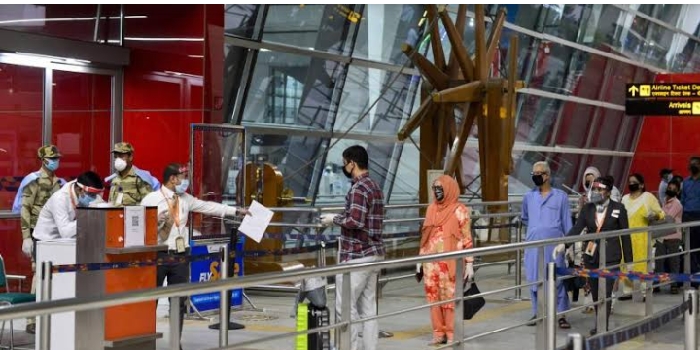
New Delhi, Aug 2: The Ministry of Health and Family Welfare on Sunday issued fresh guidelines for international passengers coming to India amid the COVID-19 pandemic. The new guidelines will be implemented from 12:01 am on August 8.

The ministry has also asked all passengers to submit a self-declaration form online at least 72 hours before travel.

"All travellers should submit self-declaration form on the on the online portal (www.newdelhiairport.in) at least 72hours before the scheduled travel," the guidelines said.

It also said that those coming to India must give an undertaking that they would undergo mandatory quarantine for 14 days as prescribed by the government. "They should also give an undertaking on the portal that they would undergo mandatory quarantine for 14 days i.e. 7 days paid institutional quarantine at their own cost, followed by 7 days isolation at home with self-monitoring of health," it added.

Giving exemptions in some cases, the guidelines mentioned, "Only for compelling reasons/cases of human distress such as pregnancy, death in the family. Serious illness and parent (s) with children of 10 years or below, home quarantine may be permitted for 14 days."

"If they wish to seek such exemption, they shall apply to the online portal at least 72 hours before boarding. The decision taken by the government as communicated on the online portal will be final," it said further.

The guidelines further said that travellers could request for exemption from institutional quarantine by submitting a negative RT-PCR test report on arrival.

"This test should have been conducted within 96 hours prior to undertaking the journey. The test report should be uploaded on the portal for consideration," it added.

Passengers have also been asked to download the Aarogya Setu app on their mobile phones.

Comments

Add new comment

  • Coastaldigest.com reserves the right to delete or block any comments.
  • Coastaldigset.com is not responsible for its readers’ comments.
  • Comments that are abusive, incendiary or irrelevant are strictly prohibited.
  • Please use a genuine email ID and provide your name to avoid reject.
News Network
March 27,2020

Mumbai, Mar 27: The Reserve Bank of India (RBI) on Friday lowered the key repo rate by 75 basis points to 4.4 per cent in a bid to arrest the economic slowdown amid coronavirus (COVID-19) outbreak.
The reverse repo rate now stands at 4 per cent, down by 90 basis points, said RBI Governor Shaktikanta Das adding this has been done to make it unattractive for banks to passively deposit funds with the central bank and instead lend it to the productive sectors.
The six-member monetary policy committee (MPC) met on March 24, 25 and 27 and voted 4:2 in favour of the repo rate reduction. The MPC also decided to continue with the accommodative stance as long as it is necessary to revive growth and mitigate the impact of COVID-19 on the economy while ensuring that inflation remains within the target.
"The need of the hour is to shield the economy from the pandemic," said Das. "We need to mitigate the impact of coronavirus, revive economic growth and provide financial stability."
Repo rate is the rate at which a country's central bank lends money to commercial banks, and the reverse repo rate is the rate at which it borrows from them.
The RBI Governor further said that the economic growth and inflation projection will be highly contingent depending on the duration, spread and intensity of the pandemic.
"Global economic activity has come to a near standstill as COVID-19 related lockdowns and social distancing are imposed across a widening swathe of affected countries. Expectations of a shallow recovery in 2020 from 2019's decade low in global growth have been dashed," said Das.
"The outlook is now heavily contingent upon the intensity, spread and duration of the pandemic. There is a rising probability that large parts of the global economy will slip into recession," he said.
However, the RBI has injected liquidity of Rs 2.8 lakh crore via various instruments equal to 1.4 per cent of GDP. "Along with today's measures, liquidity measures equal to 3.2 per cent of GDP. The RBI will take continuous measures to ensure liquidity in the system."
The RBI governor has said that all banking institutions can offer a three-month moratorium on all loans for a period of three months. The RBI has also allowed banks to restructure the working capital cycle for companies without worrying that these will have to be classified as a non-performing asset (NPA).
The three-month moratorium will permit banks to avoid a large onset of NPAs during the 21-day lockdown and keep their books healthy.
Das said banks and other financial institutions should do all they can to keep credit flowing to economic agents facing financial stress on account of the isolation that the virus has imposed.
"Market participants should work with regulators like the RBI and the Securities and Exchange Board of India (SEBI) to ensure the orderly functioning of markets in their role of price discovery and financial intermediation," he said.

Comments

Add new comment

  • Coastaldigest.com reserves the right to delete or block any comments.
  • Coastaldigset.com is not responsible for its readers’ comments.
  • Comments that are abusive, incendiary or irrelevant are strictly prohibited.
  • Please use a genuine email ID and provide your name to avoid reject.