


Differences in NDA, decision on Prez poll deferred

June 17, 2012

nda-file


New Delhi, Jun 17: Strong reservations from key ally JD-U over pitting a candidate against UPA nominee Pranab Mukherjee today forced the NDA to defer its decision on the Presidential election.

At a two-hour inconclusive meeting of the NDA, the JD-U is believed to have disavoured a fight against Mukherjee because of his stature but BJP is said to have been keen on backing former Speaker P A Sangma, who has been propped up by BJD and AIADMK with an eye on the 2014 Lok Sabha polls.

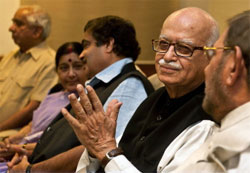
After the meeting at BJP leader L K Advani's residence, from which BJP's oldest ideological ally Shiv Sena kept away, NDA convener Sharad Yadav merely said more discussions were needed to arrive at a right decision.

"The NDA meeting took place today. Various leaders put forth their views in detail. More discussions are required in this regard to arrive at the right decision.

"L K Advani will talk to Chief Ministers of NDA-ruled states and all others. NDA will meet sometime later again to take a decision in this regard. Those outside (Delhi) will also be consulted," Tadav told reporters after the meeting.

The JD-U, which shares power with BJP in Bihar, was clear that there is no strong purpose served by contesting against Mukherjee, a tall leader with vast experience in government and Parliament, and more so when the UPA has a clear edge in the electoral college.

However, BJP leaders including Advani and Sushma Swaraj are understood to have argued that Mukherjee should not go uncontested, especially in view of the Lok Sabha polls due two years hence.

The BJP is said to be keen on supporting Sangma so that the alliance could rope in parties like BJD and AIADMK that could be valuable in the next Lok Sabha elections.

While Yadav did make the point against contesting Mukherjee, he was not averse to going with the BJP should it persist with a fight in the Presidential election.

However, Shivanand Tiwari, the other JD-U leader, who is considered close to Bihar chief minister Nitish Kumar, strongly opposed a contest. This is seen as an attempt by Nitish Kumar to keep his options open.

Prime Minister Manmohan Singh and Mukherjee had called Kumar on Friday seeking JD-U's support for the UPA candidate.

BJP leaders remained tight-lipped after the meeting and downplayed any differences within the NDA, saying more consultations were required as it is a democratic alliance.

BJP leaders felt Advani should stay in touch with AIADMK chief Jayalalithaa and BJD chief Naveen Patnaik so that the options of a contest are still open.

Shiv Sena, the oldest ideological ally of the BJP, skipped the key meeting of alliance leaders here, triggering speculation the party was opposed to a fight due to lack of numbers.

"Shiv Sena chief Bal Thackerey will take a decision on the issue," said party leader Sanjay Raut, when asked about speculation that the Sena was against fielding any candidate against Pranab Mukherjee, UPAs Presidential nominee.

Shiv Sena had not backed former Vice President Bhairon Singh Shekhawat in the Presidential poll last time despite BJP and several others in the alliance supporting him.

At that time, it had backed Pratibha Patil--she being the first Maharashtrian to be nominated for the top post of President.

Comments

Add new comment

  • Coastaldigest.com reserves the right to delete or block any comments.
  • Coastaldigset.com is not responsible for its readers’ comments.
  • Comments that are abusive, incendiary or irrelevant are strictly prohibited.
  • Please use a genuine email ID and provide your name to avoid reject.
News Nerwork
June 7,2020

New Delhi, Jun 7: Rain lashed some parts of the Delhi-NCR on Sunday morning.

The India Meteorological Department (IMD) has predicted partly cloudy sky with possibility of development of thunder lightning for three days from June 10 onwards with minimum and maximum temperature will hover around 29° Celcius and 42° Celcius respectively.

Strong surface winds during day time have been predicted for today by IMD.

Comments

Add new comment

  • Coastaldigest.com reserves the right to delete or block any comments.
  • Coastaldigset.com is not responsible for its readers’ comments.
  • Comments that are abusive, incendiary or irrelevant are strictly prohibited.
  • Please use a genuine email ID and provide your name to avoid reject.
Agencies
June 14,2020

Mumbai, Jun 14: A 42-year old man suddenly collapsed and died due to natural causes onboard Air India's Lagos-Mumbai flight on Sunday, the national carrier said.

The flight was part of Vande Bharat Mission, under which the Central government is operating special repatriation flights to bring back stranded Indians from abroad amid the coronavirus pandemic.

Air India's flight AI 1906 departed from Lagos in Nigeria at 7 pm Indian Standard Time on Saturday and landed in Mumbai at 3.45 am on Sunday.

"A passenger aboard AI 1906 of June 13 from Lagos to Mumbai passed away due to natural causes today.

"A doctor onboard along with our crew, trained to handle such medical emergencies, made a valiant attempt to revive the passenger, aged 42, who had suddenly collapsed, through resuscitation etc but all their efforts went in vain," the airline's spokesperson said.

He was declared dead onboard by the attending doctor. Mumbai International Airport Limited doctors attended to the passenger after the flight landed at 3.45 am and after all the procedures were complete, the body was sent to a hospital as per protocol, the spokesperson noted.

Relatives of the deceased were informed and aircraft was taken for full fumigation as per the norms, the spokesperson said.

Comments

Add new comment

  • Coastaldigest.com reserves the right to delete or block any comments.
  • Coastaldigset.com is not responsible for its readers’ comments.
  • Comments that are abusive, incendiary or irrelevant are strictly prohibited.
  • Please use a genuine email ID and provide your name to avoid reject.
News Network
April 23,2020

Washington, Apr 23: Air pollution over northern India has plummeted to a 20-year-low for this time of the year, according to satellite data published by US space agency National Aeronautics and Space Administration (NASA).
The US space agency's satellite sensors observed aerosol levels at a 20-year low post the countrywide lockdown, implemented to slow the spread of the novel coronavirus.

"We knew we would see changes in atmospheric composition in many places during the lockdown," said Pawan Gupta, a Universities Space Research Association (USRA) scientist at NASA''s Marshall Space Flight Center. "But I have never seen aerosol values so low in the Indo-Gangetic Plain at this time of year," added Mr Gupta.

Acting Assistant Secretary of State for South and Central Asia Alice G Wells tweeted, "These images from NASA were taken each spring starting in 2016 and show a 20-year low in airborne particle levels over India. When India and the world are ready to work and travel again, let's not forget that collaborative action can result in cleaner air."

The data published with maps show aerosol optical depth (AOD) in 2020 compared to the average for 2016-2019. Aerosol optical depth is a measure of how light is absorbed or reflected by airborne particles as it travels through the atmosphere.

If aerosols are concentrated near the surface, an optical depth of 1 or above indicates very hazy conditions. An optical depth, or thickness, of less than 0.1 over the entire atmospheric vertical column is considered "clean." The data were retrieved by the Moderate Resolution Imaging Spectroradiometer (MODIS) on NASA's Terra satellite.

In the first few days of the lockdown, it was difficult to observe a change in the pollution signature. "We saw an aerosol decrease in the first week of the shutdown, but that was due to a combination of rain and the lockdown," said Mr Gupta.

Around March 27, heavy rain poured over vast areas of northern India and helped clear the air of aerosols. Aerosol concentrations usually increase again after such heavy precipitation.

"After the rainfall, I was really impressed that aerosol levels did not go up and return to normal. We saw a gradual decrease and things have been staying at the level we might expect without anthropogenic emissions," Mr Gupta said.

On March 25, the Indian government placed its 1.3 billion citizens under a strict lockdown to reduce the spread of COVID-19. The countrywide mandate decreased activity at factories and severely reduced car, bus, truck and airplane traffic. Every year, aerosols from anthropogenic (human-made) sources contribute to unhealthy levels of air pollution in many Indian cities.

Aerosols are tiny solid and liquid particles suspended in the air that reduce visibility and can damage the human lungs and heart.

In southern India though, the story is a little hazier. Satellite data show aerosol levels have not yet decreased to the same extent. In fact, levels seem to be slightly higher than in the past four years. The reasons are unclear but could be related to recent weather patterns, agricultural fires, winds or other factors.

"This a model scientific experiment," Robert Levy, program leader for NASA's MODIS aerosol products, said about the lockdown and its effects on pollution.

"We have a unique opportunity to learn how the atmosphere reacts to sharp and sudden reductions in emissions from certain sectors. This can help us separate how natural and human sources of aerosols affect the atmosphere," Mr Levy added.

Comments

Add new comment

  • Coastaldigest.com reserves the right to delete or block any comments.
  • Coastaldigset.com is not responsible for its readers’ comments.
  • Comments that are abusive, incendiary or irrelevant are strictly prohibited.
  • Please use a genuine email ID and provide your name to avoid reject.