


Presidential fight finalised, focus shifts on Ansari's successor

June 23, 2012

hamid_copy


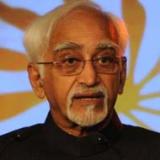
New Delhi, June 23: With the battle lines drawn for the July 19 presidential election, the focus is gradually shifting to the vice-presidential poll in August, for which incumbent M. Hamid Ansari appears to be a strong contender, Congress sources said Saturday.

After having had its way on fielding Finance Minister Pranab Mukherjee as the United Progressive Alliance (UPA) nominee for the next president, the Congress appears keen to call the shots in the vice-presidential election as well.

Congress sources said that there was a possibility of Ansari getting a second term at the high post but other names were also doing the rounds. These included former union minister Mohsina Kidwai, the Rajya Sabha's former deputy chairman K. Rahman Khan and Jammu and Kashmir Congress chief Saifuddin Soz.

A party leader, insisting on anonymity, said that generally the vice president was chosen for the post of president if the same party continued in power. However, since Mukherjee was named for presidency, "I feel he (Ansari) may be renominated," the leader told IANS.

He said the Communist Party of India-Marxist (CPI-M), which announced support for Mukherjee in the presidential poll, may back Ansari if he was renominated as vice-president.

Ansari was a common candidate of the UPA and the Left parties in the vice-presidential poll in 2007. His term comes to end Aug 10.

Congress general secretary Digvijay Singh, in a recent TV interview, praised Ansari saying he had conducted himself admirably as the vice-president.

At one point, Ansari was in the reckoning as the Congress choice for the post of president along with Mukherjee, who was eventually chosen as the official UPA nominee.

A party leader said that there was high probability of Ansari being re-nominated as the vice-president as he had missed the UPA's nomination as the presidential candidate.

Congress leaders said there was “sufficient time” to decide the vice-presidential candidate and an announcement was likely to be made after the declaration of the presidential poll result July 22.

The main opposition Bharatiya Janata Party is expected to chart its course warily in the vice presidential election as two of its allies in the National Democratic Alliance (NDA) broke ranks with it and declared their support to Mukherjee in the presidential poll.

The party decided to contest the presidential poll so as to not allow a "walkover" to the Congress and not to be seen as backing a nominee of what it has consistently called a "failed" government.

The name of Punjab Chief Minister Parkash Singh Badal was doing the rounds, initially, as a possible choice of the NDA in the vice-presidential poll.

BJP leader Jaswant Singh met Samajwadi Party chief Mulayam Singh Yadav earlier this month, fuelling speculation about his interest in the vice president's post.

The vice president is elected by an electoral college consisting of members of both houses of parliament, in accordance with the system of proportional representation by the means of the single transferable vote. The voting is by secret ballot.

Comments

Add new comment

  • Coastaldigest.com reserves the right to delete or block any comments.
  • Coastaldigset.com is not responsible for its readers’ comments.
  • Comments that are abusive, incendiary or irrelevant are strictly prohibited.
  • Please use a genuine email ID and provide your name to avoid reject.
News Network
February 1,2020

Feb 1: The Congress on Saturday expressed hope that the Union Budget would provide relief to the salaried class through tax cuts and invest in rural India besides providing a healing touch to the common man and industry facing “hardship” since demonetisation.

Congress chief spokesperson Randeep Surjewala said the last budget led to crashing consumption levels, soaring unemployment and falling GDP. “Budget 2019= Consumption crashed, Unemployment soared, Farm distress surged, Incomes declined, Investments slumped, Public spending fell, GDP nose dived!,” Surjewala tweeted. “Yet, Modiji gave Corporate Tax Cuts of Rs 1,45,000 crore. Let Budget 2020 give tax cuts to Salaried Class and invest in Rural India,” he said

Rajasthan Chief Minister Ashok Gehlot hoped the budget fulfils expectations of the common people. “Budget 2020 is the time for NDA government to provide a healing touch to common people and industries facing hardships since noteban. Hope the budget fulfils expectations of common people and provide relief across sections,” Gehlot said.

Comments

Add new comment

  • Coastaldigest.com reserves the right to delete or block any comments.
  • Coastaldigset.com is not responsible for its readers’ comments.
  • Comments that are abusive, incendiary or irrelevant are strictly prohibited.
  • Please use a genuine email ID and provide your name to avoid reject.
News Network
March 30,2020

New Delhi, Mar 30: Prime Minister Narendra Modi on Monday interacted with Indian ambassadors and high commissioners abroad and urged them to remain alert to developments in global efforts against COVID-19 including breakthroughs to help the country's fight against the coronavirus.

External Affairs Minister S Jaishankar and Foreign Secretary Harsh Vardhan Shringla were also present during the interaction through video-conferencing.

"Coming together for India PM interacted with Indian Ambassadors/High Commissioners abroad and urged them to remain alert to developments in global efforts against COVID-19 including breakthroughs to help our national efforts to fight COVID19," External Affairs Ministry spokesperson Raveesh Kumar said in a tweet.

"PM appreciated the efforts of our missions in helping Indians abroad, in particular, students and workers," he added.

The number of positive coronavirus cases in the country stood at 1,071 on Monday. It includes 29 deaths and 99 people, who have been cured of the highly contagious virus.

Comments

Add new comment

  • Coastaldigest.com reserves the right to delete or block any comments.
  • Coastaldigset.com is not responsible for its readers’ comments.
  • Comments that are abusive, incendiary or irrelevant are strictly prohibited.
  • Please use a genuine email ID and provide your name to avoid reject.
Agencies
June 6,2020

United Nations, Jun 6: The coronavirus disease has not "exploded" in India, but the risk of that happening remains as the country moves towards unlocking its nationwide lockdown that was imposed in March to contain the Covid-19, according to a top WHO expert.

WHO Health Emergencies Programme Executive Director Michael Ryan on Friday said the doubling time of the coronavirus cases in India is about three weeks at this stage.

“So the direction of travel of the epidemic is not exponential but it is still growing,” he said, adding that the impact of the pandemic is different in different parts of India and varies between urban and rural settings.

“In South Asia, not just in India but in Bangladesh and...in Pakistan, other countries in South Asia, with large dense populations, the disease has not exploded. But there is always the risk of that happening,” Ryan said in Geneva.

He stressed that as the disease generates and creates a foothold in communities, it can accelerate at any time as has been seen in a number of settings.

Ryan noted that measures taken in India such as the nationwide lockdown have had an impact in slowing transmission but the risk of an increase in cases looms as the country opens up.

“The measures taken in India certainly had an impact in dampening transmission and as India, as in other large countries, open up and as people begin to move again, there's always a risk of the disease bouncing back up,” he said.

He added that there are specific issues in India regarding the large amount of migration, the dense populations in the urban environment and the fact that many workers have no choice but to go to work every day.

India went past Italy to become the sixth worst-hit nation by the COVID-19 pandemic.

India saw a record single-day jump of 9,887 coronavirus cases and 294 deaths on Saturday, pushing the nationwide infection tally to 2,36,657 and the death toll to 6,642, according to the health ministry.

The lockdown in India, was first clamped on March 25 and spanned for 21 days, while the second phase of the curbs began on April 15 and stretched for 19 days till May 3. The third phase of the lockdown was in effect for 14 days and ended on May 17. The fourth phase ended on May 31.

The country had registered 512 coronavirus infection cases till March 24.

The nation-wide lockdown in containment zones will continue till June 30 in India but extensive relaxations in a phased manner from June 8 are listed in the Union home ministry's fresh guidelines on tackling the Covid-19 pandemic issued last week.

WHO Chief Scientist Soumya Swaminathan said the over 200,000 current coronavirus cases in India, a country of over 1.3 billion people, "look big but for a country of this size, it's still modest.”

She stressed that it is important for India to keep track of the growth rate, the doubling time of the virus and to make sure that that number doesn't get worse.

She said that India is a “heterogeneous and huge country” with very densely populated cities and much lower density in some rural areas and varying health systems in different states and these offer challenges to the control of Covid-19.

Swaminathan added that as the lockdown and restrictions are lifted, it must be ensured that all precautions are taken by people.

“We've been making this point repeatedly that really if you want behaviour change at a large level, people need to understand the rationale for asking them to do certain things (such as) wearing masks,” she said.

In many urban areas in India, it's impossible to maintain physical distancing, she said adding that it then becomes very important for people to wear appropriate face coverings when they are out, in office settings, in public transport and educational institutions.

“As some states are thinking about opening, every institution, organisation, industry and sector needs to think about what are the measures that need to be put in place before you can allow a functioning and it may never be back to normal.”

She said that in many professions working from home can be encouraged but in several jobs, people have to go to work and in such cases measures must be put in place that allow people to protect themselves and others.

“I think communication and behaviour change is a very large part of this whole exercise,” she added.

Comments

Add new comment

  • Coastaldigest.com reserves the right to delete or block any comments.
  • Coastaldigset.com is not responsible for its readers’ comments.
  • Comments that are abusive, incendiary or irrelevant are strictly prohibited.
  • Please use a genuine email ID and provide your name to avoid reject.