



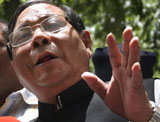
Prez poll: Sangma hopes for miracle to emerge winner

June 24, 2012

sangma_copy

New Delhi, June 24: With Pranab Mukherjee having a clear edge in the Presidential poll, P A Sangma is now hoping for a "miracle" to see himself emerge a winner, even as he denied being a "tool" in the hands of those supporting him.

"Yes, miracles can and do happen in this world...it happens...I believe in miracles. You are right. I do believe in miracles," Sangma said when suggested that only a miracle could ensure victory for him as over 60 per cent of the electorates have already extended their support to Mukherjee.

Sangma said it was not right to tick him off even before the Presidential poll and claimed that God was with him.

"Politics moves very fast...This is politics. In politics anything can happen...Things will change everyday, you just watch," he told Karan Thapar in Devil's Advocate programme on CNN-IBN.

The tribal leader denied being used a "tool" by BJP to win over other political allies or by Naveen Patnaik to woo 25 per cent tribals in Orissa.

"Not at all," he said. He, however, suggested that even media is playing as a tool in someone's hands and said, "We are all tools. You are a tool for someone. I am a tool for someone. Don't bring in these petty things."

Sangma who is supported by BJP, AIADMK and BJD said his candidature "will do good to secularism of this nation".

He also downplayed the "anti-Christian" stance of both BJP and AIADMK in the past and said, "Religious problems are everywhere" and cited examples of countries like the United Kingdom and the United States where only Anglicals and non- Catholics respectively were made prime ministers. When pointed out that Sangh outfit, the ideology of which is followed by BJP, have been blamed for Kandhamal killings in Orissa and Graham Stein's murder, Sangma said, "Forgiveness is the essence of Christianity. We as Christians, do not keep things permanently...Christianity is the biggest religion in the world. We don't go by small incidents here and there...It has a big heart."

"Where is the proof that BJP has done it (Kandhamal killings)?...Don't jump to conclusions...Don't make such wild allegations," he said, adding that one should not go by the actions of individuals.

On whether his support from BJP and AIADMK contradicted the principles for which he stood for, Sangma said, "India is a large democracy. Congress is the largest party. BJP is the second largest party. In such huge political parties, few incidents here and there do happen, will happen. You can't judge it by that."

"I am standing for principles...for democracy...for the welfare of poor people. I am very clear in my conscience," he said.

Sangma brushed aside reports that it was "wrong" on his part to contest the presidential poll against odds and negated suggestions that the move would end his political career.

"There is no end to a political career. I am just 65 now. I don't need to join a political party to contest...my margin never goes down, it always goes up," he said.

He said it was not his obsession to contest for President but his right to assert. "I am only asserting my right as a citizen of India...as a tribal...as a person coming from the north eastern region."

Brushing aside as "speculation" reports of Mamata Banerjee denying him time to meet, he said, "I have requested for time. I am waiting for the reply. I will (get time). Still there is time. It's almost one month left (for the poll)."

Comments

Add new comment

  • Coastaldigest.com reserves the right to delete or block any comments.
  • Coastaldigset.com is not responsible for its readers’ comments.
  • Comments that are abusive, incendiary or irrelevant are strictly prohibited.
  • Please use a genuine email ID and provide your name to avoid reject.
News Network
April 24,2020

New Delhi, Apr 24: The trajectory of COVID-19 cases could have plateaued and might even fall for some weeks after the lockdown is lifted but India is likely to see a second wave in late July or August with a surge in the number of cases during the monsoon, say scientists.

The timing of the peak will depend on how India is able to control physical distancing and on the level of infection spreads after restrictions are relaxed, they said.

It looks apparent that the trajectory of daily new cases has reached a plateau and eventually it will take a downward fall, maybe for some weeks or even months, Samit Bhattacharya, associate professor at the Department of Mathematics, Shiv Nadar University, said.

Still, we may get a surge of new cases of the same coronavirus and this will be considered a second wave, Bhattacharya explained.

The second epidemic may come back in late July or August in the monsoon, although the peak timing will depend on how we control social distancing during that time, he said.

Rajesh Sundaresan, professor at Bengaluru's Indian Institute of Science (IISc), agreed.

“Once we return to normal activity levels, there is a chance that infection may begin to rise again. China is seeing this to some extent post easing of some restrictions on travel,” Sundaresan, corresponding author of a working paper by researchers at IISc and the Tata Institute of Fundamental Research (TIFR) in Mumbai, said.

On March 25, when the number of coronavirus cases was 618 with 13 deaths, the government announced a nationwide lockdown that was later extended to May 3.

On Friday, the death toll due to COVID-19 rose to 718 and the number of cases to 23,077, according to the Union Health Ministry.

In good news, officials said this week that the doubling rate of cases has slowed down in the period, going from 3.4 days before lockdown to 7.5 days, with 18 states doing better than the national average. The recovery rate has also almost doubled in the last 10 days.

"Looking at the new cases in the past few days, it seems the growth of new daily infection is much slower than earlier. This apparently indicates that we might have reached at the plateau of the growth curve, Bhattacharya said.

He noted that recent studies in China and Europe observed that the infection might relapse in those people who have already recovered from earlier phases.

So, there is no evidence that the earlier infection may help acquire immunity against the second infection. And in that way, the entire population may be vulnerable to the second wave to some extent, said the scientist.

In their study unveiled this week, IISc and TIFR researchers analysed the impact of strategies such as case isolation, home quarantine, social distancing and various post-lockdown restrictions on COVID-19 that might remain in force for some time.

The study modelled on Bengaluru and Mumbai suggests the infection is likely to have a second wave and the public health threat will remain, unless steps are taken to aggressively trace, localise, isolate the cases, and prevent influx of new infections.

The new levels and the peaking times for healthcare demand depend on the levels of infection spreads in each city at the time of relaxation of restrictions, they said.

The lockdown is currently upon us. It has given us valuable time. Let us test, trace, quarantine, isolate, practice better hygiene, search for a vaccine, etc. We should do these anyway, and these are being done. When and how to lift the lockdown is going to be a difficult decision to make, said Sundaresan.

It's clear that it's going to be phased. What our team is focusing on is to come up with tools to help the decision makers assess the public health impact of various choices, he said.

According to the experts, infectious diseases spread via contact between infectious and susceptible people. In the absence of any control measures, an outbreak will grow as long as the average number of people infected by each infectious person is more than one.

Once enough people are immune there will be fewer people susceptible to the infection and the outbreak will die.

However, when an outbreak is brought under control by social distancing and other interventions, it is possible only a small proportion of the population will have been infected and gained immunity, they said.

This means enough susceptible people may remain to fuel a second wave if controls are relaxed and infection is reintroduced.

Until the vaccine comes on the market, we have to remain alert Once sporadic cases occur here and there in the country, we immediately need to implement quarantine or social distancing locally for the people in that region, and also need to perform tests to identify positive cases irrespective of showing symptoms, Bhattacharya explained.

Note that these monsoon months are also flu season in many places of India. So, we should not ignore the early signs of the flu symptoms. Irrespective of symptoms, we need to increase tests in the hotspots to identify people and contain the surge, he said.

Sundaresan added that the timeline for a second wave will depend on a lot of circumstances which may change as the time passes.

Significant testing may have been underway, there may be behavioural changes with people becoming more careful about their hygiene, wearing masks may become more common, etc. All these responses may help restrict the second wave, he said.

A study published in The Lancet journal earlier this month modelled the potential adverse consequences of premature relaxation of interventions, and found it might lead to a second wave of infections.

The finding is critical to governments globally, because it warns against premature relaxation of strict interventions, the researchers said.

While interventions to control the spread of SARS-CoV-2 are in place, countries will need to work toward returning to normalcy; thus, knowledge of the effect of each intervention is urgently required, they said in the study.

According to a recent analysis by the Harvard Chan School of Public Health, the best strategy to ease the critical care burden and loss of life from COVID-19 might be on-again, off-again social distancing.

In the absence of such interventions, surveillance and intermittent distancing may need to be maintained into 2022, which would present a substantial social and economic burden, the researchers wrote.p

Comments

Add new comment

  • Coastaldigest.com reserves the right to delete or block any comments.
  • Coastaldigset.com is not responsible for its readers’ comments.
  • Comments that are abusive, incendiary or irrelevant are strictly prohibited.
  • Please use a genuine email ID and provide your name to avoid reject.
News Network
March 23,2020

New Delhi, Mar 23: The central government has asked state governments to take strict action against violators of the coronavirus lockdown being enforced in 80 districts across the country.

An official statement released on Monday said there will be a total lockdown in 80 districts where coronavirus cases have been reported. The shutdown will end on March 31.

Delhi's borders will remain sealed during the lockdown, but essential services related to health, food, water and power supply will continue, and 25 per cent of the DTC buses will run to transport people associated with essential services.

Prime Minister Narendra Modi earlier on Monday appealed to state governments to ensure that rules and regulations of the coronavirus lockdown are enforced as he noted that many people were not taking the measure seriously.

"Many people are still not taking the lockdown seriously. Please save yourself, save your family, follow the instructions seriously. I request state governments to ensure rules and laws are followed," he said in a tweet in Hindi.

Comments

Add new comment

  • Coastaldigest.com reserves the right to delete or block any comments.
  • Coastaldigset.com is not responsible for its readers’ comments.
  • Comments that are abusive, incendiary or irrelevant are strictly prohibited.
  • Please use a genuine email ID and provide your name to avoid reject.
News Network
January 28,2020

Kolkata, Jan 28: West Bengal chief minister Mamata Banerjee Tuesday said she is ready for talks with Prime Minister Narendra Modi on the issue of Citizenship Amendment Act but the Centre has to first withdraw the contentious law.

Banerjee said protesting against the decisions of the centre doesn't make opposition parties anti-national and iterated that she will not implement CAA, NRC or NPR in the state.

"It is good that the prime minister is ready for talks but the Citizenship Amendment Act (CAA) must be revoked first. They (Centre) did not call an all-party meeting before taking a decision on Kashmir and CAA.

"We are ready for talks but first withdraw this Citizenship Amendment Act," Banerjee, a staunch critic of the BJP, said addressing a protest programme against CAA through paintings.

The West Bengal assembly had on Monday passed a resolution against the CAA to become the fourth state after Kerala, Punjab and Rajasthan, to do so. The state assembly had on September 6, 2019, passed a resolution against the NRC.

Comments

Add new comment

  • Coastaldigest.com reserves the right to delete or block any comments.
  • Coastaldigset.com is not responsible for its readers’ comments.
  • Comments that are abusive, incendiary or irrelevant are strictly prohibited.
  • Please use a genuine email ID and provide your name to avoid reject.