



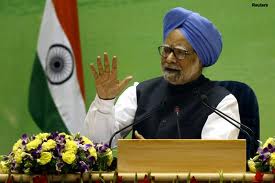
Black money a problem, but no magic solutions: PM

June 25, 2012
Black_Money_A_problem

New Delhi, June 25: As G-20 countries worked on steps to tackle black money, Prime Minister Manmohan Singh has said it is a problem but no "magic solutions" were available to deal with menace.

"The problem is there but there are no magic solutions available. I think it is going to be a slow process," Singh told reporters accompanying him on his return home after his eight-day foreign tour.

The Prime Minister's remark came when he was asked whether the black money issue has become irrelevant for the Group of Developed and Developing countries (G-20) or any improvement was there in dealing with the problem.

"It is too early to say one way or the other," he said. The just concluded G-20 Summit at Los Cabos in Mexico welcomed the efforts to enhance interagency cooperation to tackle illicit financial flows.

In its communique, the G-20 said it supported the renewal of the Financial Action Task Force (FATF) mandate, thereby sustaining global efforts to combat money laundering.

In the tax area, the G-20 leaders including Prime Minister Singh reiterated their commitment to strengthen transparency and comprehensive exchange of information.

The 14-page document also called on relevant stakeholders to play an active role in fighting corruption, saying graft impeded economic growth, threatened the integrity of markets, undermined fair competition and undermined the rule of law.

Global Financial Integrity (GFI), a US NGO, praised G-20 leaders today for prominently focusing on the issue of illicit financial flows and committing to move toward the automatic exchange of tax information.

G-20 leaders have committed "to lead by example in implementing" the practice of automatic tax information exchange, and called upon other "countries to join this growing practice as appropriate," a move lauded by GFI as a major step in the right direction.

Corruption, crime, and tax evasion in the form of illicit financial outflows cost the developing world US$1 trillion per year, according to GFI research.

"We are thrilled to see the G-20 commit to adopting a standardized system of automatic tax information exchange," said GFI Director Raymond Baker. "Automatic information exchange will go a long way towards curtailing tax evasion."

Comments

Add new comment

  • Coastaldigest.com reserves the right to delete or block any comments.
  • Coastaldigset.com is not responsible for its readers’ comments.
  • Comments that are abusive, incendiary or irrelevant are strictly prohibited.
  • Please use a genuine email ID and provide your name to avoid reject.
Agencies
July 2,2020

Mumbai, Jul 2: The Shiv Sena on Thursday termed the ban on 59 Chinese apps by the Indian government as a "digital strike" and asked if these apps were a threat to the national security, how did they operate for so many years.

An editorial in Sena mouthpiece 'Saamana' sought to know when did the Centre realise these apps were a threat to the national security.

By banning the Chinese apps, Prime Minister Narendra Modi protected the interests of Indian internet users and his courage has be lauded, the Marathi publication said.

India on Monday banned 59 apps with Chinese links, including TikTok, UC Browser, SHAREit and WeChat, saying they were prejudicial to sovereignty, integrity and security of the country.

"If these apps were a threat to national security, how is it that these apps were functioning without any hurdles for so many years. If the opposition says the government neglected national security,then what will the Centre's stand be?" the Shiv Sena asked.

It said questions should be raised on all the previous governments for "allowing national data to go out of the country".

China has expressed displeasure over the Indian government's decision, the Marathi daily said, adding that Chinese soldiers are "still not ready to leave the Galwan Valley (in Ladakh)".

The Sena said it took the sacrifices of 20 soldiers for the government to realise Indian data was being illegally taken out of the country.

"The government took revenge by a digital strike," it stated.

There have been complaints earlier that users' data on Chinese apps was illegally sent out of the country, and apps like TikTok were "promoting vulgarity", it said.

"Many TikTok stars had reportedly joined the BJP," the Sena claimed. "What will happen to them?" it asked.

There is a need to break China economically, but that will not happen by banning its apps. The issue is about trade and investment between the two countries, it said.

"The largest Chinese investment is in Gujarat.

Chinese company Huawei has got the contract to set up 5G network in India. This company having keys to India's digital economy is akin to the Chinese Communist Party owning the Indian economy in future," it said.

Comments

Add new comment

  • Coastaldigest.com reserves the right to delete or block any comments.
  • Coastaldigset.com is not responsible for its readers’ comments.
  • Comments that are abusive, incendiary or irrelevant are strictly prohibited.
  • Please use a genuine email ID and provide your name to avoid reject.
Agencies
February 11,2020

New Delhi, Feb 11: People of Delhi have explained the true meaning of nationalism through their mandate, AAP's prominent face Manish Sisodia said as he clinched victory on the Patparganj seat.

Sisodia, who retained his seat for the third time, said the BJP indulged in "politics of hate", but people refused to be divided.

"I am happy to have won the Patparganj seat again. The BJP indulged in politics of hate, but I thank the people of Patparganj. Today, Delhi's people have chosen a government which works for them and explained the true meaning of nationalism through their mandate," he told reporters.

Sisodia, who was the Deputy Chief Minister and led the government's education reforms agenda, defeated BJP's Ravinder Singh Negi by a margin of over 3,500 votes.

The initial trends saw a seesaw battle between Sisodia and Negi.

In 2013, Sisodia had won by a margin of 11,000 votes and in 2015 by over 28,000 votes.

Comments

Add new comment

  • Coastaldigest.com reserves the right to delete or block any comments.
  • Coastaldigset.com is not responsible for its readers’ comments.
  • Comments that are abusive, incendiary or irrelevant are strictly prohibited.
  • Please use a genuine email ID and provide your name to avoid reject.
Agencies
August 3,2020

The Drugs Controller General of India (DCGI) has given nod to the Serum Institute of India (SII) for conducting phase 2 and 3 human clinical trials of the Oxford University developed Covid-19 vaccine candidate in the country.

Government officials said that the approval for conducting phase 2 and 3 clinical trials by the SII was granted by DCGI Dr V G Somani late Sunday night after a thorough evaluation based on the recommendations of the Subject Expert Committee (SEC) on Covid-19.

"The firm has to submit safety data, evaluated by the Data Safety Monitoring Board (DSMB), to the CDSCO before proceeding to phase 3 clinical trials," a senior official said.

"As per the study design, each subject will be administered two doses four weeks apart (first dose on day one and second dose on day 29) following which the safety and immunogenicity will be assessed at predefined intervals," the official said.

As a rapid regulatory response, the expert panel at the Central Drugs Standard Control Organisation (CDSCO) on Friday, after a detailed deliberation and considering the data generated on the vaccine candidate in phase 1 and 2 of the Oxford University trial, had recommended granting permission for phase 2 and 3 clinical trials of the potential vaccine, 'Covishield', on healthy adults in India,  the officials said.

Currently, phase 2 and 3 clinical trials of the Oxford vaccine candidate is going on in the United Kingdom, phase 3 clinical trial in Brazil and phase 1 and 2 clinical trials in South Africa.

The officials said that the SII had submitted a revised proposal on Wednesday after the SEC on July 28, following deliberation over its application, had asked it to revise its protocol for the phase 2 and 3 clinical trials besides seeking some additional information.

The panel had also recommended that the clinical trial sites which have been proposed for the study be distributed across India.

According to the revised proposal by the SII, 1,600 people aged above 18 years will participate in the trials across 17 selected sites, including AIIMS-Delhi, B J Medical College in Pune, Rajendra Memorial Research Institute of Medical Sciences (RMRIMS) in Patna, Post Graduate Institute of Medical Education and Research in Chandigarh, AIIMS-Jodhpur, Nehru Hospital in Gorakhpur, Andhra Medical College in Visakhapatnam and JSS Academy of Higher Education and Research in Mysore.

"According to the application, it would conduct an observer-blind, randomised controlled study to determine the safety and immunogenicity of 'Covishield' on healthy Indian adults," the official said.

The SII, which has partnered with AstraZeneca, for manufacturing the Oxford vaccine candidate for Covid-19 had submitted its first application to the DCGI on July 25 seeking permission for conducting the phase 2 and 3 trials of the potential vaccine. 

Initial results of the first two-phases of trials of the vaccine conducted in five trial sites in the UK showed that it has an acceptable safety profile and homologous boosting increased antibody response, sources had said.

To introduce the vaccine, SII, the world's largest vaccine maker by number of doses produced and sold, has signed an agreement to manufacture the potential vaccine developed by the Jenner Institute (Oxford University) in collaboration with British-Swedish pharma company AstraZeneca. 

Comments

Add new comment

  • Coastaldigest.com reserves the right to delete or block any comments.
  • Coastaldigset.com is not responsible for its readers’ comments.
  • Comments that are abusive, incendiary or irrelevant are strictly prohibited.
  • Please use a genuine email ID and provide your name to avoid reject.