



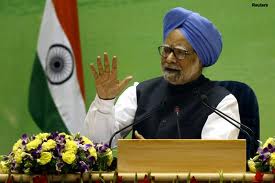
Black money a problem, but no magic solutions: PM

June 25, 2012
Black_Money_A_problem

New Delhi, June 25: As G-20 countries worked on steps to tackle black money, Prime Minister Manmohan Singh has said it is a problem but no "magic solutions" were available to deal with menace.

"The problem is there but there are no magic solutions available. I think it is going to be a slow process," Singh told reporters accompanying him on his return home after his eight-day foreign tour.

The Prime Minister's remark came when he was asked whether the black money issue has become irrelevant for the Group of Developed and Developing countries (G-20) or any improvement was there in dealing with the problem.

"It is too early to say one way or the other," he said. The just concluded G-20 Summit at Los Cabos in Mexico welcomed the efforts to enhance interagency cooperation to tackle illicit financial flows.

In its communique, the G-20 said it supported the renewal of the Financial Action Task Force (FATF) mandate, thereby sustaining global efforts to combat money laundering.

In the tax area, the G-20 leaders including Prime Minister Singh reiterated their commitment to strengthen transparency and comprehensive exchange of information.

The 14-page document also called on relevant stakeholders to play an active role in fighting corruption, saying graft impeded economic growth, threatened the integrity of markets, undermined fair competition and undermined the rule of law.

Global Financial Integrity (GFI), a US NGO, praised G-20 leaders today for prominently focusing on the issue of illicit financial flows and committing to move toward the automatic exchange of tax information.

G-20 leaders have committed "to lead by example in implementing" the practice of automatic tax information exchange, and called upon other "countries to join this growing practice as appropriate," a move lauded by GFI as a major step in the right direction.

Corruption, crime, and tax evasion in the form of illicit financial outflows cost the developing world US$1 trillion per year, according to GFI research.

"We are thrilled to see the G-20 commit to adopting a standardized system of automatic tax information exchange," said GFI Director Raymond Baker. "Automatic information exchange will go a long way towards curtailing tax evasion."

Comments

Add new comment

  • Coastaldigest.com reserves the right to delete or block any comments.
  • Coastaldigset.com is not responsible for its readers’ comments.
  • Comments that are abusive, incendiary or irrelevant are strictly prohibited.
  • Please use a genuine email ID and provide your name to avoid reject.
Agencies
February 11,2020

New Delhi, Feb 11: With Election Commission">Election Commission's trends indicating a landslide victory for the Aam Aadmi Party (AAP), party chief Arvind Kejriwal expressed his gratitude towards the people of the national capital and said that this is the victory of the people who consider him as their son.

Making his first public appearance after the day's results, Kejriwal made a brief address to supporters in which, AAP chief thanked supporters, outlined his personal connection with citizens and party workers as well as credited his family for their continued support.

"I thank people of Delhi for reposing their faith in AAP for the third time. This is not my personal victory, this is the victory of Delhiites. This the victory of the people who consider me as their son and voted for us," Kejriwal said at party office here.

He also referred to the trends of the assembly polls, as the beginning of a new kind of politics.

"This is the beginning of a new kind of politics. This is a new sign. Only the party will get vote who will built mohalla clinics and good schools... This is the victory of mother India and India. Today is Tuesday, Hanuman-ji's day. Hanumanji ji blessed Delhi today, I thank him. We pray that Hanuman Ji keeps showing the right path to us so that we continue to serve people for the next five years," he said.

According to Election Commission", AAP won 5 seats while the party is leading on 58 seats in 70-member Delhi Assembly. 

Comments

Add new comment

  • Coastaldigest.com reserves the right to delete or block any comments.
  • Coastaldigset.com is not responsible for its readers’ comments.
  • Comments that are abusive, incendiary or irrelevant are strictly prohibited.
  • Please use a genuine email ID and provide your name to avoid reject.
Agencies
July 29,2020

New Delhi, Jul 29: The new National Education Policy (NEP) approved by the Union Cabinet on Wednesday is set to usher in a slew of changes with the vision of creating an education system that contributes directly to transforming the country, providing high-quality education to all, and making India a global knowledge superpower.

The draft of the NEP by a panel headed by former Indian Space Research Organisation (ISRO) chief Kasturirangan and submitted to the Union Human Resource Development Minister Ramesh Pokhriyal when he took charge last year. The new NEP replaces the one formulated in 1986.

Some of the key highlights of the New Education Policy are:-

The policy aims to enable an individual to study one or more specialized areas of interest at a deep level, and also develop character, scientific temper, creativity, spirit of service, and 21st century capabilities across a range of disciplines including sciences, social sciences, arts, humanities, among others.

It identified the major problems facing the higher education system in the country and suggested changes such as moving towards multidisciplinary universities and colleges, with more institutions across India that offer medium of instruction in local/Indian languages, a more multidisciplinary undergraduate education, among others. 

The governance of such institutions by independent boards having academic and administrative autonomy has also been suggested.

Under the suggestions for institutional restructuring and consolidation, it has suggested that by 2040, all higher education institutions (HEIs) shall aim to become multidisciplinary institutions, each of which will aim to have 3,000 or more students, and by 2030 each or near every district in the country there will be at least one HEI.

The aim will be to increase the Gross Enrolment Ratio in HEIs including vocational education from 26.3 per cent (2018) to 50 per cent by 2035.

Single-stream HEIs will be phased out over time, and all will move towards becoming vibrant multidisciplinary institutions or parts of vibrant multidisciplinary HEI clusters.

It also pushes for more holistic and multidisciplinary education to be provided to the students.

Comments

Add new comment

  • Coastaldigest.com reserves the right to delete or block any comments.
  • Coastaldigset.com is not responsible for its readers’ comments.
  • Comments that are abusive, incendiary or irrelevant are strictly prohibited.
  • Please use a genuine email ID and provide your name to avoid reject.
Agencies
July 30,2020

New Delhi, Jul 30: Even as COVID-19 cases continue to surge in various parts of India, more than 1 million people have recovered and discharged till now, informed Rajesh Bhushan, Secretary, Ministry of Health, here on Thursday.

"More than 1 million people have recovered from COVID-19 in the country. This landmark recovery has been achieved because of the selfless work and dedication of our doctors, nurses and frontline workers," Bhushan said at a press conference.

Giving the number of cured persons, Bhushan said, "More than 1,020,000 patients have recovered. They have been discharged. It is a great achievement."

He said, "The recovery rate has shown positive trends. It was 7.85 per cent in April and today it is 64.4 per cent, which is another heartening news which tells us that whatever battle is put by the Union government in collaboration with state governments is showing results."

"Sixteen states of the country have a recovery rate that is more than the national average. Of these, Delhi has a recovery rate of 88 per cent, Ladakh 80 per cent, Haryana 78 per cent, Assam 76 per cent, Telangana 74 per cent, Tamil Nadu & Gujarat 73 per cent, Rajasthan 70 per cent, Madhya Pradesh 69 per cent and Goa 68 per cent," Bhushan said.

He said effective clinical management lead to a decrease in case fatality rate. In June it was 3.33 per cent and now 2.21 per cent.

Bhushan said the case fatality rate in India today is 2.21 per cent and it's among the lowest in the world. Twenty-four states and Union Territories have lesser fatality rate than that of the country.

Herd immunity in a country of the size and population of India can not be a strategic option. It can only be achieved through immunisation.

"Over 18,190,000 tests have been conducted in the country including RT-PCR and rapid antigen tests. There has been a week-on-week increase in average tests per day. India is conducting 324 test per 10 lakhs population per day," Bhushan said.

He added, three vaccine candidates, are in phase 3 clinical trial. These three are in the US, UK and China. In India, two indigenously developed vaccine candidates are in phase I and II of clinical trials. 

Trial of the first vaccine involves 1,150 subjects at eight sites, second on 1,000 subjects at five sites.

Comments

Add new comment

  • Coastaldigest.com reserves the right to delete or block any comments.
  • Coastaldigset.com is not responsible for its readers’ comments.
  • Comments that are abusive, incendiary or irrelevant are strictly prohibited.
  • Please use a genuine email ID and provide your name to avoid reject.