Clashes erupt in Kashmir after shrine fire

June 26, 2012

clashes_erupt3

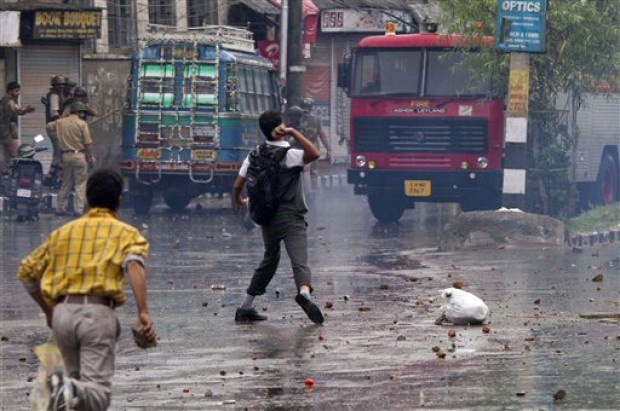
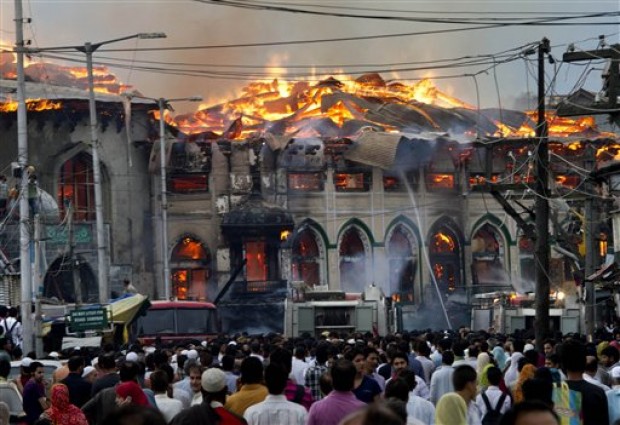
Srinagar, June 26: A fire destroyed a revered Muslim shrine in Kashmir on Monday, prompting anti-government protests by residents angered over what they said was a slow response by firefighters.

The Peer Dastgeer Sahib shrine here was gutted but the holy relic of the 11th century Muslim saint is safe, an official said.

clashes_erupt

“The holy relic [a hair of the beard] was kept in a fire/burglary proof vault inside the shrine. The holy relic is safe and has been retrieved,” a senior official of the state government told IANS.

Tension, however, continued in Srinagar city in the wake of the devastating fire that destroyed the over 300-year-old wooden shrine in the Khanyar area.

Groups of youth stone pelted and clashed with the police in Khanyar, where a mob attacked a police station.

Police used batons and tear smoke canisters to disperse the protesters, three of whom have been shifted to hospital following symptoms of choking due to smoke.

“The youth are out of danger,” a police officer said.

A spontaneous shutdown crippled life in the old city areas, where traffic was diverted to uptown areas by the police.

Dozens of fire tenders were pressed into service immediately after the fire broke out at the shrine around 6.30am on Monday.

“The cause of fire is being ascertained,” a fire brigade official told IANS.

Shaikh Abdul Qadir, is popularly known as Peer Dastgeer Sahib or ‘Ghaus-e-Azam’ by Muslims and ‘Kahnoow’ by the Hindus. The reverence for the 11th century figure cuts across religious barriers in Kashmir.

Interestingly, Peer Dastgeer Sahib never visited Kashmir and the relic was brought here by an Afghan governor, Abdullah Khan, 337 years ago.

The shrine had many antique chandeliers and invaluable wood carving panels, all of which have been reportedly destroyed in the blaze.

clashes_erupt2

clashes_erupt3

Comments

Add new comment

  • Coastaldigest.com reserves the right to delete or block any comments.
  • Coastaldigset.com is not responsible for its readers’ comments.
  • Comments that are abusive, incendiary or irrelevant are strictly prohibited.
  • Please use a genuine email ID and provide your name to avoid reject.
News Network
January 2,2020

New Delhi, Jan 2: Thirteen firefighters were among the 14 people injured when a battery factory collapsed in northwest Delhi's Peera Garhi following an explosion due to a fire that broke out early on Thursday morning, officials said.

A fire brigade personnel still remained trapped under the debris of the building in Udyog Nagar area, an official said.

A large portion of the two-storey building collapsed following an explosion when firefighters were dousing the blaze, the official said, adding that fire department had received a call at 4.23am.

Plumes of smoke billowed out from the building as the fire brigade personnel battled to contain the blaze. An eyewitness said several explosions were heard as the blaze gutted down the building.

The National Disaster Response Force (NDRF) and civil authorities rushed to the spot to control the situation, an official said, adding that 35 fire tenders were at the spot.

The injured, including a security guard of the factory, were rushed to nearby hospitals, a police officer said.

Chief Minister Arvind Kejriwal said he was monitoring the situation.

"V sad to hear this. Am closely monitoring the situation. Fire personnel trying their best. Praying for the safety of those trapped," Kejriwal tweeted.

Comments

Add new comment

  • Coastaldigest.com reserves the right to delete or block any comments.
  • Coastaldigset.com is not responsible for its readers’ comments.
  • Comments that are abusive, incendiary or irrelevant are strictly prohibited.
  • Please use a genuine email ID and provide your name to avoid reject.
News Network
February 19,2020

New Delhi, Feb 19: India will switch to the world's cleanest petrol and diesel from April 1 as it leapfrogs straight to Euro-VI emission compliant fuels from Euro-IV grades now - a feat achieved in just three years and not seen in any of the large economies around the globe.

India will join the select league of nations using petrol and diesel containing just 10 parts per million of sulphur as it looks to cut vehicular emissions that are said to be one of the reasons for the choking pollution in major cities.

Sanjiv Singh, Chairman of Indian Oil Corp (IOC) - the firm that controls roughly half of the country's fuel market, said almost all refineries began producing ultra-low sulphur BS-VI (equivalent to Euro-VI grade) petrol and diesel by the end of 2019 and oil companies have now undertaken the tedious task of replacing every drop of fuel in the country with the new one.

"We are absolutely on track for supplying BS-VI fuel from April 1. Almost all refineries have begun supplying BS-VI fuel and the same has reached storage depots across the country," he said.

From storage depots, the fuel has started travelling to petrol pumps and in the next few weeks all of them will only have BS-VI grade petrol and diesel, he said. "We are 100 per cent confident that fuel that will flow from nozzles at all the petrol pumps in the country on April 1 will be BS-VI emission compliant fuel."

India adopted Euro-III equivalent (or Bharat Stage-III) fuel with a sulphur content of 350 ppm in 2010 and then took seven years to move to BS-IV that had a sulphur content of 50 ppm. From BS-IV to BS-VI it took just three years.

"It was a conscious decision to leapfrog to BS-VI as first upgrading to BS-V and then shifting to BS-VI would have prolonged the journey to 4 to 6 years. Besides, oil refineries, as well as automobile manufacturers, would have had to make investments twice - first to producing BS-V grade fuel and engines and then BS-VI ones," he said.

State-owned oil refineries spent about Rs 35,000 crore to upgrade plants that could produce ultra-low sulphur fuel. This investment is on top of Rs 60,000 crore they spent on refinery upgrades in the previous switchovers.

BS-VI has a sulphur content of just 10 ppm and emission standards are as good as CNG.

Originally, Delhi and its adjoining towns were to have BS-VI fuel supplies by April 2019 and the rest of the country was to get same supplies from April 2020.

But oil marketing companies switched over to supply of BS-VI grade fuels in the national capital territory of Delhi on April 1, 2018.

The supply of BS-VI fuels was further extended to four contiguous districts of Rajasthan and eight of Uttar Pradesh in the National Capital Region (NCR) on April 1, 2019, together with the city of Agra.

BS-VI grade fuels were made available in 7 districts of Haryana from October 1, 2019.

Singh said the new fuel will result in a reduction in NOx in BS-VI compliant vehicles by 25 per cent in petrol cars and by 70 per cent in diesel cars.

The switchover, he said, is a tedious task as every drop of old, higher-sulphur content fuel has to be flushed out in depots, pipelines and tanks before being replaced by BS-VI.

"We are confident of disruption-free switchover to BS-VI supplies across the country," he said. "What we will be supplying is the best quality available anywhere in the world. You don't have any better fuel that is supplied in any part of the world. Perhaps our BS-VI fuel will be better than equivalent fuel in some parts of the US and Europe."

India adopted a fuel upgradation programme in the early 1990s. Low lead gasoline (petrol) was introduced in 1994 in Delhi, Mumbai, Kolkata and Chennai. On February 1, 2000, unleaded gasoline was mandated nationwide.

Similarly, BS-2000 (Euro-I equivalent, BS-1) vehicle emission norms were introduced for new vehicles from April 2000. BS-II (Euro-II equivalent) emission norms for new cars were introduced in Delhi from 2000 and extended to the other metro cities in 2001.

Benzene limits have been reduced progressively from 5 per cent in 2000 to 1 per cent nationwide. Lead content in gasoline was removed in phases and only unleaded gasoline is being produced and sold from February 1, 2000.

The octane number of gasoline signifies the improved performance of the engine. Loss in octane number due to phasing out of lead was made up by installing new facilities in the refinery and changes in refinery operation. RON (Research Octane Number) of gasoline for BS-2000 spec was increased to 88. This has over time been increased to 91.

Singh said sulphur reduction will reduce Particulate Matter (PM) emissions even in the in-use older generation diesel vehicles.


Comments

Add new comment

  • Coastaldigest.com reserves the right to delete or block any comments.
  • Coastaldigset.com is not responsible for its readers’ comments.
  • Comments that are abusive, incendiary or irrelevant are strictly prohibited.
  • Please use a genuine email ID and provide your name to avoid reject.
News Network
April 3,2020

New Delhi, April 3: The Government on Thursday launched a mobile app developed in public-private partnership as part of efforts to contain the spread of coronavirus.

"The app, called 'AarogyaSetu' will enable people to assess themselves the risk for their catching the coronavirus infection," an official release said.

It said that the app will calculate this based on their interaction with others, using cutting edge Bluetooth technology, algorithms and artificial intelligence.

"Once installed in a smartphone through an easy and user-friendly process, the app detects other devices with AarogyaSetu installed that come in the proximity of that phone. The app can then calculate the risk of infection based on sophisticated parameters," the release said.

It said that the app will help the government take necessary timely steps for assessing risk of spread of COVID-19 infection and ensuring isolation where required.

"The app's design ensures privacy. The personal data collected by the app is encrypted using state-of-the-art technology and stays secure on the phone till it is needed for facilitating medical intervention," the release said.

It said the app is available in 11 languages and has highly scalable architecture.

"This app is a unique example of the nation's young talent coming together and pooling resources and efforts to respond to a global crisis. It is at once a bridge between public and private sectors, digital technology and health services delivery," the release said.

Comments

Add new comment

  • Coastaldigest.com reserves the right to delete or block any comments.
  • Coastaldigset.com is not responsible for its readers’ comments.
  • Comments that are abusive, incendiary or irrelevant are strictly prohibited.
  • Please use a genuine email ID and provide your name to avoid reject.