


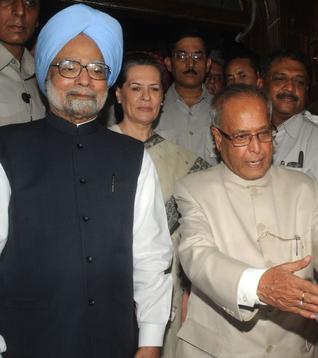
PM to ‘clarify’ Pranab’s tax measures

June 29, 2012

28_pranab_1127824e

New Delhi, June 29: Taking charge of the Finance portfolio after the resignation of Pranab Mukherjee, Prime Minister Manmohan Singh has kindled hopes of a rethink on the controversial tax measures the departing Minister leaves behind.

While the Finance Ministry maintained on Thursday that there were no plans to defer the roll-out of the General Anti-Avoidance Rules (GAAR) beyond April 1, 2013, it said it was committed to providing “clarifications” to the PMO within two or three weeks on tax matters, which have raised the hackles of industry ever since the budget was presented.

Besides transfer pricing issues, the clarifications, in particular, would pertain to the retrospective amendment of Section 9 of the Income Tax Act — now popularly known as the Vodafone tax — which now forms apart of the Finance Act, 2012, on enactment of the Finance Bill.

Speaking to journalists, after another meeting with the Prime Minister a day after Dr. Singh in his review meeting with top Finance Ministry officials referred to “problems on the tax front which need to be addressed” as they were among the “many factors that have contributed to this general negative mood,” Finance Secretary R.S. Gujral said: “The Prime Minister’s Office sought clarifications on taxation issues and Section 9 of the Income Tax Act [related to tax on indirect transfer of assets]... We asked them to give us two-three weeks’ time.”

Under the amended provisions of Section 9 of the I-T Act, 1961, with retrospective effect, Vodafone would now be liable to pay about Rs. 20,000 crore (including interest), if and when a tax demand is raised by the authorities, though the British telecom major had won its case in the Supreme Court under the earlier legal framework.

While not giving any indication as to whether clarifications on the retrospective tax law were likely to result in any softening of the government’s stance, compared with what obtained when Mr. Mukherjee was Finance Minister, Mr. Gujral, who also heads the Revenue Department, sought to scotch speculation on deferment of the GAAR beyond April next year, as was indicated by the Finance Minister in his reply during the debate on the budget.

There is “no deferment... the GAAR is staying,” Mr. Gujral said, pointing out that the Finance Ministry would shortly issue draft explanatory guidelines on the GAAR for public comments. “We have finalised the GAAR draft rules after three meetings with the stakeholders. The draft will have examples for what would be deemed as permissible and impermissible arrangement.”

Late at night, the Central Board of Direct Taxes (CBDT) went into fast-forward mode to clear the confusion in the minds of foreign investors and issued a 23-page draft guidelines on the implementation of the GAAR in terms of Section 101 of the I-T Act with illustrative examples of cases, in which the provisions of the law would be invoked.

“The GAAR will be applicable for income arising from April 1, 2013. Certain grey areas have been highlighted. We need to clear the legislative intent of the proposal,” Mr. Gujral said. He pointed out that stakeholders would have 15 days to offer comments on the draft rules, after which the Finance Ministry would come out with the final guidelines.


Comments

Add new comment

  • Coastaldigest.com reserves the right to delete or block any comments.
  • Coastaldigset.com is not responsible for its readers’ comments.
  • Comments that are abusive, incendiary or irrelevant are strictly prohibited.
  • Please use a genuine email ID and provide your name to avoid reject.
News Network
April 11,2020

New Delhi, Apr 11: As India battles the Covid-19 crisis, Prime Minister Narendra Modi on Saturday held a video conference with chief ministers primarily to take their feedback on whether the 21-nation-wide lockdown be extended beyond April 14 to stem the tide of the infections.

The Central government is understood to have also obtained views on the issue from all the relevant agencies and stakeholders involved in the efforts to contain the spread of the pandemic.

The video conference, which began at 11am, comes amidst indications that the central government may extend the nationwide lockdown with some possible relaxations even as Punjab and Odisha have already announced extending the lockdown beyond April 14 when the current spell of 21-day shutdown across the country ends on Tuesday.

The Union Home Ministry has sought views of state governments on various aspects, including whether more categories of people and services need to be exempted. In the current lockdown only essential services are exempted.

This is for the second time the prime minister is interacting with the chief ministers via video link after the lockdown was imposed.

During his April 2 interaction with chief ministers, Modi had pitched for a "staggered" exit from the ongoing lockdown.

A PTI tally of numbers reported by various states as on Thursday at 9.30pm showed a total of 7,510 having been affected by the virus nationwide so far with at least 251 deaths. More than 700 have been cured and discharged. However, the last update from the Union Health Ministry put the number of confirmed infections at 7,447 and the death toll at 239.

Addressing floor leaders of various parties who have representation in Parliament, Modi had on Wednesday made it clear that the lockdown cannot be lifted in one go, asserting that the priority of his government is to "save each and every life".

According to an official statement after the Wednesday interaction, the prime minister told these leaders that states, district administrations and experts have suggested extension of the lockdown to contain the spread of the virus.

Before the lockdown was announced on March 24, the prime minister had interacted with the chief ministers on March 20 to discuss ways and means to check the spread of the novel coronavirus.

Comments

Add new comment

  • Coastaldigest.com reserves the right to delete or block any comments.
  • Coastaldigset.com is not responsible for its readers’ comments.
  • Comments that are abusive, incendiary or irrelevant are strictly prohibited.
  • Please use a genuine email ID and provide your name to avoid reject.
News Network
June 20,2020

New Delhi, Jun 20: A rare celestial event, annular solar eclipse, which is popularly known as the "ring of fire" eclipse, will be visible this Sunday in India.

It will be the first solar eclipse of this year takes place on the summer solstice, which is the longest day in the Northern Hemisphere.

While people living along the path annular eclipse passing through Anupgarh, Suratgarh, Sirsa, Jakhal, Kurukshetra, Yamunanagar, Dehradun, Tapowan and Joshimath will be able to see the annular phase, people in rest of India can witness a partial eclipse, said the Ministry of Science and Technology.

When Moon comes between the Sun and Earth, the shadow falls on the surface of the Earth. The Sun is entirely covered by the Moon for a brief period. Those places that are engulfed by the dark, dense umbral shadow of the Moon experience the total solar eclipse. In the regions that plunge into the soft diffused penumbral shadow of the Moon experience the partial eclipse.

"Annular solar eclipse is a particular case of the total solar eclipse. Like the total solar eclipse, the Moon is aligned with the Sun. However, on that day, the apparent size of the Moon happens to be a wee smaller than the Sun. Hence the Moon covers the central part of the Sun, and the rim of the Sun appear like a 'ring of fire' in the sky for a very brief moment" explains Samir Dhurde of The Inter-University Centre for Astronomy and Astrophysics, Pune.

During the solar eclipse, the apparent size of the Moon is smaller than that of the Sun by 1 per cent, the expert said.

Allying rumours that the eclipse will mark the end of coronavirus, Aniket Sule, Chairperson, Public Outreach and Education Committee of the Astronomical Society of India, said: "Solar eclipse is caused when the Moon comes in front of the Sun for a short time. As seen from Earth eclipses occur somewhere in the Earth 2 to 5 times a year. Eclipses do not impact microorganisms on Earth. Likewise there no danger in eating of stepping out during an eclipse. No mysterious rays come out of the Sun during an eclipse."

Comments

Add new comment

  • Coastaldigest.com reserves the right to delete or block any comments.
  • Coastaldigset.com is not responsible for its readers’ comments.
  • Comments that are abusive, incendiary or irrelevant are strictly prohibited.
  • Please use a genuine email ID and provide your name to avoid reject.
News Network
May 7,2020

May 7: India is projected to record the highest number of births in the 9 months since COVID-19 was declared a pandemic in March, with more than 20 million babies expected to be born in the country between March and December, according to top UN body.

The United Nations Children's Fund (UNICEF) warned that pregnant mothers and babies born during the pandemic across the world were threatened by strained health systems and disruptions in services.

An estimated 116 million babies will be born under the shadow of COVID-19 pandemic, UNICEF said on Wednesday, ahead of Mother's Day, observed on May 10.

These babies are projected to be born up to 40 weeks after COVID-19 was recognised as a pandemic on March 11.

The highest numbers of births in the 9 months since the pandemic was declared are expected to occur in India, where 20.1 million babies are projected to be born between March 11 and December 16. Other countries with the expected highest numbers of births during this period are China (13.5 million), Nigeria (6.4 million), Pakistan (5 million) and Indonesia (4 million), it said.

"Most of these countries had high neonatal mortality rates even before the pandemic and may see these levels increase with COVID-19 conditions," UNICEF said.

It is estimated that there will be 24.1 million births in India for the January-December 2020 period.

UNICEF warned that COVID-19 containment measures can disrupt life-saving health services such as childbirth care, putting millions of pregnant mothers and their babies at great risk.

Even wealthier countries are affected by this crisis. In the US, the sixth-highest country in terms of the expected number of births, over 3.3 million babies are projected to be born between March 11 and December 16.

"New mothers and newborns will be greeted by harsh realities," UNICEF said, adding they include global containment measures such as lockdowns and curfews; health centres overwhelmed with response efforts; supply and equipment shortages; and a lack of sufficient skilled birth attendants as health workers, including midwives, are redeployed to treat COVID-19 patients.

"Millions of mothers all over the world embarked on a journey of parenthood in the world as it was. They now must prepare to bring a life into the world as it has become – a world where expecting mothers are afraid to go to health centres for fear of getting infected, or missing out on emergency care due to strained health services and lockdowns," UNICEF Executive Director Henrietta Fore said.

"It is hard to imagine how much the coronavirus pandemic has recast motherhood" Fore said.

UNICEF said its analysis was based on data from World Population Prospects 2019 of the UN Population Division.

An average full-term pregnancy typically lasts a complete 9 months, or 39 to 40 weeks. For the purposes of this estimate, the number of births for a 40-week period in 2020 was calculated.

The 40-week period of March 11 to December 16 is used in this estimate based upon the WHO's March 11 assessment that COVID-19 can be characterised as a pandemic.

UNICEF warned that although evidence suggests that pregnant mothers are not more affected by COVID-19 than others, countries need to ensure they still have access to antenatal, delivery and postnatal services.

Similarly, sick newborns need emergency services as they are at high risk of death. New families require support to start breastfeeding, and to get medicines, vaccines and nutrition to keep their babies healthy, it said.

"This is a particularly poignant Mother's Day, as many families have been forced apart during the coronavirus pandemic, but it is also a time for unity, a time to bring everyone together in solidarity. We can help save lives by making sure that every pregnant mother receives the support she needs to give birth safely in the months to come," Fore said.

Issuing an urgent appeal to governments and health care providers to save lives in the coming months, UNICEF said efforts must be made to help pregnant women receive antenatal checkups, skilled delivery care, postnatal care services, and care related to COVID-19 as needed.

Ensure health workers are provided with the necessary personal protective equipment and get priority testing and vaccination once a COVID-19 vaccine becomes available so that can deliver high quality care to all pregnant women and newborn babies during the pandemic, it said.

While it is not yet known whether the virus is transmitted from a mother to her baby during pregnancy and delivery, UNICEF advised all pregnant women to follow precautions to protect themselves from exposure to the virus.

Closely monitor themselves for symptoms of COVID-19 and seek advice from the nearest designated facility if they have concerns or experience symptoms. Pregnant women should also take the same precautions to avoid COVID -19 infection as other people: practice physical distancing, avoid physical gatherings and use online health services, it said.

UNICEF said even before COVID-19 pandemic, an estimated 2.8 million pregnant women and newborns died every year, or 1 every 11 seconds, mostly of preventable causes.

The agency called for immediate investment in health workers with the right training, who are equipped with the right medicines to ensure every mother and newborn is cared for by a safe pair of hands to prevent and treat complications during pregnancy, delivery and birth.

Comments

Add new comment

  • Coastaldigest.com reserves the right to delete or block any comments.
  • Coastaldigset.com is not responsible for its readers’ comments.
  • Comments that are abusive, incendiary or irrelevant are strictly prohibited.
  • Please use a genuine email ID and provide your name to avoid reject.