


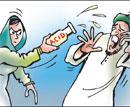
Acid attacks: SC fiat to Centre, states on sale of acid

July 2, 2012

acid

New Delhi, July 2: The Supreme Court today asked the Centre to apprise it of their measures to regulate the sale of acid to prevent its misuse as a weapon, particularly against women by their jilted lovers.

The court sought a "comprehensive affidavit" from the Ministry of Home Affairs, which was asked to "consider proper action" for making appropriate provision for "regulation of sale of acids so that it is not easily or readily available to offenders."

A bench of justices R M Lodha and A R Dave also asked all the state governments and Union territories to file their replies to the notices issued to them on February 11, 2011 for restricting the sale of acid to prevent the growing incidents of attack on women with it.

The court on April 29 this year had asked the Union Home Ministry to coordinate with the various states and the Union territories for formulation of an appropriate scheme.

The apex court had also sought the responses of the Centre and the state governments on whether any suitable scheme can be prepared by them to provide adequate compensation to the victims for their treatment and rehabilitation.

The court's directions came during the hearing of a PIL, filed in 2006 by Laxmi, a minor girl whose arms, face and other body parts were disfigured in an acid attack.

Laxmi, through her counsel Aparna Bhat, had sought framing of a new law or amendment in the existing criminal laws like IPC, Indian Evidence Act and the CrPC for dealing with the offence and had also sought compensation.

Luxmi was subjected to acid attack by three youths near Tughlaq Road as she had refused to marry one of them. The trial is going on for the offence of attempt to murder and two of the accused are out on bail.

The Centre had earlier told the apex court that the report of the Law Commission on the issue was supplied to all concerned parties and the National Commission for Women has placed a draft legislation to make acid attack a serious offence.

The advocate had pleaded for a total ban of sale of acid as there were increasing number of incidents of such attacks on women in different states.

The counsel had submitted that even a small country like Bangladesh had banned the use of acid to prevent such attacks.

The apex court in its February 11, 2011 order had noted that during the pendency of this writ petition, the code of Criminal Procedure, 1973 has been amended and Section 357A has been inserted by Act 5 of 2009.

It also noted that the amendment requires every state government, in coordination with the Central government, to prepare a scheme for providing funds for the purpose of compensation to the victims or their dependants who have suffered loss or injury as a result of the crime and who require rehabilitation.

"Though the said section has come into effect on December 31, 2009 and more than a year has elapsed, we are informed that no schemes have been formulated by any of the state governments," the bench had noted in its order.

While issuing notices to the Centre and state governments in February 2011, the court had directed them to prepare schemes as provided in Section 357A for the purpose of providing compensation to victims of crimes, in particular, acid attack victims.


Comments

Add new comment

  • Coastaldigest.com reserves the right to delete or block any comments.
  • Coastaldigset.com is not responsible for its readers’ comments.
  • Comments that are abusive, incendiary or irrelevant are strictly prohibited.
  • Please use a genuine email ID and provide your name to avoid reject.
News Network
May 18,2020

New Delhi, May 18: The nationwide tally of COVID-19 cases crossed one lakh on Monday with more people testing positive for the deadly virus in Maharashtra, Gujarat, Tamil Nadu and other states, even as a much-relaxed fourth phase of the lockdown began with restarting of market complexes, autos, taxis and inter-state buses in various parts of the country.

The death toll due to COVID-19 crossed the 3,000-mark too.

With an aim to reboot numerous locked down economic activities, authorities across the country ordered reopening of markets, intra-state transport services and even of barber shops and salons in some states, barring in containment zones.

However, schools, colleges, theatres, malls and religious gatherings are among those that would remain shut down, at least till May 31.

India has been under a lockdown since March 25, which was first supposed to be for 21 days or toll April 14, but was later extended till May 3, then further till May 17 and now for another two weeks till May 31.

However, a number of relaxations have been given in the current fourth phase, while states and union territories have also been granted significant flexibility for deciding the red, orange or green zones in terms of the quantum and severity of the virus spread.

In its morning 8 AM update, the Union Health Ministry put the total number of confirmed COVID-19 cases 96,169 and the death toll at 3,029.

It also said that 36,824 people have so far recovered from the infection.

However, a news agency tally of figures announced by different states and UTs as of 9.40 PM put the number of those having tested positive for the infection at 1,00,096, with a death toll of 3,078 and recoveries at 38,596 across the country.

Maharashtra topped the nationwide tally with over 35,000 confirmed cases and 1,249 deaths, followed by Tamil Nadu with 11,760 confirmed cases and 81 deaths.

Gujarat has also reported 11,746 confirmed cases, while its death toll is higher than that of Tamil Nadu at 694.

Delhi has also crossed the 10,000 mark in terms of the number of confirmed cases, while its death toll has now reached 160.

Gujarat, during the day, recorded 366 new COVID-19 cases and 35 deaths, including 31 from the worst-hit Ahmedabad, taking the state's case count to 11,746 and the number of fatalities to 694, a health department official said.

Maharashtra reported 2,033 new cases, taking the tally to 35,058.

This was the second consecutive day when the state has reported more than 2,000 COVID-19 cases.

Mumbai alone reported 1,185 fresh cases and 23 more deaths, taking the total count of the city to 21,152 and the fatalities to 757.

Of the 1,185 new cases, 300 samples were tested positive in private laboratories between May 12 and 16.

Kerala also saw 29 new cases -- all but one being returnees from overseas and other states --  raising concerns about the state witnessing a possible third wave of the dreaded virus infection.

The state was first to report the virus infection, but at least twice it has already been seen as having flattened the curve of the infection.

The nationwide count of confirmed infections incidentally crossed the crucial one-lakh mark on a day when the fourth phase of the nationwide lockdown kicked in with several relaxations for economic and public activities, barring in containment zones or areas identified as serious hotspots of the virus infection.

Revising its strategy for COVID-19 testing, ICMR also said on Monday that returnees and migrants who show symptoms for influenza-like illness will be tested for coronavirus infection within seven days of ailment and stressed that no emergency clinical procedure, including deliveries, should be delayed for lack of testing.

The Indian Council of Medical Research (ICMR) in its revised strategy for coronavirus testing in India also added that all hospitalised patients who develop symptoms for influenza-like illness (ILI) and frontline workers involved in containment and mitigation of COVID-19 having such signs will also be tested for coronavirus infection through RT-PCR test.

Besides, asymptomatic direct and high-risk contacts of a confirmed case are to be tested once between day five and day 10 of coming in contact, the new document stated.

Asymptomatic contacts of a confirmed case were being tested once between day five and day 14.

The Health Ministry also said that for every one lakh population, there are 7.1 coronavirus cases in India so far as against 60 globally.

It also said the recovery rate of coronavirus cases in India stood at 38.39 per cent.

Besides, India also joined nearly 120 countries at a crucial conference of the World Health Organisation in pushing for an impartial and comprehensive evaluation of the global response into the coronavirus crisis as well as to examine the origin of the deadly infection.

Since the first case of the deadly coronavirus was reported in China last December, more than 47 lakh people have tested for this virus across the world and over 3 lakh have lost their lives.

India is the 11th most affected country, while the US tops the chart with over 14.9 lakh confirmed cases so far.

China's official tally of confirmed infections is less than 84,000, while it has reported more than 4,600 deaths.

Comments

Add new comment

  • Coastaldigest.com reserves the right to delete or block any comments.
  • Coastaldigset.com is not responsible for its readers’ comments.
  • Comments that are abusive, incendiary or irrelevant are strictly prohibited.
  • Please use a genuine email ID and provide your name to avoid reject.
Bloomberg
July 27,2020

New Delhi, Jul 27: India’s coronavirus epidemic is now growing at the fastest in the world, increasing 20% over the last week to more than 14 lakh confirmed cases, according to Bloomberg’s Coronavirus Tracker.

Infections in the South Asian nation of 130 crore people have reached 14.3 lakh, including 32,771 deaths, India’s health ministry said, with daily cases close to a record 50,000 on Monday. India is only trailing the US and Brazil now in the number of confirmed infections, but its growth in new cases is the fastest.

Maharashtra, Tamil Nadu, Andhra Pradesh and Karnataka are among the states where the maximum number of daily cares are being reported. The world’s second-most populous country has been ramping up testing, with 515,472 samples taken on Sunday, according to the Indian Council of Medical Research.

Still, India and Brazil have some of the world’s lowest testing rates, with 11.8 tests and 11.93 tests per 1,000 people respectively, compared to the US with 152.98 tests per 1,000 and Russia with 184.34, according to Our World in Data, a project based at the University of Oxford in the UK.

Comments

Add new comment

  • Coastaldigest.com reserves the right to delete or block any comments.
  • Coastaldigset.com is not responsible for its readers’ comments.
  • Comments that are abusive, incendiary or irrelevant are strictly prohibited.
  • Please use a genuine email ID and provide your name to avoid reject.
News Network
February 9,2020

Panaji, Feb 9: RSS general secretary Suresh Bhaiyyaji Joshi on Saturday said that anybody who wants to work (in India) will have to do so with the Hindu community and for their empowerment.

Addressing a lecture on the topic "Vishwaguru Bharat, an RSS perspective" at Dona Paula in Panaji, Mr Joshi referred to his communication with an intellectual who had said that India should become a "supre-rashtra" in the year 2020.

"Anybody who wants to work (in India) will have to work with the Hindu commumnity by taking them along and for their empowerment. Hindus have witnessed the rise and fall of India since the time immemorial. India cannot be separated from (the) Hindu (community). Hindus have always been at the centre of this nation," Mr Joshi said in Marathi.

He also added that since Hindus are not communal or antagonist, "nobody should be reluctant to work for the Hindu community".

The RSS leader further said, "The world says India will become a superpower in 2020, but I remember my conversation with an intellectual who had said that India should become a super-rashtra (super nation) in 2020".

Goa Chief Minister Pramod Sawant was among those who attended the lecture.

"To create awareness and unity amongst Hindus does not amount to (taking) an action against others (community). No one should feel it that way. We can say with utter self confidence before the entire world that Hindus becoming strong won't result in destructive activities, but (such proposition) will work for the society and humanity," he added.

Invoking history, Mr Joshi said Hindus never invaded other countries. "Whatever wars (they had fought) were for self defence. Everyone has the right to self defence," he said.

"It is India's duty to teach the world to walk on the path of ''samanvay'' (coordination). Nobody else other than India and Hindus can do this," Mr Joshi said.

He said some communities in the world keep preaching that only their path is "great".

"But we are from the (Hindu) community which says that we have our own path so as you. When the world will accept this ideology, then all the issues would get solved. It is the duty of India to take the world on that path," he added.

Comments

Add new comment

  • Coastaldigest.com reserves the right to delete or block any comments.
  • Coastaldigset.com is not responsible for its readers’ comments.
  • Comments that are abusive, incendiary or irrelevant are strictly prohibited.
  • Please use a genuine email ID and provide your name to avoid reject.