


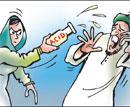
Acid attacks: SC fiat to Centre, states on sale of acid

July 2, 2012

acid

New Delhi, July 2: The Supreme Court today asked the Centre to apprise it of their measures to regulate the sale of acid to prevent its misuse as a weapon, particularly against women by their jilted lovers.

The court sought a "comprehensive affidavit" from the Ministry of Home Affairs, which was asked to "consider proper action" for making appropriate provision for "regulation of sale of acids so that it is not easily or readily available to offenders."

A bench of justices R M Lodha and A R Dave also asked all the state governments and Union territories to file their replies to the notices issued to them on February 11, 2011 for restricting the sale of acid to prevent the growing incidents of attack on women with it.

The court on April 29 this year had asked the Union Home Ministry to coordinate with the various states and the Union territories for formulation of an appropriate scheme.

The apex court had also sought the responses of the Centre and the state governments on whether any suitable scheme can be prepared by them to provide adequate compensation to the victims for their treatment and rehabilitation.

The court's directions came during the hearing of a PIL, filed in 2006 by Laxmi, a minor girl whose arms, face and other body parts were disfigured in an acid attack.

Laxmi, through her counsel Aparna Bhat, had sought framing of a new law or amendment in the existing criminal laws like IPC, Indian Evidence Act and the CrPC for dealing with the offence and had also sought compensation.

Luxmi was subjected to acid attack by three youths near Tughlaq Road as she had refused to marry one of them. The trial is going on for the offence of attempt to murder and two of the accused are out on bail.

The Centre had earlier told the apex court that the report of the Law Commission on the issue was supplied to all concerned parties and the National Commission for Women has placed a draft legislation to make acid attack a serious offence.

The advocate had pleaded for a total ban of sale of acid as there were increasing number of incidents of such attacks on women in different states.

The counsel had submitted that even a small country like Bangladesh had banned the use of acid to prevent such attacks.

The apex court in its February 11, 2011 order had noted that during the pendency of this writ petition, the code of Criminal Procedure, 1973 has been amended and Section 357A has been inserted by Act 5 of 2009.

It also noted that the amendment requires every state government, in coordination with the Central government, to prepare a scheme for providing funds for the purpose of compensation to the victims or their dependants who have suffered loss or injury as a result of the crime and who require rehabilitation.

"Though the said section has come into effect on December 31, 2009 and more than a year has elapsed, we are informed that no schemes have been formulated by any of the state governments," the bench had noted in its order.

While issuing notices to the Centre and state governments in February 2011, the court had directed them to prepare schemes as provided in Section 357A for the purpose of providing compensation to victims of crimes, in particular, acid attack victims.


Comments

Add new comment

  • Coastaldigest.com reserves the right to delete or block any comments.
  • Coastaldigset.com is not responsible for its readers’ comments.
  • Comments that are abusive, incendiary or irrelevant are strictly prohibited.
  • Please use a genuine email ID and provide your name to avoid reject.
Agencies
July 21,2020

The Retailers Association of India (RAI) has said that ad hoc lockdowns by state governments are impacting the businesses of already-stressed retailers, along with hurting the economic revival of the country.

In a statement, the body of the organised retail industry said that the long road to recovery for the Indian retail industry continues to meet stumbling blocks with numerous restrictions being imposed at the state and local levels.

"Total lockdowns in some places and limited operational hours and days in several others are creating setbacks for retailers as the already stressed retail businesses are getting further interrupted and in turn, dampening consumer sentiment," it said.

According to RAI, although the intentions are that of citizen safety and social distancing, the recent instances of local lockdowns and ad hoc restrictions being imposed in Uttar Pradesh, Maharashtra, Andhra Pradesh and Karnataka are having a distressing impact on retail businesses.

Retailers are already facing huge setbacks in terms of payment of wages and rentals due to very low sales of about 40 per cent as compared to last year, thanks to the extended lockdown, it said.

Contesting the restrictions on operating hours, Sandeep Kataria, CEO, Bata India said: "Restricted shopping time can lead to unnecessary overcrowding of stores, which is unfavourable towards the personal safety of both store staff and customers. Longer operational hours will support recovery for retailers as well as help adhering to social distancing norms."

Arvind Mediratta, MD and CEO, METRO Cash & Carry India said that these lockdowns will create severe inconvenience for all citizens as they also bar operations of food and grocery retail and wholesale stores.

Such hastily-implemented decisions by states undermine investor confidence and would come in the way of making the country "aatmanirbhar" or self-reliant, he said.

Voicing the concerns of retailers, the RAI has submitted representations to various state and local authorities that puts forth recommendations to get businesses and life of consumers on the track to recovery.

It has said that authorities should mandatorily allow essential shops including kiranas, general trade shops, supermarkets, hypermarkets and wholesalers to operate every day of the week until 9 p.m. to cater to the daily needs of the customers.

It has also sought ensuring uniform and regular opening of all categories of retail for full working hours while following stringent hygiene practices and adhering to social distancing norms. This will help avoid overcrowding outside stores as demand will get distributed over all days of the week, it said.

The industry body has also asked the local authorities to open malls in all states. Malls can ensure a safe shopping experience wherein safety measures are taken by both, the mall authorities and the retailers, it said.

Kumar Rajagopalan, CEO, RAI, said: "The need of the hour is concerted efforts by all stakeholders. While retailers are doing their bit by following stringent hygiene practices, the policymakers too need to support to ensure economic revival across the country. Consumption is important for the country and supports the business environment."

Comments

Add new comment

  • Coastaldigest.com reserves the right to delete or block any comments.
  • Coastaldigset.com is not responsible for its readers’ comments.
  • Comments that are abusive, incendiary or irrelevant are strictly prohibited.
  • Please use a genuine email ID and provide your name to avoid reject.
News Network
February 18,2020

Ayodhya, Feb 18: A senior Supreme Court lawyer has written to the Ram temple trust on behalf of a group of Muslims in Ayodhya, asking that five acres of land around the demolished Babri Masjid where a graveyard is situated be spared for the sake of 'sanatan dharma'.

The letter, written by advocate M R Shamshad, is addressed to all 10 trustees of Shri Ram Janmabhoomi Teertha Kshetra.

Shamshad said according to Muslims, there is a graveyard known as 'Ganj Shahidan' around the demolished Babri Masjid where 75 Muslims who lost their lives in the 1885 riots in Ayodhya were buried.

"There is a mention of this in Faizabad Gazetteer also," he said.

"The central government has not considered the issue not using the grave-yard of Muslims for constructing the grand temple of Lord Ram. It has violated 'dharma'," the letter stated.

"In view of religious scriptures of 'sanatan dharma', you need to consider whether the temple of Lord Ram can have foundation on the graves of Muslims? This is a decision that the management of the trust has to take," it said.

"With all humility and respect to Lord Ram, I request you, not to use the land of about four to five acres in which the graves of Muslims are there around the demolished mosque," the letter added.

Comments

Add new comment

  • Coastaldigest.com reserves the right to delete or block any comments.
  • Coastaldigset.com is not responsible for its readers’ comments.
  • Comments that are abusive, incendiary or irrelevant are strictly prohibited.
  • Please use a genuine email ID and provide your name to avoid reject.
News Network
June 27,2020

New Delhi, Jun 27: Delhi Environment Minister Gopal Rai on Saturday called an emergency meeting here to discuss the situation following a locust attack in neighbouring Gurugram.

The minister also directed the administration to be alert, an official said.

"After the emergency meeting, an advisory will be issued on steps to be taken to deal with the situation," Rai told PTI.

He asked the officials of the Agriculture department to make field visits to areas close to Gurugram.

The development secretary, divisional commissioner, director, Agriculture department, and the district magistrates of South Delhi and West Delhi will attend the meeting, the official said.

Earlier in the day, the skies over many parts of Gurugram turned dark as swarms of locusts descended on the town.

However, the migratory pests are likely to spare the national capital for now, officials said.

The swarms of locusts, spread across two kilometres, moved from west to east. They entered Gurugram around 11.30 am, K L Gurjar of the Locust Warning Organisation, Ministry of Agriculture, told PTI.

The pests, he said, were headed towards Faridabad and Palwal in Haryana.

Alarmed at the invasion of the locusts, which settled on trees, rooftops and plants, many residents of Gurugram shared videos from their high-rise perches.

In May, India battled a devastating desert locust outbreak. The crop-destroying swarms first attacked Rajasthan and then spread to Punjab, Gujarat, Maharashtra and Madhya Pradesh.

According to experts, broadly four species of locusts are found in India – desert locust, migratory locust, Bombay locust and tree locust. The desert locust is considered the most destructive.

It multiplies very rapidly and is capable of covering 150 kilometers in a day.

This insect, a type of a grasshopper, can eat more than its body weight. A one square kilometer of locust swarm containing around 40 million locusts can in a day eat as much food as 35,000 people.

Experts blame the growing menace of desert locusts on climate change. They say breeding of locusts is directly related to soil moisture and food availability.

Comments

Add new comment

  • Coastaldigest.com reserves the right to delete or block any comments.
  • Coastaldigset.com is not responsible for its readers’ comments.
  • Comments that are abusive, incendiary or irrelevant are strictly prohibited.
  • Please use a genuine email ID and provide your name to avoid reject.