


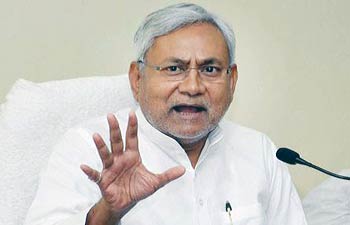
JD(U) has an alliance with BJP, not RSS: Nitish Kumar

July 2, 2012

nitish


Patna, July 2: Firmly sticking to his stand for a secular person to be projected as the NDA's prime ministerial candidate in the next general elections, Bihar chief minister Nitish Kumar today swept aside criticism by the RSS saying his party JD(U) has alliance with BJP and not the Sangh Parivar.

"JD(U) has a long standing alliance with BJP and not RSS...I stand by what I have said in an interview," he said, referring to his view on a secular person to be projected as the NDA's prime ministerial candidate.

"I did not take name of any individual," he told reporters on the sidelines of his Janata Durbar in reference to his secular NDA prime ministerial candidate demand being read as an attempt to undermine Gujarat chief minister Narendra Modi's prime ministerial ambitions.

Apparently seeking to link his secular NDA prime ministerial candidate plank to the foundation of ties between JD(U) and BJP in 1996, Kumar said his party had formed an alliance on the agenda against scrapping of Article 370 of the Constitution and Uniform Civil Code, besides judicial or negotiated settlement of Ayodhya dispute.

JD(U) will not compromise with dilution in any of these core issues vis-a-vis its relations with BJP, he said.

On the ties between JD(U) and BJP in Bihar, Kumar said the two parties had come together under the banner of the NDA in 1999 with a tactical understanding to defeat the then ruling party, he said referring to the RJD-led government in the state that time.

Comments

Add new comment

  • Coastaldigest.com reserves the right to delete or block any comments.
  • Coastaldigset.com is not responsible for its readers’ comments.
  • Comments that are abusive, incendiary or irrelevant are strictly prohibited.
  • Please use a genuine email ID and provide your name to avoid reject.
News Network
February 9,2020

New Delhi, Feb 8: Arvind Kejriwal is set to return as Delhi chief minister and his Aam Aadmi Party (AAP) will virtually sweep the assembly elections, exit polls predicted Saturday.

As polling came to a close at 6 pm, with the Election Commission of India (ECI) projecting a voter turnout at 60.24% (as of 9:50 pm), a poll of polls covering 10 exit polls gave 52 seats to AAP, 17 to the Bharatiya Janata Party and one to the Indian National Congress.

The polls, which are sample surveys conducted among voters exiting polling booths, signalled that the Delhi voter responded to AAP’s campaign that focused on “kaam”, or getting work done.

Kejriwal, a former civil servant and activist who stormed into electoral politics with an anti-corruption campaign in 2013, led a campaign focusing on the development work his government did in Delhi, especially in education and healthcare, as well as sops such as lower electricity bills and free bus rides for women.

The exit polls gave AAP between 47 and 68 seats in the 70-member Assembly.

They predicted an absolute rout for Congress, which ruled Delhi for three terms between 1998 and 2013. The maximum seats to AAP were given by India Today TV-Axis exit poll, which predicted 59-68 seats for the party, while giving 2-11 for the BJP and none to the Congress.

If these figures hold, the results will come as a disappointment for the BJP, which had hoped its sweep in the Lok Sabha elections in 2019 would reflect in the assembly polls.

Delhi’s voter turnout saw a sharp fall over the 2015 elections. According to the Election Commission of India, voter turnout till 9 pm was projected at 60.24% — lower than 67.12% in 2015.

Traditionally, a lower voter turnout is read as a vote for the incumbent.

The voter turnout in Delhi has been similar during the Congress regime under Sheila Dikshit, when she won consecutive terms. In 2003, when Delhi voted a second time for the Dikshit government, the voter turnout was 53.42%, and a comparable 57.58% was the turnout in 2008.

Later, in two consecutive elections — 2013 and 2015 — voters turned out in big numbers to vote Dikshit out of power. In 2013, 65.63% of Delhi turned out and the percentage increased further to 67.12% in 2015.

Across constituencies, Matia Mahal in Central Delhi registered the highest voter turnout of 68.36%, whereas Bawana assembly constituency in North district saw the lowest turnout at 41.95%. Among districts, North East district registered the highest (62.75%) voter turnout, while the lowest turnout was recorded in South East district (54.15%), according to the ECI app.

Comments

Add new comment

  • Coastaldigest.com reserves the right to delete or block any comments.
  • Coastaldigset.com is not responsible for its readers’ comments.
  • Comments that are abusive, incendiary or irrelevant are strictly prohibited.
  • Please use a genuine email ID and provide your name to avoid reject.
News Network
July 15,2020

New Delhi, Jul 14: India's COVID-19 tally has reached 9,36,181 as 29,429 new coronavirus cases were reported in the last 24 hours, informed the Union Ministry of Health and Family Welfare on Wednesday.

The death toll went up to 24,309, including 582 fatalities in the last 24 hours.

Out of the total cases, 3,19,840 are currently active and 5,92,032 are cured/discharged/migrated.

As per the Ministry, Maharashtra -- the worst-affected state from the infection -- has a total of 2,67,665 COVID-19 cases and 10,695 fatalities. While Tamil Nadu has a tally of 1,47,324 cases and 2,099 deaths due to COVID-19.

Delhi has reported a total of 1,15,346 cases and 3,446 deaths due to COVID-19.

As per the information provided by the Indian Council of Medical Research (ICMR) 3,20,161 samples have been tested for COVID-19 till July 14, of these 1,24,12,664 samples were tested on Tuesday.

Comments

Add new comment

  • Coastaldigest.com reserves the right to delete or block any comments.
  • Coastaldigset.com is not responsible for its readers’ comments.
  • Comments that are abusive, incendiary or irrelevant are strictly prohibited.
  • Please use a genuine email ID and provide your name to avoid reject.
News Network
May 6,2020

New Delhi, May 6: Taking a cue from states, the Centre announced one of the steepest hikes in duties on petrol and diesel in the recent past, by raising it by Rs 10 and Rs 13 per litre, respectively, in a notification issued late on Tuesday.

Retail prices, however, will see no change as the price hike will be absorbed by oil marketing companies against the fall in crude prices.

Road and infrastructure cess was hiked by Rs 8 for petrol and diesel and the special additional excise duty (SAED) was hiked by Rs 2 per litre and Rs 5 per litre, respectively. While the road cess will only go into the Centre’s coffers, the hike on account of SAED will be passed on to states via devolution at 42 per cent. Hence, the states will get only Rs 0.84 per litre in case of petrol and Rs 2.1 in case of diesel.

The decision comes after several states increased the value added tax (VAT) on petrol and diesel making use of the lower price regime. The Delhi government on Tuesday increased VAT on petrol and diesel to 30 per cent each, from 27 and 16.75, respectively. As a result, the price of petrol in Delhi increased by Rs 1.67 to Rs 71.26 a litre and diesel by Rs 7.10 to Rs 69.29 in Delhi on Tuesday.

Amid falling international crude oil prices, the Centre introduced an enabling provision in March to raise excise duty on petrol and diesel by Rs 8 per litre in the Finance Act. The government had on March 14 raised excise duty on petrol and diesel by? 3 per litre each, which was to help raise an additional ?39,000 crore in revenue annually.

This duty hike included Rs 2 a litre increase in SAED and Rs 1 in road and infrastructure cess. It raised SAED to Rs 10 for petrol and Rs 4 for diesel. The limit has now been increased to Rs 18 a litre in case of petrol and Rs 12 in case of diesel by way of amendment of the Eighth Schedule of the Finance Act.

Economists said the move would impact retail inflation by over half a percentage point at least. “With lower consumption, there was loss of revenue for Centre and states, who earn Rs 6 trillion annually or Rs 50,000 crore monthly from fuel. Amid lockdown in April, the collection must have come down to just Rs 5,000 crore, and this will hold for May.

This means that Centre and states have lost 20 per cent of annual revenue from fuel. Hence, they have hiked duties to recover losses,” said Madan Sabnavis, chief economist, CARE Ratings. He added that the hike will impact inflation by at least 0.6-0.7 percentage points.

According to industry experts, an estimate of the additional government revenue cannot be made as the consumption of petrol and diesel has dropped to 40 per cent of what it was before the lockdown. The duty hike comes following a drop in international crude oil prices in April, owing to lower consumption figures globally. At 11.50 pm on Tuesday, Brent was priced at $30.67 a barrel, while West Texas Intermediate (WTI) crude was seen at $24.36 a barrel. On Monday, the Indian basket of crude oil was priced at $23.38 a barrel, after touching a 15-year low last month.

Comments

Add new comment

  • Coastaldigest.com reserves the right to delete or block any comments.
  • Coastaldigset.com is not responsible for its readers’ comments.
  • Comments that are abusive, incendiary or irrelevant are strictly prohibited.
  • Please use a genuine email ID and provide your name to avoid reject.