



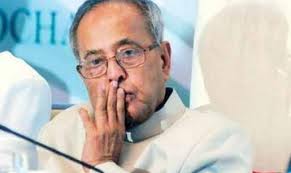
President polls: Pranab Mukherjee to respond to Team Sangma's objections to his nomination

July 3, 2012

Team

New Delhi, July 3: Pranab Mukherjee, who is the UPA's candidate for President of India's elections, will today respond to the objections raised against his nomination by Purno Sangma's team. Yesterday, Mr Sangma's supporters demanded that Mr Mukherjee be disqualified from the race because he allegedly holds an office of profit as Chairman of the Indian Statistical Institute. Team Mukherjee, however, countered the claim and said this was factually incorrect as Mr Mukherjee quit this position even before he resigned as Finance Minister last week.

Mr Sangma, a former Lok Sabha Speaker, takes on Mr Mukherjee in the Presidential election scheduled for July 19.

Bhartrihari Mahatab, a Member of Parliament who is serving as Mr Sangma's election agent, complained to the returning officer yesterday that Mr Mukherjee still held the post at the Kolkata-based Indian Statistical Institute and hence could not run for President.

The BJP too stepped up the attack on Mr Mukherjee and said his nomination would be rejected. "Pranab was the chairman of Indian Statistical Institute and has continued to be so. Article 102, has a power to Parliament that we can exempt a member to file nomination... I am confident that the nomination will be rejected and Sangma shall become President," said BJP spokesperson Ravi Shankar Prasad.

But Mr Mukherjee's election agent and Parliamentary Affairs Minister Pawan Kumar Bansal described this as "legally ill-conceived." He said Mr Mukherjee had resigned before he filed his nomination. Mr Bansal also said that both he and Home Minister P Chidambaram checked with Mr Mukherjee who said he had resigned. Mr Bansal said Team Mukherjee would file a written reply today.

The scrutiny of nomination papers was delayed for a day in view of Team Sangma's objection raised on Monday. Mr Mukherjee has to file a response by 2 pm today. The issue may be settled if the returning office is satisfied that chairman of the statistical institute is not an office of profit, or Mr Mukherjee quit in time.

The Indian Statistical Institute too has said that Mr Mukherjee submitted his resignation as Chairman on June 20, this year. It has also clarified that Mr Mukherjee's position was not an office of profit in any case as he was not paid an honorarium, nor were his travel expenses reimbursed. The institute has admitted it made a mistake in not updating its website, which listed Mr Mukherjee as its Chairman till Monday afternoon. It has now removed his name.

The Indian Constitution, while defining qualifications for a Presidential candidate under Article 58, states that "A person shall not be eligible for election as President if he holds any office of profit under the Government of India or the Government of any State or under any local or other authority subject to the control of any of the said Governments."

Mr Mahatab is a member of Navin Patnaik's BJD party, which has nominated Mr Sangma for President along with Jayalalithaa's AIADMK and the BJP.

BJD chief Naveen Patnaik also accused Mr Mukherjee yesterday of having doled out huge amounts of money as Finance Minister to several states to ensure support for his candidacy. "Could it be that this money is going because he wants certain parties, you know, like Mulayam Singh's party, Nitish Kumar and Mamata Banerjee to support his candidature as Rashtrapati of India? Well, this is not private money. This is the people's money," the Odisha Chief Minister said.

Clearly, though the numbers don't favour Mr Sangma in the race for President, his side will pull out all stops to make a battle of it.

Mr Mukherjee's party the Congress has smirked in response; in Law Minister Salman Khursheed's words, "You cannot stop working five years before you are actually considered as the President, saying we will do nothing at all. So I think we should all be good sports. Now that it has become clear that there is an overwhelming majority for Pranabda not just from people who support the UPA, but across the board, it's best to accept the reality."

The Congress also attacked Mr Mukherjee's rival, PA Sangma, fielding its Meghalaya Chief Minister, Mukul Sangma. "The President cannot represent just one community... Only Congress has taken care of tribals," he said.

Mr Mukherjee has also won the endorsement of two Left parties and Nitish Kumar's JD(U), which partners with the BJP in Bihar. All that pledged support totals more than 50 per cent of the electoral college that elects the President and as of now, Mr Mukherjee seems all set to be the next President of India. Both candidates have begun campaigning.


Comments

Add new comment

  • Coastaldigest.com reserves the right to delete or block any comments.
  • Coastaldigset.com is not responsible for its readers’ comments.
  • Comments that are abusive, incendiary or irrelevant are strictly prohibited.
  • Please use a genuine email ID and provide your name to avoid reject.
News Network
March 2,2020

New Delhi, Mar 2: Senior Congress leader P Chidambaram on Sunday hit out at Union Home Minister Amit Shah for his comments that no one from the minority community will be affected by amended Citizenship Act and asked why then was the community excluded from the law in the first place.

Addressing a rally in Kolkata, Shah assured people of the minority community that not a single person will lose citizenship due to the Citizenship (Amendment) Act (CAA).

"The Home Minister says that no minority will be affected by CAA. If this is correct, they should tell the country who would be affected by CAA. If no one would be affected by CAA, as it currently is, why did the government pass the law?

"If the CAA aims to benefit all minorities (no one will be affected, says HM), then why are Muslims excluded from the list of minorities mentioned in the Act?," the former finance minister asked in a post on Twitter.

At his first public rally in Kolkata after the 2019 general elections, Shah said, "The opposition is terrorising the minorities. I assure every person from the minority community that the CAA only provides citizenship, does not take it away. It won't affect your citizenship."

"The opposition parties are spreading canards that refugees will have to show papers but this is absolutely false. You don't have to show any paper. We will not stop until all refugees are granted citizenship," Shah told the public.

Comments

Add new comment

  • Coastaldigest.com reserves the right to delete or block any comments.
  • Coastaldigset.com is not responsible for its readers’ comments.
  • Comments that are abusive, incendiary or irrelevant are strictly prohibited.
  • Please use a genuine email ID and provide your name to avoid reject.
Agencies
April 23,2020

New Delhi, Apr 23: The nationwide lockdown in India which started about a month ago has impacted nearly 40 million internal migrants, the World Bank has said.

The lockdown in India has impacted the livelihoods of a large proportion of the country's nearly 40 million internal migrants. Around 50,000 60,000 moved from urban centers to rural areas of origin in the span of a few days, the bank said in a report released on Wednesday.

According to the report -- 'COVID-19 Crisis Through a Migration Lens' -- the magnitude of internal migration is about two-and-a-half times that of international migration.

Lockdowns, loss of employment, and social distancing prompted a chaotic and painful process of mass return for internal migrants in India and many countries in Latin America, it said.

Thus, the COVID-19 containment measures might have contributed to spreading the epidemic, the report said.

Governments need to address the challenges facing internal migrants by including them in health services and cash transfer and other social programmes, and protecting them from discrimination, it said.

World Bank said that coronavirus crisis has affected both international and internal migration in the South Asia region.

As the early phases of the crisis unfolded, many international migrants, especially from the Gulf countries, returned to countries such as India, Pakistan, and Bangladesh until travel restrictions halted these flows.

Some migrants had to be evacuated by governments, such as those of China and Iran, it said.

Before the coronavirus crisis, migrant outflows from the region were robust, the report said.

The number of recorded, primarily low-skilled emigrants from India and Pakistan rose in 2019 relative to the prior year but is expected to decline in 2020 due to the pandemic and oil price declines impacting the Gulf countries.

In India, the number of low-skilled emigrants seeking mandatory clearance for emigration rose slightly by eight percent to 368,048 in 2019.

In Pakistan, the number of emigrants jumped 63 per cent to 6,25,203 in 2019, largely due to a doubling of emigration to Saudi Arabia, it said.

According to the bank, migration flows are likely to fall, but the stock of international migrants may not decrease immediately, since migrants cannot return to their countries due to travel bans and disruption to transportation services.

In 2019, there were around 272 million international migrants.

The rate of voluntary return migration is likely to fall, except in the case of a few cross-border migration corridors in the South (such as Venezuela-Colombia, Nepal-India, Zimbabwe South Africa, Myanmar-Thailand), it said.

Migrant workers tend to be vulnerable to the loss of employment and wages during an economic crisis in their host country, more so than native-born workers.

Lockdowns in labour camps and dormitories can also increase the risk of contagion among migrant workers.

Many migrants have been stranded due to the suspension of transport services. Some host countries have granted visa extensions and temporary amnesty to migrant workers, and some have suspended the involuntary return of migrants, it said.

Observing that government policy responses to the COVID-19 crisis have largely excluded migrants and their families back home, the World Bank said there is a strong case for including migrants in the near-term health strategies of all countries, given the externalities associated with the health status of an entire population in the face of a highly contagious pandemic.

The Bank said governments would do well to consider short, medium and long-term interventions to support stranded migrants, remittance infrastructure, loss of subsistence income for families back home, and access to health, housing, education, and jobs for migrant workers in host/transit countries and their families back home.

The pandemic has also highlighted the global shortage of health professionals and an urgent need for global cooperation and long-term investments in medical training, it said.

Comments

Add new comment

  • Coastaldigest.com reserves the right to delete or block any comments.
  • Coastaldigset.com is not responsible for its readers’ comments.
  • Comments that are abusive, incendiary or irrelevant are strictly prohibited.
  • Please use a genuine email ID and provide your name to avoid reject.
News Network
May 18,2020

The Centre on Sunday extended the COVID-19 lockdown for two more weeks till May 31 with more exemptions as the Centre allowed states more powers for profiling its zones, re-starting of inter-state and intra-state bus travel, plying of autos and taxis and opening of all shops, including in markets but barring those in malls.

Here are the answers to all your questions:

What is 'Lockdown 4.0'?

On March 24, 2020, Prime Minister Narendra Modi announced a 21-day nation-wide lockdown to prevent the spread of the coronavirus outbreak. India follows several countries in its measures to curb the pandemic, which was the first lockdown. Prime Minister then extended the coronavirus lockdown till May 3, which was dubbed as 'Lockdown 2.0'. This lockdown was further prolonged till May 17 which became 'Lockdown 3.0' and now, as the government aims at a staggered re-opening of the country while maintaining the norms such as social distancing, the fourth extension till May 31 is called 'Lockdown 4.0'.

Who issues the guidelines for the lockdown?

The Ministry of Home Affairs (MHA) issues the guidelines for the lockdown.

Are guidelines different during a lockdown compared to normal life?

Well, of course. Guidelines during a lockdown instruct people on all matters from whether you are allowed to leave your house, to whether an MNC is allowed to function and with what percentage of attendance.

Are masks compulsory even now?

Masks are made mandatory in all public places, by the Union Health Ministry. All the states and UTs are to strictly abide by this law. Not wearing masks will attract penalties which are specified by the state.

How would that be determined for an area?

By Lockdown 3.0, all areas of state districts were segregated into containment, red, orange and green zones. In the Lockdown 4.0, states will categorise the areas into red, orange and green zones.

Colourful... but what are red, orange and green zones?

According to the guidelines issued by the Ministry of Health and Family Welfare, states can categorise districts or municipal corporations as red or orange zones.

"States may, however, also choose to categorise a sub-division or ward or any other appropriate administrative unit as red/orange/green zone after detailed analysis at their end, duly taking into consideration the geographical spread of cases, contacts and their zone of influence in terms of disease spread," the ministry said.

With the commencement of the third phase of lockdown, the Union Health Ministry listed 130 districts across the country in the red zone, 284 in the orange zone and 319 in green zones based on the incidence of cases of COVID-19, doubling rate, the extent of testing and surveillance feedback.

Districts were earlier designated as hotspots/red-zones, orange zones and green zones primarily based on the cumulative cases reported and the doubling rate.

A district will be considered under green zone if there have been no confirmed cases of COVID-19 so far or there is no reported case since last 21 days in the district, according to the letter.

Now, what is a buffer zone?

A buffer zone is an area of spread in a 5-kilometre radius (7 Kms in rural areas) of a containment zone.

How do I find out the zone I am in?

You either look at your state or city's municipal corporation pages to avail the zone details. You can also look at your district magistrate's Twitter handle or Facebook account to find out the list of the zone under which your area falls.

Can I leave my home now?

That depends. If you are in a containment zone or a red zone, you may not be allowed to leave your residence. Otherwise, in the other zones, the state governments and the district magistrates will decide upon the level of movement within and outside the zones.

Can I shift from a red zone to an orange or green zone?

You cannot. The residents of a red or containment zone cannot move out of their zones, nobody may enter the zones as well.

What about my office?

The private offices can operate in non-containment zones. The guidelines for offices to work will be listed by the state governments and the DMs (district magistrates).

Will I be allowed to use my bike/car or any other personal vehicle?

There is a likely chance of you being allowed to take out your bike or car or other vehicles (not helicopters or aeroplanes), if you are not in a containment zone. You need to check the rules listed by your state government or DM. The number of people who can ride at one time will also be decided by the state.

Can my driver, house help or neighbour drive me to my office/destination? Will I be allowed to take them to my workplace?

Yes, provided they are not from a red zone which may be risky for the passenger. This facility is prohibited in a containment zone. Also, check with your workplace regarding the norms to follow within the office. For the details on travelling with others in the car, look into the info provided by your state government, DM and Resident Welfare Association (RWA).

Will be able to fill petrol or diesel for my vehicle?

Definitely, yes. All petrol pumps, LPG and oil agencies will continue to be open.

What if I need to take a cab, auto or book one via Ola/Uber?

The same rules apply to them as well. Unless you are in a containment zone, the restrictions for using cabs and autos will be eased.

What if I need to use public transport like buses?

Some states have allowed buses to run, such as in Tamil Nadu in certain areas. You will have to check with the state government or DM's regulations enlisted for knowing the routes and norms to follow inside a bus.

Can I use my city's Metro line?

Unfortunately, metro lines are not allowed to open and will remain closed until further notification from the Centre.

Can I walk around in my area?

Walking will be permitted under the guidelines issued by the state and DM. Walking in groups will be prohibited and social distancing norms are to be followed in public at all times. Movement is allowed between 7 am to 7 pm in any zone - containment, red, orange or green.

Can I take my grandparents/kids out for a walk?

People older than 65 years of age, or younger than 10, persons with co-morbidities, pregnant women are not allowed to venture out of their residences, as they are highly susceptible to the infection.

Can I go out with my friends?

A group of less than 5 people are allowed to walk together. If you are planning to use vehicles such as bikes, every induvial must have their own as more than one person on atwo-wheeler is not allowed in certain areas. Curfew timings are from 7 am to 7 pm as movent is prohibited beyond these timings. Check the regulations issued by your local DM or state government to know further details.

What if I need to see my friends, relatives or others?

The Resident Welfare Association (RWA) will make a decision about allowing visitors inside a zone, barring containment zones. Nobody is allowed within the containment zone or permitted to leave.

Can we now go to restaurants?

Restaurants are still closed irrespective of the zone. Take-away or delivery services will be available, nevertheless.

Can we go to malls?

Malls and restaurants and shops in the malls will remain closed irrespective of the zone, as these are crowd-pulling zones.

Does that mean multiplexes, theatres and drama/concert halls are closed as well?

Cinema halls, theatres, multiplexes and drama/concert halls will remain closed regardless of which zone they are in, till further instructions are sent by the Centre.

Can I go to the beach or a monument/heritage site?

Since such public places will attract a huge crowd that will be tough to control, beaches, monuments, heritage sites and such public places will be closed.

Can I go to coffee shops?

As coffee shops will fall under the category of restaurants, they will also be closed. Take-away and delivery services can be availed from the shops.

What about essentials?

Grocery shops, milk vendors, newspaper circulation are allowed to stay open. Proper sanitisation must be done from time-to-time to ensure customer and vendors’ safety.

I need to repair my phone. Will stand-alone non-essential services be open?

Such non-essential services are allowed to open in non-containment zones. Refer the state governments and DMs rules for knowing the type of shops and state and districts they are permitted in.

What about in-house repairs or services? Can I call a mechanic to my house?

Yes, provided your RWA has permitted to allow mechanics, workmen and labourers inside in non-containment zones.

Comments

Add new comment

  • Coastaldigest.com reserves the right to delete or block any comments.
  • Coastaldigset.com is not responsible for its readers’ comments.
  • Comments that are abusive, incendiary or irrelevant are strictly prohibited.
  • Please use a genuine email ID and provide your name to avoid reject.